How a skilled nursing facility uses Central Staffing to cover more shifts with its own staff and cut overtime hours

After its scheduling tool stopped syncing, one union skilled nursing facility spent a year struggling to keep an accurate schedule on paper. With Central Staffing, its own staff now claim open shifts in the app, agency use has held steady through a COVID outbreak, and its scheduler works 1–2 fewer overtime hours a day.

Sign Up

Before Central Staffing

  • A scheduling tool that stopped pulling time-off requests from Workday
  • Paper schedules, paper swap forms, and schedule work most nights from home

After Central Staffing

  • Fully digital within one schedule cycle, with one live schedule that leadership trusts
  • Staff swap, split, and pick up their own shifts, and in-house shift pickup has risen

Key statistics

  • ‍50+ shift requests from its own staff roster, before any shifts were sourced outside the building‍
  • 1-2 hrs/day less scheduler overtime‍
  • Flat agency use through a COVID outbreak among staff
  • 1/3 fewer hours spent on the schedule from home

Facility background

The facility is a union skilled nursing facility that staffs around the clock. One staffing coordinator, Christy, builds and manages the schedule for its CNAs and nurses, and also runs HR and payroll. The facility moved to Central Staffing starting with its October 2026 schedule.

Facility type Skilled nursing facility, union building
Licensed beds 76
Average daily census 73
Scheduling rules PTO requests due the 15th; schedule published by the 20th of the prior month
Central Staffing users Staffing coordinator, DON, nurse managers, and scheduled staff

‍

The challenge

The facility’s original scheduling software worked well until an ownership change broke its connection to Workday. The replacement platform worked “realistically, a month, at the most two months,” Christy said. After that, it stopped pulling time-off requests, and the facility went back to paper.

For a building that never closes, that meant constant work. “There are constant call-ins and changes in the schedule throughout the day,” she explained. “Having that mental drain of trying to remember everything to document it whenever I got back to my laptop was not effective.”

The hardest stretch came every month. Between PTO requests on the 15th and the schedule deadline on the 20th, she printed the schedule and counted every person on every shift on every day before approving time off. Shift swaps ran on paper forms that both staff members had to sign, sometimes after the shift had already happened. Nurse leaders on weekend call had to ask her who was working, which meant “a lot of heavy communication.” Most nights, the schedule came home with her.

Her own staff stepped up first

50+ Shift requests from in-house staff after the first schedule went out.

“There’s been a huge uptick in our in-house employees picking up shifts, versus having to reach out to agency to cover.”
Christy R.
, Staffing Coordinator

The solution

Christy built the facility’s schedule template with the Central Staffing team. “I didn’t have to use a lot of brainpower to create it,” she said. She published the first schedule two weeks before go-live, messaged all staff to check their shifts, and almost nothing needed fixing.

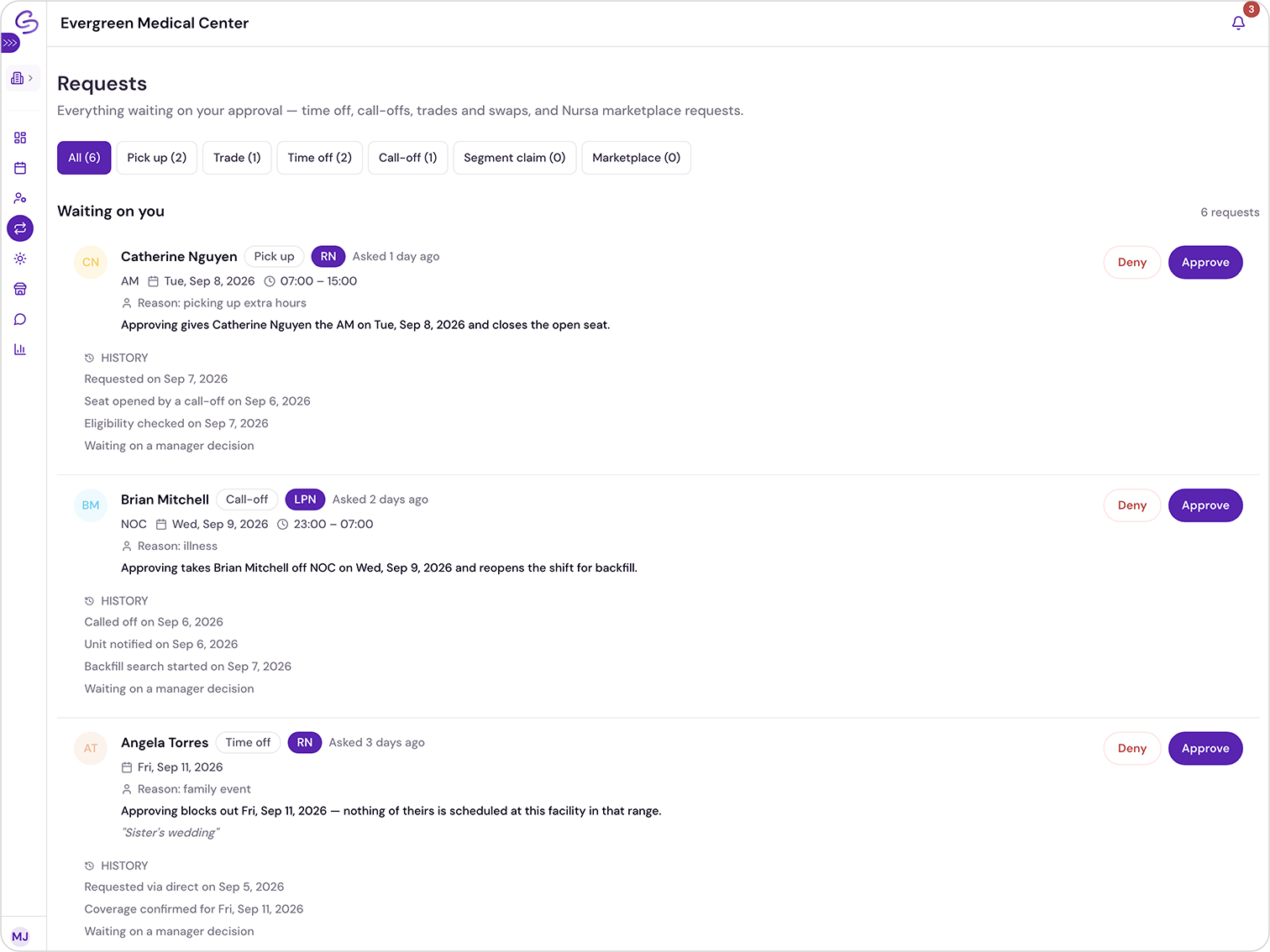
On October 1, she left one printed copy on the DON’s desk as a comfort blanket. The DON hasn’t asked for another since, and she now checks Central Staffing every day. Call-outs, early departures, and coverage changes go in from Christy’s phone as they happen, so the schedule always matches the floor.

“The schedule is accurate, and everybody has that transparency and that confidence to be able to see it.”
Christy R., Staffing Coordinator

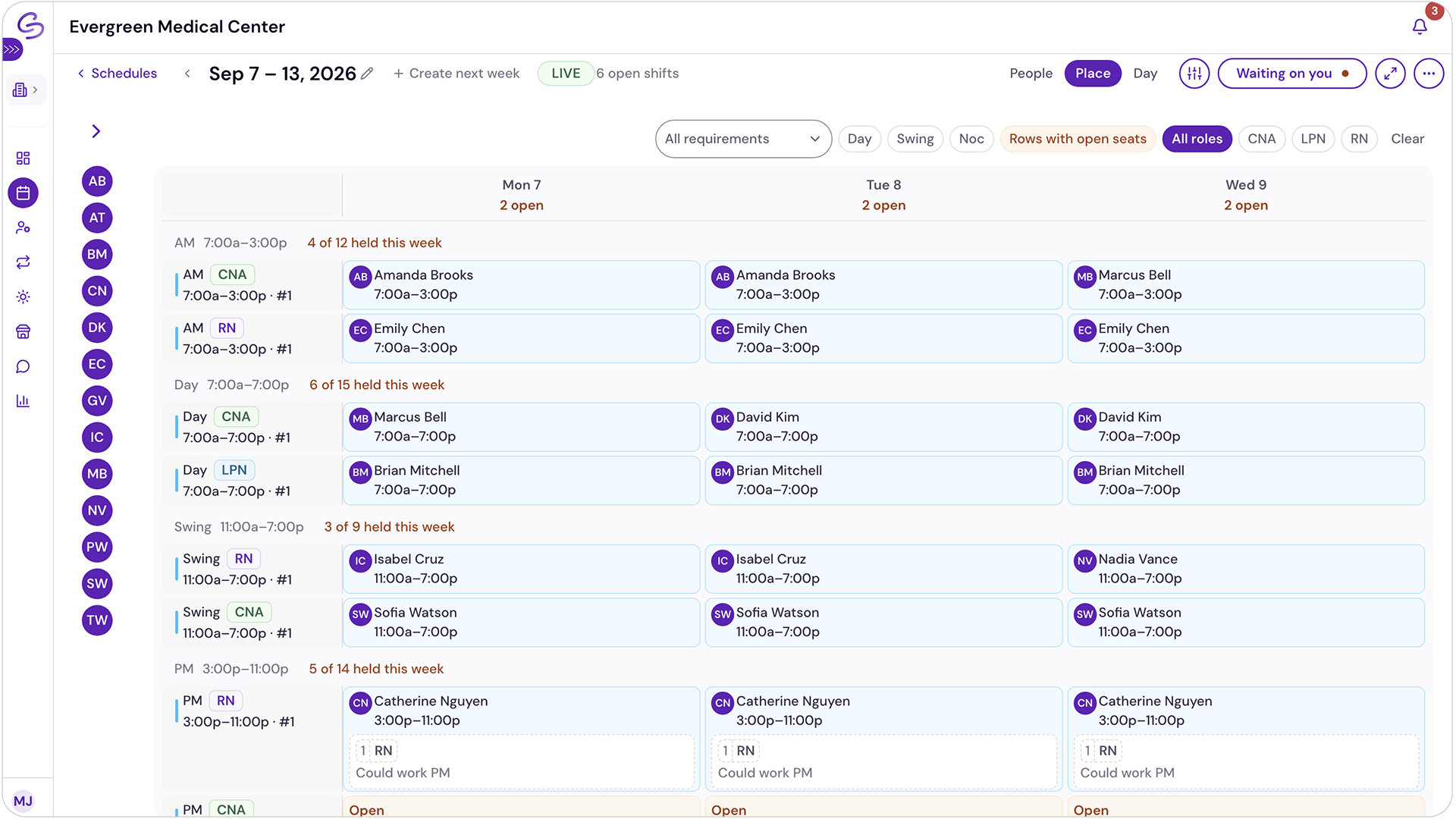
The biggest change came from putting the schedule in staff members’ hands. CNAs swap, give up, and split shifts in the app. When a colleague accepts a shift, the original worker is released and the new one takes responsibility. “I haven’t had to handhold them at all,” she said. “It’s self-explanatory. You don’t have to be tech-savvy.”

Staff took to it fast. More than 50 shift requests came in from in-house staff right after the first schedule was published, before she had posted a single shift outside the building. Even when a COVID outbreak hit the staff, agency use stayed on par with prior months.

How the facility stays ready for state surveys

When state surveyors visit, they compare the facility’s assignment sheet with its schedule. If the two don’t line up, surveyors have “a multitude of questions” about every discrepancy. It was one of the areas Christy “really, really stressed over.” Now every change is recorded as it happens:

  • Call-outs and early departures are updated in the app the moment they happen.
  • Coverage swaps are recorded when a colleague accepts the shift, so it’s clear who covered for whom.
  • The schedule surveyors review matches who actually worked, with no end-of-day catch-up.

The result is less time spent worrying about the record. “I’m not spending so much of my day worried about reporting accurately to state,” she said.

“Now I feel very confident being able to say, ‘This is who worked and this is who was on,’ because I’m able to get everything switched over in the app in the moment.”
Christy R., Staffing Coordinator

How Central Staffing solved the facility’s biggest scheduling problems

Problem Solution Impact
Call-outs couldn’t be logged on mobile Call-outs and coverage updated from the coordinator’s phone in real time 1–2 fewer overtime hours a day
Paper swap forms, sometimes signed after the shift Swaps, giveaways, and splits handled by staff in the app Both staff agree before the shift
Few staff picked up open shifts Open shifts visible in the app and ready to request as soon as the schedule publishes 50+ in-house requests before any shift went outside
Leaders couldn’t see who was working One live schedule shared with the DON and nurse managers Transparency across the management team
Survey prep anxiety over mismatched records Changes made in the moment, so records match the floor Confident answers for state surveyors

‍

Central Staffing features the facility uses

  • Mobile app: real-time updates to call-outs and coverage
  • Schedule templates: build once, then adjust with a click and a save
  • Shift swaps, giveaways, and splits: staff-managed, with automatic handoff of responsibility
  • Open-shift requests: in-house staff claim open shifts when the schedule publishes
  • Team messaging: group announcements and staff-to-staff coordination
  • Shared live schedule: visibility for the DON and nurse managers on call

The impact

More shifts covered by its own staff

Open shifts go to the team the facility already has. Staff sent more than 50 requests after the first schedule went out, and in-house pickup is higher than it has ever been.

Less overtime for the scheduler

The scheduler works 1–2 fewer overtime hours a day and spends at least a third fewer hours on the schedule from home. HR and payroll now get done daily, “instead of putting out fires.”

Steady coverage in a crisis

When a COVID outbreak hit the staff, agency use stayed on par with prior months, and the schedule stayed “smooth and fluid, instead of crisis mode.”

Ready to Get Started?
Sign up for free to see the difference yourself.

Sign Up
Briefcase purple icon

Join 4,500+ Facilities

The smartest facilities use Nursa to fill in shifts in 31 states and counting. Join to get staffing solutions now.

Sign Up
Building Purple Icon

Post Your Jobs Today

Facilities who use Nursa fill 3 times as many open per diem shifts, on average, compared to trying to fill the shifts themselves.

Post Jobs