



Healthcare facilities nationwide are under pressure due to ongoing nursing shortages, and safe staffing is needed to balance growing patient needs.
One of the most effective ways to maintain flexibility and continuity of care is through float pool nursing. By building a strong float pool, hospitals and clinics can quickly adjust to changes in patient volume, cover unexpected no-shows, and ease the burnout of permanent staff.
For many organizations, float pool staffing has become an essential part of workforce planning. Still, the success of any program depends on how well it is managed. Healthcare float pool management involves much more than filling last-minute shifts. It requires careful scheduling, fair workload distribution, and strategies that keep nurses engaged even when they are moving between units. Without this level of attention, float pools can fall short. Nurses may feel disconnected from teams, managers may face challenges coordinating assignments, and patient care may be affected.
This guide explores what makes a float pool successful and where common shortcomings often appear. It highlights proven methods for scheduling, communication, and staff support while also offering solutions for challenges that healthcare leaders frequently face. The outlined strategies will help you achieve stronger results for your facility.
What are float pools?
A float pool is a group of nurses and clinicians trained to work across multiple units within the same healthcare organization. Instead of being tied to one department, float pool staff are deployed where coverage is most needed.
For facilities, float pools can deliver measurable benefits. They reduce reliance on contract labor, which lowers agency costs and improves return on investment. They also support flexible scheduling for nurses, allowing teams to meet patient demand without overloading permanent staff. Over time, this approach strengthens float pool retention by giving clinicians greater control over their work-life balance.
Key advantages of float pools
When healthcare float pools are structured with best practices in mind, the benefits are clear:
- Significant labor cost savings
- Reduced dependence on outside staffing agencies
- Better ROI through consistent patient coverage
- A built-in pathway for developing internal talent
For your nurses, float pools can provide flexibility, the chance to develop new skills, and opportunities to achieve a better work-life balance. This makes effective float pool scheduling and engagement strategies critical for both retention and patient outcomes.
Why float pool management matters
Strong healthcare float pool management goes beyond filling shifts. A well-structured nurse float pool stabilizes staffing during census spikes, absences, or seasonal surges. When float pool scheduling is handled effectively, patient safety is preserved while permanent staff experience less fatigue and burnout.
Facilities that prioritize strategies for effective float pool management often see better float pool retention, stronger patient outcomes, and improved clinician engagement. Float pools act as a stabilizer, giving leaders a flexible workforce while reducing the financial and operational risks of relying exclusively on contract labor.
Best practices for float pool management
Across healthcare, one of the most pressing challenges is balancing safe staffing with unpredictable patient volumes.
Facilities often rely on overtime, contract labor, or staffing agencies to close gaps, but these solutions can be costly and unsustainable. Nurse float pools offer a more efficient way forward, helping hospitals and clinics maintain coverage, improve flexibility, and strengthen retention. Still, effective healthcare float pool management requires planning, clear communication, and systems that support both patient care and staff satisfaction.
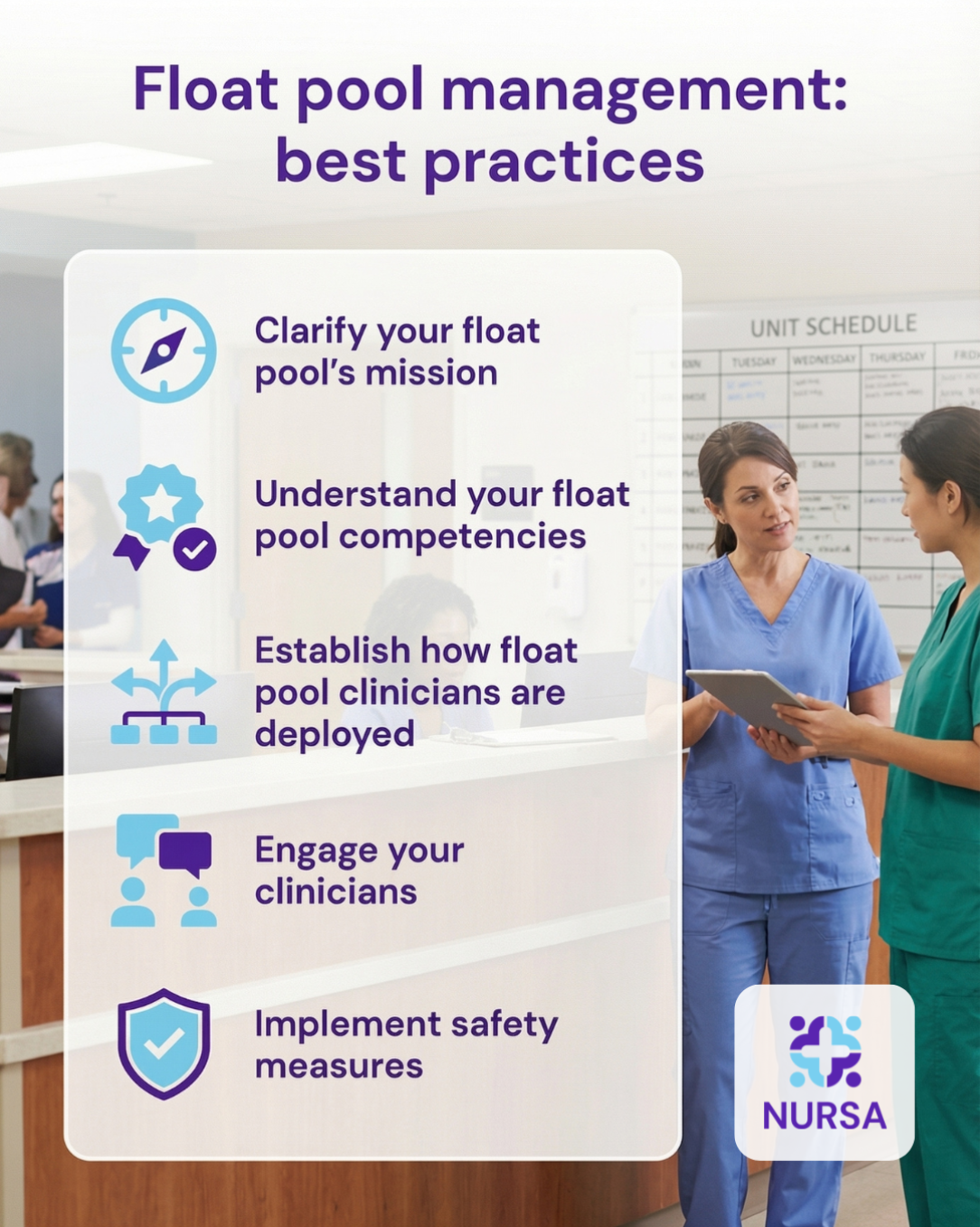
1. Clarify your float pool’s mission
Defining the mission of your float pool is the first step in learning how to manage a float pool effectively. Common goals include stabilizing unit coverage, minimizing overtime and agency use, and preserving care quality.
Facilities should:
- List eligible units and define exclusion rules
- Tier units by competency level (for example, Level 1: medical-surgical, Level 2: telemetry, Level 3: step-down and ICU)
- Establish policies around cancellations, fatigue limits, on-call expectations, and minimum notice for shift changes
Having a clear mission prevents confusion, supports float pool nurse scheduling efficiency, and sets expectations that help staff feel respected and supported
2. Understand your float pool competencies
Credentialing is essential for any nurse float pool. Facilities should maintain up-to-date records of licenses, unit-specific competencies, device training (such as pumps or ventilators), and recency of experience.
Practical tools include:
- Orientation checklists tailored to each unit
- Competency validation forms that document skills before independent assignments
By tracking competencies carefully, leaders improve safety, reduce risk, and build trust with both float nurses and permanent unit staff.
3. Establish how float pool clinicians are deployed
Deployment rules create fairness and consistency in float pool scheduling. Assignments should always prioritize skill match first, followed by rotation order, clinician preferences, overtime or fatigue limits, and recent unit familiarity.
For cancellations, a “first in, first out” approach based on the last canceled assignment works well. Some facilities also use paid standby options, which protect coverage while supporting retention and morale.
4. Engage your clinicians
A nurse float pool thrives when staff members feel connected and valued. Belonging tactics such as assigning a float buddy to each unit, holding monthly float huddles, and including float staff in recognition programs help reduce isolation.
Professional growth is equally important. Offering paid cross-training slots, continuing education support, and skill ladders demonstrates commitment to long-term development. Facilities should also capture preferred units and shifts and honor them whenever clinically feasible. These efforts directly influence float pool retention and job satisfaction.
5. Implement safety measures
Safety must remain the foundation of every float pool. Clinicians should never receive independent assignments in units where competency has not been validated. During a nurse’s first three shifts on a new unit, conservative patient ratios should be used, with rapid escalation if mismatches occur.
These safeguards not only protect patients but also reduce nurse stress and improve float pool retention.
Where float pools often fall short
Even with careful planning, healthcare float pool management is not without challenges.
Budget constraints, limited scale, and insufficient management resources can restrict a program’s effectiveness. Some facilities struggle with float pool scheduling fairness, while others face difficulties maintaining credentialing records or ensuring strong engagement.
This is where flexible staffing models become valuable.
Contract labor vs. float pool
Alternatives to float pools, such as healthcare staffing platforms, can provide on-demand support without the overhead of maintaining a large pool. A hybrid model that blends traditional staffing, float pools, and per diem nurses allows facilities to adapt quickly to census changes while still controlling costs.
Hybrid approaches also create a pipeline, as per diem nurses can transition into float pools or full-time roles when both parties are a good fit. This makes staffing more sustainable and future-proof.
Maximize your float pool management with Nursa
Float pools are one of the most practical tools for improving workforce efficiency, reducing agency costs, and supporting flexible scheduling for nurses. When managed thoughtfully, they strengthen retention, improve patient care, and offer a more cost-effective alternative to contract labor.
However, not every facility has the resources to sustain a large float pool. Alternatives to float pools, such as per diem staffing, can fill that gap, especially when combined with hybrid staffing models that bring together permanent staff, float pools, and flexible on-demand nurses.
Ultimately, the key to success lies in clear policies, fair scheduling, strong credentialing practices, and consistent engagement. By focusing on strategies for effective float pool management and tracking KPIs for float pool performance, healthcare leaders can build sustainable staffing models that support both clinicians and patients.
In addition to float pools, explore how to incorporate per diem staffing through a healthcare platform to fill last-minute gaps.
Sources:





.png)

.png)

