



Is your facility struggling with unpredictable staffing needs, soaring overtime costs, and staff burnout? You're not alone. Many healthcare leaders are turning to per diem nurses to solve these challenges.
Per diem clinicians can provide the staffing flexibility you need. But to truly unlock the benefits of this model, you need to know how to manage per diem nurses effectively.
This article provides a guide to best staffing practices for per diem nurse management that will help you get the most out of per diem nurses.
What are per diem nurses?
Let’s start with the basics. Per diem nurses are professionals who work shifts on an as-needed basis rather than set, full-time schedules. Also frequently called PRN nurses (from the Latin "pro re nata," meaning "as the situation demands"), they benefit facilities primarily by filling sudden staffing gaps, call outs, weekends, and seasonal census surges.
Per diem nurses can provide a flexible talent pool for quickly responding to shifting patient volumes and acute staffing demands. Most facilities work with per diem nurses for a number of reasons:
- Fill last-minute absences due to illness or leave
- Cover unpopular shifts such as weekend, holiday, or evening shifts
- Help with scheduling during times of peak patient census or emergencies
- Supplement your permanent staff to reduce reliance on overtime
As you can see, your healthcare facility can often benefit from per diem nurses, making them a great option for solving shortages.
Per diem nurses introduce fresh thinking and experience from other settings, which can be a valuable asset to any facility. That flexibility can prove particularly useful in rapidly changing healthcare environments where demand can explode overnight.
Related: How to get buy-in with leadership for per diem staffing
Pros and cons of staffing per diem clinicians in your facility
As with any staffing option, per diem nurse staffing can provide advantages and disadvantages. It's a question of finding the proper balance to serve both your facility's operational needs as well as your entire team's health.
Advantages of per diem nurse staffing
Facilities look to work with per diem nurses because they provide them with:
- Meeting fluctuating staffing demands with safe staffing staffing levels
- Filling shifts with cost-effective (since facilities only compensate for worked hours without full-time benefits)
- Rapid coverage of last-minute or short-term needs
- Reducing reliance on overtime
- Preventing burnout among full-time staff
By avoiding the overhead costs of salaried employees like health insurance, retirement plans, and paid time off, facilities are better able to manage their budget. This model allows facilities to pay for extra staffing only when needed, which can be helpful, particularly for rural or smaller healthcare facilities with tight budgets.
This flexibility also ensures that your facility doesn’t overhire to meet peak season demand and then suffer later during low census periods.
Possible disadvantages of per diem nurse staffing
As with other staffing options, if not implemented correctly, some risks to the facility include these:
- Risk of disrupting continuity of care due to changing caregivers
- Variability in the availability of the workforce week to week
- Communication and workflow challenges in integrating per diem nurses with full time employees
Without proper onboarding and support, there are possible miscommunications, failure of procedures, and poor team bonding. This is why a strategic solution must be devised.
Per diem nurses vs W-2 staff nurses: Know your tradeoffs
Per diem nurses are best used to "bridge the gaps" quickly and inexpensively in unexpected demand, while W-2 employees best fill normal, stable staffing needs.
Per diem nurses
When considering per diem nurses, facilities typically value the following factors:
- Provide flexibility by working as needed
- Cost only the pay rate for hours worked, without benefits
- Fill gaps during peak demand and cover call outs
- Reduce the use of overtime for permanent employees
Per diem nurses are very effective at providing rapid and flexible staffing services. They are optimal for census fluctuations or crisis management situations.
However, a lack of familiarity with your facility's standard operating procedures can be a concern. This is where tailored onboarding and integration become key to maintaining quality care.
W-2 staff nurses
In comparison, W-2 staff nurses differ in the following ways:
- Work stable and predictable schedules
- Receive salaries and benefits
- Sustain routine staffing levels
- Require overtime pay when facilities are short-staffed
W-2 staff nurses form the backbone of routine, predictable care and are critical to institutional memory and long-term patient relationships.
Adherence to a routine schedule promotes greater team building and sustained quality improvement, but can limit an organization's ability to respond quickly to changing staffing demands.
10 Best practices for managing per diem clinicians
How do you integrate per diem nurses and manage them as part of your team dynamic?
To maximize return on per diem nurse management, your healthcare facility can execute these targeted best practices:
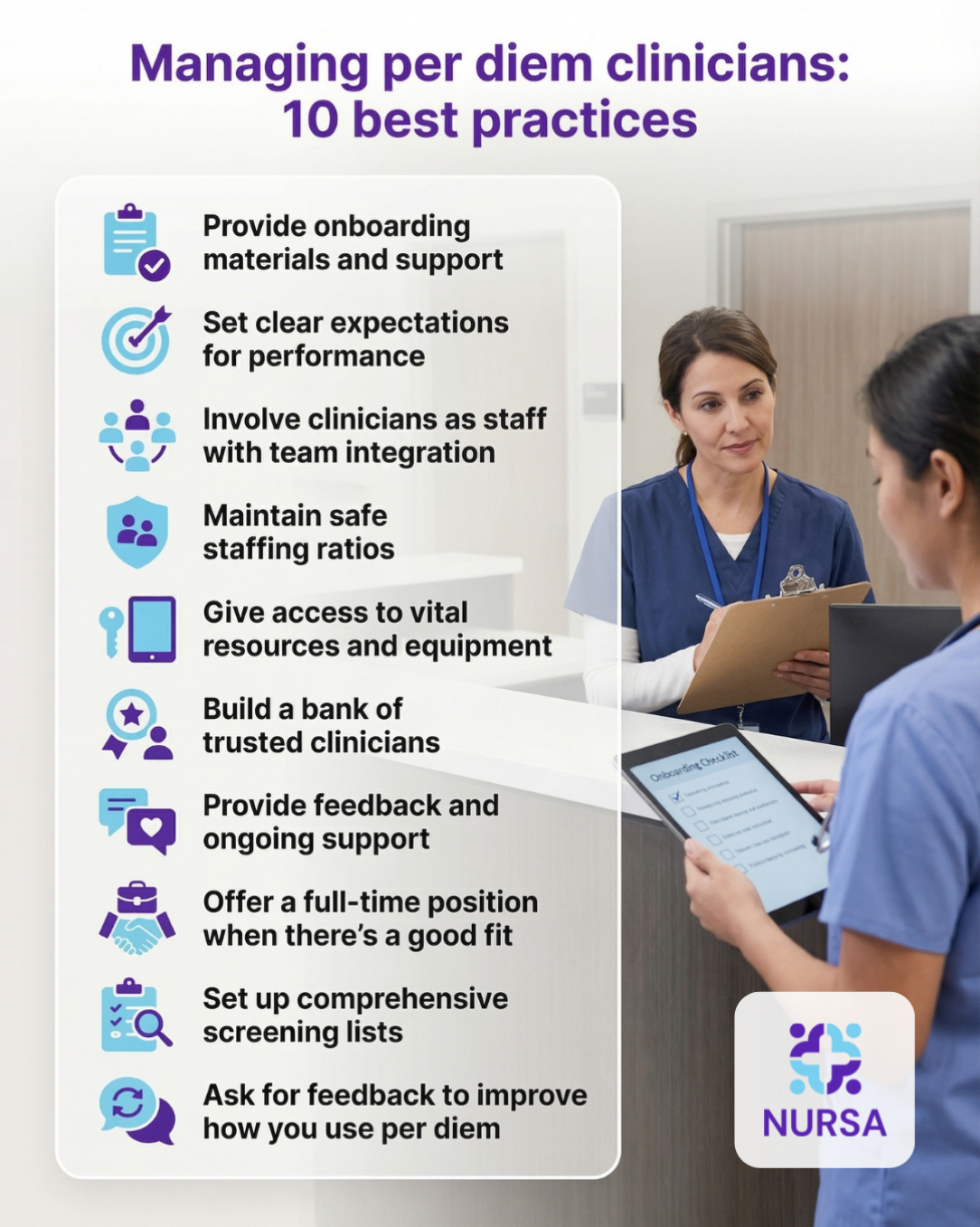
1. Provide onboarding materials and support
Onboarding PRN nurses can be easy when the right materials are at hand. Offer detailed, readable materials on facility-specific policies, procedures, and protocols. Place these in shift-accessible binders or electronic folders. Include must-have information such as:
- Facility procedures and safety protocols
- Points of contact of preference
- Guidelines for specific roles
- A map of the facility or unit, highlighting key areas
You can also assign an onboarding mentor among your regular staff to lead first-shift tours for new per diem nurses and address spontaneous questions in real time. This might help you foster engagement and reduce early shift anxiety.
Nursa partner ShiftReady enables facilities to create free training materials for PRN clinicians working shifts at their facility.
2. Set clear expectations for performance
PRN nurses are here to save the day, but that doesn’t mean that they can read minds. Identify shift objectives, tasks, and performance management levels expected before the clinician's arrival to reduce confusion and align with facility processes.
For this purpose, written job aids or checklists specific to per diem shifts should be provided so clinicians know what to do on each shift without ambiguity.
3. Involve clinicians as staff with team integration
Include per diem nurses in team meetings, social events, shift reports, and even community events. Recognizing their good work and asking for feedback enhances team integration and communication between staffing models. This will also help the clinician feel included and supported.
4. Maintain safe staffing ratios
Set PRN clinicians up for success by keeping your facility at safe staffing levels. If they’re struggling to keep up, there’s no conceivable way they can provide quality care, especially if it’s their first time at your facility. Safe ratios allow for optimal patient outcomes and clinician productivity.
Monitor staffing patterns regularly to ensure that per diem nurses are neither underworked nor overworked, shifting as needed to adjust them.
5. Give access to vital resources and equipment
Clinicians can’t do their job correctly if they can’t access your charting system or find the right supplies.
Ensure that per diem clinicians are given timely access to electronic health records, supply rooms, equipment, and other vital resources before the start of their shifts.
To prevent delays at shift starts, create quick orientation checklists that include login information, supply locations, and equipment use procedures.
6. Build a bank of trusted clinicians
Make note of who the outstanding performers are and invite them to more shift opportunities to build relationships with trustworthy per diem nurses. This facilitates faster scheduling and increases rapport between regular staff and per diem nurses.
With Nursa, you can build a list of “Favorites,” which helps facilities find trusted clinicians and schedule them for shifts more quickly using Auto-Schedule.
7. Provide feedback and ongoing support
Check in regularly with per diem nurses to learn about their experiences, give constructive feedback, and discover ways to improve support and workflow. This is key to enhancing job satisfaction.
Use short post-shift questionnaires or accelerated debrief telephone calls to gather timely feedback that can be used immediately to improve future assignments.
8. Find a good fit for an opening? Offer a full-time position
Per diem staffing flexibility allows shifts to serve as de facto working interviews.
This minimizes the risk of a hiring mismatch by observing clinicians in their actual working conditions and making easier transitions to full-time staff when appropriate.
Pro-tip: When a clinician is well-suited for your team, extend a W-2 offer with no hire-away fees using Nursa's platform.
9. Set up comprehensive screening lists
Set strict screening criteria and competency requirements prior to shifts. This allows you to find the best-qualified clinicians and reduces time spent with unsuitable candidates.
10. Ask for feedback to improve how you use per diem
Ask for advice from per diem nurses who work shifts across multiple facilities. Their experience can help you discover best practices to improve your scheduling, orientation, and retention initiatives at your own facility.
Improve your experience with per diem clinicians
Applying these per diem staffing best practices enables facilities to achieve the full benefits of this model. Help your facility improve patient care quality, maximize staffing flexibility, and achieve cost-effective staffing.
By focusing on proper onboarding, clear communication, and nurturing relationships with your PRN nurses, you can build a reliable and effective team ready to support your facility's needs.
Want to put these tips into practice?
Find out how Nursa can optimize your staff now and simplify per diem nurse management.


.png)

.png)

