



The U.S. will need more than 207,980 registered nurses (RNs) and 302,440 licensed practical nurses (LPNs) by 2030.
Nurse short-staffing has emerged as a significant problem in healthcare facilities across the country, affecting many aspects of care and operations for facilities and patients.
- Diminishes the quality of patient care.
- Negatively impacts employee wellness.
- Takes away the efficiency of operations for facilities.
- Leads to higher nurse turnover.
- Creates regulatory compliance challenges and risks.
- Strains resources by increasing the need for expensive supplemental staffing solutions.
Studies have shown that greater ratios of patients to nurses are associated with increased patient deaths. The chronic nursing shortages and institutional short-staffing issues create greater demands on healthcare networks, leaving managers and administrators no choice but to look for practical solutions.
If you want to know how to deal with staffing shortages, or if you are wondering how to manage staff shortages in nursing, this article is for you. We will cover the causes and consequences of short-staffing, as well as indicators and best practices for effectively managing nursing staff shortages.
What is nurse short-staffing?
Short-staffing of nurses occurs when hospitals cannot maintain the recommended standard of staff-to-patient ratios. Understaffing in healthcare is due to a combination of various factors. Reasons usually involve:
- High number of patients: Facilities need to tend to an ever-growing patient demand.
- Nurse turnover: Short-staffing leads to high nurse turnover and burnout.
- Limited academic capacity: Limited admission to nursing schools and a slow pipeline of new graduates impact supply.
- Location: Competition for veteran nurses in some geographic regions leaves facilities in other areas struggling to find enough nurses.
- Financial strains: Budget reductions restrict competitive wages and benefits, resulting in a limited number of available nursing positions.
Understanding nurse short-staffing and its causes is crucial because adequate nurse-to-patient ratios are essential to patient safety, quality outcomes, and staff well-being. Hospitals must address the shortage of nurses to prevent a series of adverse consequences to patient care and employee morale.
Risks of being short-staffed
There is a significant impact on multiple levels as nursing short-staffing persists. For example, it can affect:
- Quality of patient care: Missed care, delayed treatment, and rates of increased adverse events can result from short-staffed nursing units.
- Patient safety: Short-staffing decreases monitoring and responsiveness, thereby creating risks to patient safety.
- Staff turnover and burnout: Nurses working in short-staffed environments are more stressed, dissatisfied with their jobs, physically burned out, and likely to have heightened turnover rates.
- Operational risks: Hospitals face regulatory compliance issues and damage their reputations when staffing ratios have a direct impact on patient outcomes and satisfaction.
- Financial penalties: Facilities face an increased likelihood of fines, loss of accreditation, and reduced reimbursement due to adverse patient outcomes and noncompliance with regulatory staffing mandates.
The nursing staff shortage perpetuates a vicious cycle: understaffing in healthcare leads to burnout, which creates increased turnover, thereby perpetuating the staffing problem. These threats must be faced with focused measures and close monitoring.
How to know if you’re short-staffed
Identifying nurse short-staffing proactively can prevent patient safety risks and staff discontent. Look out for these warning signs.
Low staffing ratios and coverage gaps
Gaps may appear in your facility when there is:
- Consistent deviation from ideal nurse-to-patient ratios
- Overreliance on mandatory overtime or double shifts
- Difficulty maintaining sufficient coverage, especially in certain units or shifts
- Increased reliance upon nurse staffing agencies
Your unit may compare actual staffing against recommended ratios and see discrepancies early. Always look for the best practices for your nursing schedule.
Workload imbalances
Your facility might also experience some imbalances:
- Inflation of patient acuity without corresponding changes in staffing
- Inequitable workload distribution, resulting in some nurses having an excessively heavy workload
- Increased float assignments for nurses to take on unfamiliar units
Refer to nurse float pool management strategies to avoid workforce workload imbalances.
Compromised quality of care
Quality of care might suffer in your facility; here are some indicators to watch out for:
- Missed nursing care activities, including medication delivery or delayed hygiene support
- An increase in patient events, including falls or infections
- Decrease in patient satisfaction ratings or HCAHPS survey scores
Tracking patient census data can help correlate patient volume with care quality deficits.
Compromised workforce morale and retention
Finally, if your facility has many of these problems, retention might take a hit. Here are some problems that may arise at this point:
- Increased rate of absenteeism, call outs, or shift cancellations at the last moment
- Higher turnover rates with longer vacancy durations
- Complaints of burnout
Detailed data on healthcare staffing trends identifies these signs in the workforce as red flags of nurse short-staffing.
Best practices for solving nurse short-staffing problems
How can you manage short-staffing in your facility?
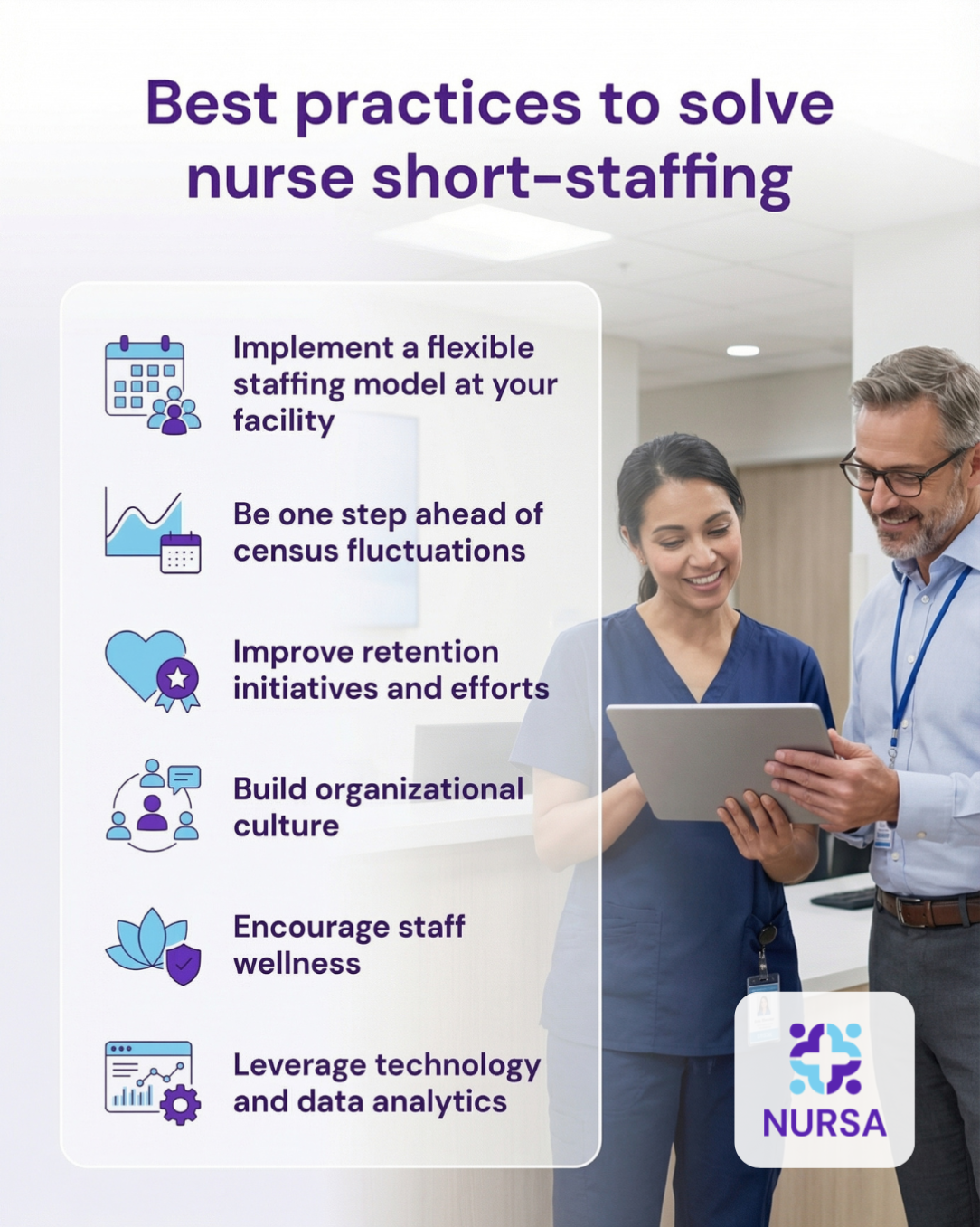
If you feel overwhelmed by the nurse staffing situation in your facility, you will require multi-faceted approaches grounded in flexibility, proactive planning, retention, staff culture, and employee health. The following are evidence-based approaches for nurse shortage management.
1. Implement a flexible staffing model at your facility
Flexible staffing options will aid your facility. With these solutions, you can:
- Establish a stable core team of full-time nurses to ensure continuity.
- Run an in-house float pool of cross-trained RNs to cover shifts in high-acuity units without relying on constant outside sourcing.
- Use per diem clinicians and contingent staffing to quickly fill gaps due to unplanned absences or surges in patient census.
- Monitor and control supplemental staffing expenses, striking a balance between the need for cost containment and quality care requirements.
- Help your regular employees by reducing their workload during patient peaks or staffing shortages, preventing burnout, and improving retention.
2. Be one step ahead of census fluctuations
With your nurses and nursing administrators, you can get ahead on nursing requirements:
- Analyze historical census patterns and establish season highs.
- Track overtime, vacancies, and fill rates as indicators of staffing stress.
- Proactively adjust staffing rather than reacting to shortages retrospectively.
- Involve nursing staff in regular review of workload and patient demand.
- Apply data-driven strategies to forecast census fluctuations and schedule accordingly.
- Rely on flexible staffing practices through identified surge periods.
- Review and revise staffing models based on current trends and outcomes.
Nurse staffing efficiency is optimized when facilities utilize mechanisms such as patient census monitoring.
3. Improve retention initiatives and efforts
Your facility can improve retention by:
- Clearly defining nurses’ roles to ensure safety while giving them more responsibility.
- Delegating non-clinical and routine tasks to support staff and unlicensed assistants.
- Shifting clerical work and patient transport duties to ancillary staff so nurses can focus more on patient care.
- Providing ongoing education and professional development opportunities for nurses.
- Recognizing and rewarding nursing staff achievements regularly.
- Offering flexible scheduling to help nurses balance work and life demands.
- Looking for the best platform for your facility to aid your current nurses.
4. Build organizational culture
Your facility can build a better organizational culture by:
- Holding brief huddles at the start of every shift to share workload and encourage teamwork
- Integrating per diem and temporary clinicians smoothly to maintain a unified unit
- Communicating openly and honestly with staff about staffing shortages and the steps being taken to address them
- Encouraging mutual respect and support among all team members
- Recognizing and celebrating team and individual successes regularly
These cultural investments do much to resolve short-staffing issues beyond numbers and grids.
5. Encourage staff wellness
Your hospital needs to promote and, in some instances, implement policies that protect the well-being of nurses:
- Limit the use of mandatory overtime and double shifts on a regular basis to allow nurses to rest.
- Offer mental health and wellness services that address the emotional challenges nurses face.
- Allow adequate rest breaks between high-energy shifts to facilitate nurse health and productivity.
- Offer access to counseling and stress management interventions.
- Promote a workplace culture that values self-care and work-life balance.
- Accommodate flexible scheduling to accommodate individual requirements and recovery time.
Prioritizing nurse well-being is crucial to maximizing retention and resolving the long-term nursing staff deficit.
6. Leverage technology and data analytics
Technology can also aid your facility:
- Implement patient acuity measurement programs to enable optimal nurse allocations.
- Implement virtual care models to increase coverage.
- Implement automation of non-clinical activities to free up nurse time.
- Proactively manage staffing.
Take a proactive approach to staffing
Your organization requires your healthcare leaders to manage staff proactively using data-driven approaches, flexible workforce models, and robust support systems. Implementing a staffing system like Nursa can help your facility handle call outs and have immediate access to skilled per diem nurses.
Nursa can even aid in recruitment by allowing facilities to “test drive” nurses before hiring, without additional fees. Facilities adopting Nursa's solutions report improved shift coverage and morale, enabling them to handle short-staffing in nursing more effectively.
Experience Nursa as an alternative for covering call outs, full-time hiring, or simply filling your next shift.
Sources:
- Jama: Hospital Nurse Staffing and Patient Mortality, Nurse Burnout, and Job Dissatisfaction
- AAMC: The Complexities of Physician Supply and Demand: Projections From 2021 to 2036
- CMS: HCAHPS: Patients' Perspectives of Care Survey
- HRSA: Health Workforce Projections
- New York State Nurses Association: Research Shows Safe Staffing Saves Lives


.png)

.png)

