



State-by-state LPN salary guide for 2026
A licensed practical/vocational nurse (LPN/LVN) in the United States makes an average of $32.24 per hour and $67,050 annually.
However, as you might expect, many factors affect LPN/LVN income. Pay rates vary by state, city, industry, and other factors. Therefore, you must understand the nuances of LPN/LVN pay to estimate your earning potential.
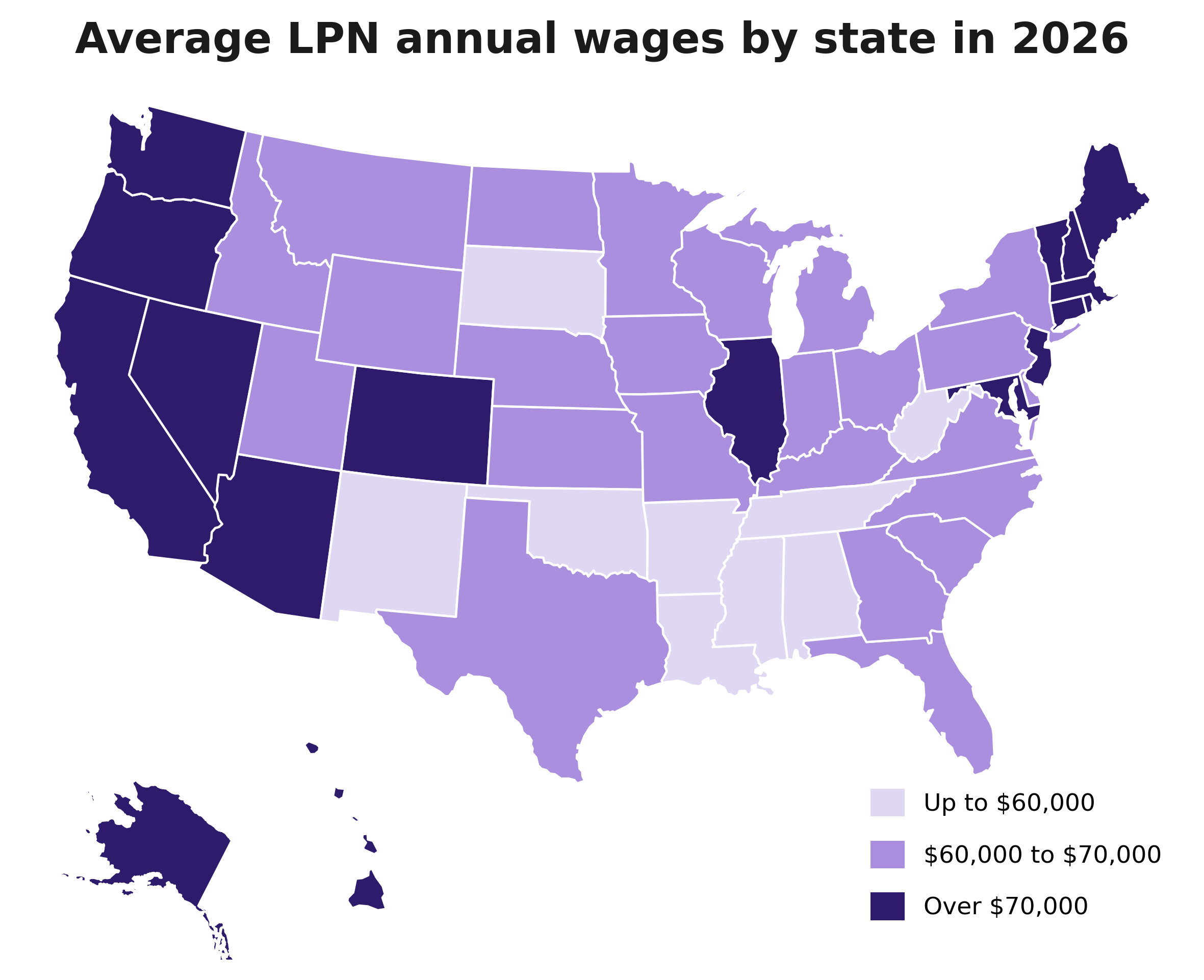
This state-by-state LPN/LVN salary guide covers everything there is to know about licensed practical nurse salaries:
- How much do LPNs make per hour?
- How much does an LPN make per year on average?
- How much do LPNs make in the highest-paying states and cities?
- How much money does an LPN make in different settings?
Read on for the answers to all your questions regarding LPN/LVN salary.
Salary data for states, metropolitan areas, nonmetropolitan areas, and industries is based on the latest available data published by the U.S. Bureau of Labor Statistics in May 2026 and represents averages for employed LPNs/LVNs.
LPN/LVN salary state by state in 2026
Location is one of the main factors that affect the average salary range for an LPN. For example, LVNs in Washington average $83,900 annually, while LPNs in Mississippi average $51,450.
Discover how LPN salaries can vary state by state in the comparison table below.
The following are the average hourly and annual LPN wages by state, according to data published by the U.S. Bureau of Labor Statistics (BLS) in May 2026. In most states, average wages increased from the previous year.
Staff LPN vs. PRN pay comparison
How much do PRN nurses make compared to staff LPNs?
In general, long-term staff LPNs earn lower hourly rates compared to per diem nurses. PRN clinicians can also earn more by picking up last-minute shifts, which tend to pay higher rates.
Furthermore, there are many differences among staff LPNs and PRN LPNs regarding overall compensation, job benefits, and other advantages.
For example, per diem nurses don’t receive benefits. On the other hand, per diem nurses have complete flexibility over their work schedules.
The following table shows general trends in LPN pay and other differences among staff LPNs vs. PRN LPNs:
What is the average per diem LPN salary in 2026?
It’s important to explain that per diem (PRN) nurses don’t earn a salary. That said, per diem LPNs typically earn a higher hourly rate and pick up shift assignments as needed.
So, how much do PRN LPNs make per hour?
PRN hourly pay rates vary but are typically much higher than those of in-house staff LPNs in the same state and work setting. For example, in Washington, per diem LPNs make an estimated hourly rate of $38.92 per hour.
Per diem/travel nurse pay rates by city vs. staff nurse salary
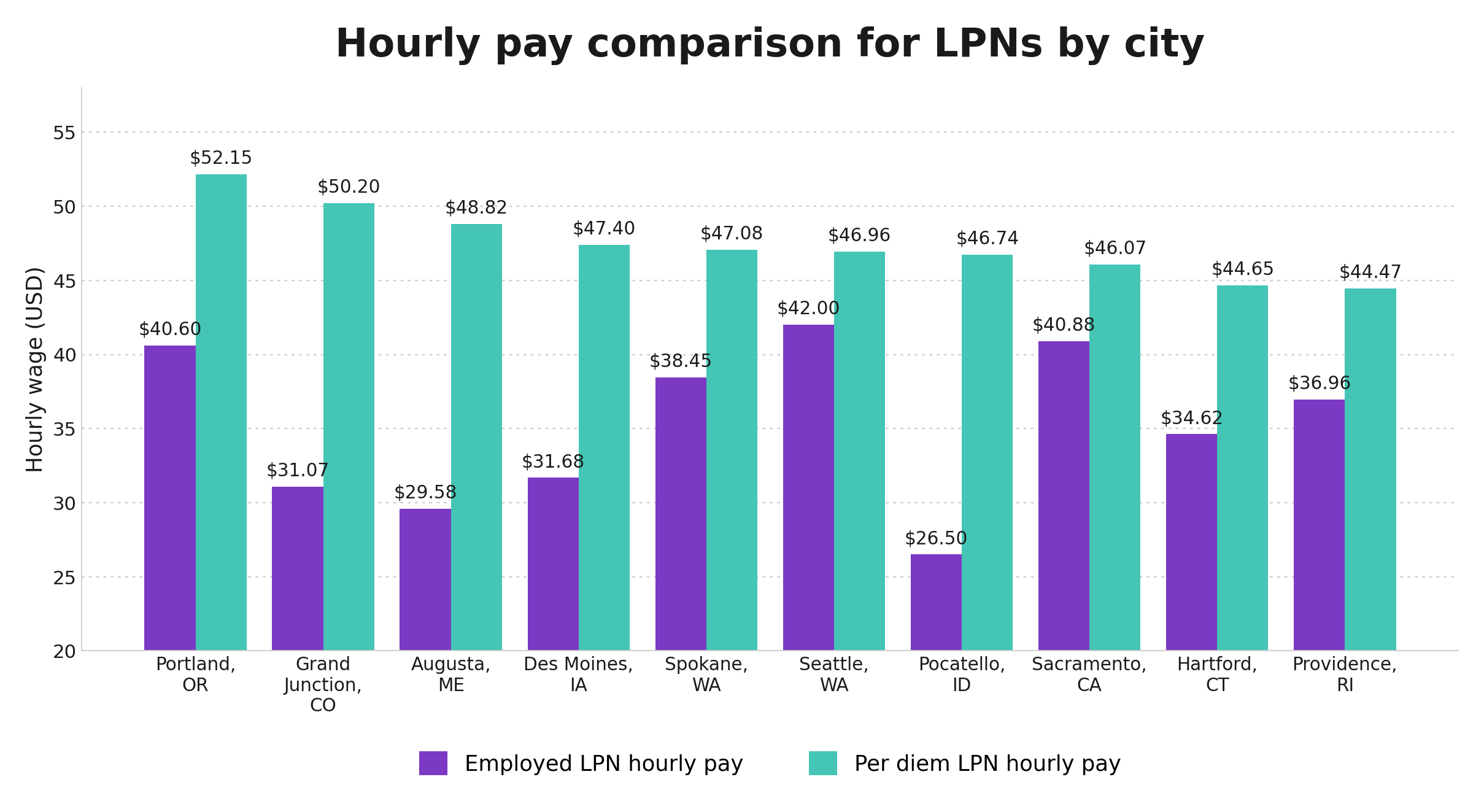
On this table, you can compare how much licensed practical nurses earn per hour as staff LPNs and as per diem LPNs picking up shifts with Nursa in 2026, as well as the difference in the salary:
LPN/LVN salaries vs. cost of living expenses
Just looking at the average LPN salary alone won’t tell you the whole story. You need to know if each state also has a good salary when adjusted to the cost of living.
By adjusting the figures for the cost of living, nurses can better compare the purchasing power of their wages across states.
Cost of living (COL) varies significantly across the country, so lists of the highest-paying states often don’t provide the full picture.
The table below adjusts each state’s average annual LPN wage for local cost of living using the Bureau of Economic Analysis (BEA) regional price parities (RPP).
What does that mean?
Basically, a lower RPP value—less than 100—means lower prices, so wages in those states have more purchasing power.
Alternatively, a higher RPP value—more than 100—indicates higher prices, so wages have less purchasing power.
The COL-adjusted pay is calculated by dividing the BLS average wage by the RPP and multiplying the result by 100.
This adjustment helps compare nurse pay in affordable states versus high-cost states, giving a truer picture of RN salary trends in 2026.
Method notes: Calculations use full-precision 2024 Bureau of Economic Analysis regional price parities, displayed to one decimal place. RPP values are the latest available from the BEA and cover all consumption goods and services, including housing rents by state.
After cost-of-living adjustments: Who pays LPNs/LVNs the lowest?
No nurse wants to see their state ranked here, but it’s an important reality check. Why does it matter?
It provides context, but more than that, it highlights how living expenses shape the real value of a paycheck.
Once adjusted for cost of living, these states give LPNs the lowest purchasing power. There are a few surprises on this list, aren’t there?
When we adjust for cost of living, the purchasing power for LPNs in these states is the lowest:
While cost-of-living adjustments provide a 'real-world' view of your paycheck, it’s also useful to see where raw, unadjusted salaries are the highest.
Which are the highest-paid LPNs in 2026?
According to BLS data, the highest-paid LPNs are in the state of Washington, where the top 10% earn about $100,950 annually and $48.54 hourly.
Which are the highest-paying states for LPNs?
Wondering which states pay the highest LPN salaries without making cost-of-living adjustments? We’ve got you covered.
Here’s how much LPNs earn annually in the top 10 best-paying states for LPNs.
Which are the highest-paying cities for LPNs?
This is the average LPN/LVN salary in the 10 highest-paying metropolitan regions for practical/vocational nurses.
Which are the industries with the highest-paying LPN jobs?
Beyond geographic location, you'll find significant LPN salary differences by industry and facility type. In fact, the highest-paying LPN jobs in healthcare may be ones you haven’t thought of.
The following table shows the 10 top-paying industries for LPNs:
What is the difference between an LPN and an LVN salary?
The term licensed vocational nurse is used in Texas and California, whereas in the rest of the country, these professionals are called licensed practical nurses. Otherwise, these terms have the same meaning.
What else increases the salary of LPN jobs?

Location and industry type are certainly essential factors affecting the average LPN income. However, LPN compensation and benefits are much more complex.
The following are some other factors influencing the practical nurse's average annual salary based on the last Medscape Compensation Report:
Male LPNs vs. female LPNs
Within the nursing profession, women make up the overwhelming majority—roughly 80% of the LPN cohort. As in many other professions, there is a pay gap between men and women in LPN roles.
- Male LPN average salary: $66,000
- Female LPN average salary: $58,000
New vs. experienced LPNs
Understanding the average LPN hourly pay for entry-level and experienced nurses helps set realistic earning expectations.
How much does experience affect an LPN’s salary?
As is also the case across most professions, more work experience usually means more pay. However, the starting salary for licensed practical nurses is not so different from that of an experienced practical nurse.
Here are average LPN salaries based on years of nursing experience:
- 21 years or more: $60,000
- 11 to 20 years: $59,000
- 6 to 10 years: $57,000
Ways LPNs supplement their income
Supplemental income is another important aspect affecting LPN pay.
Whereas about half of LPNs rely solely on a paycheck from one position, the other half take on additional responsibilities at work or even work additional jobs.
The following figures show how LPNs supplement their income and how prevalent each practice is:
- Worked extra shifts/overtime, weekends, and/or extra holidays: 28%
- Acted as a preceptor: 6%
- Worked “on call” shifts: 8%
- Took on charge nurse responsibilities: 5%
- Worked a second job or another income-producing activity (non-nursing): 16%
- Taught classes: 3%
- Other: 7%
Union membership and LPN salary
Finally, here is one more factor affecting LPN salary: union membership.
The following figures show how union membership can affect LPN wages:
- Average union-member LPN salary: $61,000
- Average non-union-member LPN salary: $59,000
What is the minimum wage for licensed practical nurses?
The current federal minimum wage is $7.25 per hour—unchanged since 2009.
However, many states have their own minimum wage regulations, which vary widely. For example, the highest minimum wage in the country is in the District of Columbia at $18.40 per hour.
Unfortunately, the lowest-earning 10% of LPNs in the country—those in Utah—make less than $18.02 per hour or $37,480 annually. However, this is still a higher hourly rate than Utah’s minimum wage, which is $7.25.

What is the LPN job outlook for 2026?
According to the BLS, the employment of LPNs and LVNs is estimated to grow 3% from 2024 to 2034, at the same rate as the average for all occupations.
This job outlook translates into demand—approximately 54,000 job openings for licensed practical and vocational nurses annually over the decade. Many of these openings will result from the need to replace nurses who transfer to different occupations or exit the labor force.
Regarding pay, the 2024 Medscape RN/LPN Compensation Report showed the following salary trends for LPNs:
- Increase in pay from the previous year: 63%
- No change in pay from the previous year: 24%
- Decrease in pay from the previous year: 13%
Assuming the salary growth trend will continue, most LPNs will see higher salaries in 2026.
Do LPNs make good money?
Whether LPNs make good money depends on the job.
In the second quarter of 2025, the median weekly earnings of full-time workers in the United States were $1,196.
Based on a 40-hour work week, the average LPN in the United States makes $1,289.60 weekly. In other words, LPN pay is comparable to the average income of a full-time worker.
For additional context, workers with a high school diploma as their highest level of education make median weekly earnings of $930. Those with at least a bachelor's degree make approximately $1,543. Therefore, pay typically increases with higher education.
How can LPNs make more money?
Based on the information already presented in this guide, LPNs can increase their income in the following ways:
- Travel or move to one of the highest-paying locations for LPNs/LVNs.
- Look for job opportunities in one of the highest-paying industries for LPNs.
- Join a nurses’ union.
- Further your education.
- Supplement your income by working extra shifts and taking advantage of shift pay differentials.
Additionally, working per diem nursing shifts is an excellent way to increase your hourly pay as an LPN. Nurses may pick up extra per diem shifts to supplement their income, or choose to work per diem full-time to take advantage of higher hourly rates.
LPN vs. RN salary gap and education impact
If you are willing to continue your education, transitioning from LPN to registered nurse (RN) would significantly increase your nursing income. LPNs can complete bridge programs for Associate Degrees in Nursing (ADNs) or Bachelor of Science in Nursing (BSN) degrees to become RNs and overcome the salary gap.
Whereas LPNs make an average of $67,050 annually, RNs make an average of $101,420. That’s a difference of $34,370 annually. But remember. Context matters. Those figures are the national averages. Discover RN salary state by state and compare it to LPN pay rates near you.
Nursing profession's salary in 2026
How do LPN salaries compare to those of other nursing professionals?
Certified nursing assistants (CNAs) earn the lowest salaries, as expected from a support occupation. Licensed practical or vocational nurses (LPNs/LVNs) earn the next-highest salaries. Further up the salary tier are registered nurses, whose average annual wage has reached the 6-figure mark.
Nurse practitioners (NPs) and certified registered nurse anesthetists (CRNAs) earn the highest wages of all nursing professionals.
Final thoughts on LPN salary
This ultimate guide breaks down LPN salaries so you can understand pay rates in your profession and see where practical nurses make the most money.
Now, it’s up to you to decide which steps you would like to take to maximize your earning potential.
Would you like to pick up high-paying PRN shifts?
Sign up with Nursa to make high hourly rates as an LPN.
Sources:
- Occupational Employment and Wage Statistics (OEWS) Maps
- Occupational Employment and Wage Statistics (OEWS) Profiles
- U.S. Department of Labor: State Minimum Wage Laws
- Real Personal Consumption Expenditures by State and Real Personal Income by State, 2024
- Medscape Compensation Report
- BLS: Usual Weekly Earnings of Wage and Salary Workers News Release
- BLS: Employment Projections: Education pays


