



State-by-state RN salary guide for 2026
The average hourly wage of a registered nurse (RN) in the United States is $48.76, and the average annual wage is $101,420—up almost $3,000 from last year’s data.
You mean, registered nurses can make 6 figures?
The short answer is yes. The average registered nurse in the United States makes a 6-figure income. However, numerous factors affect registered nurse salary, including state and city, work setting, education, experience, and more.
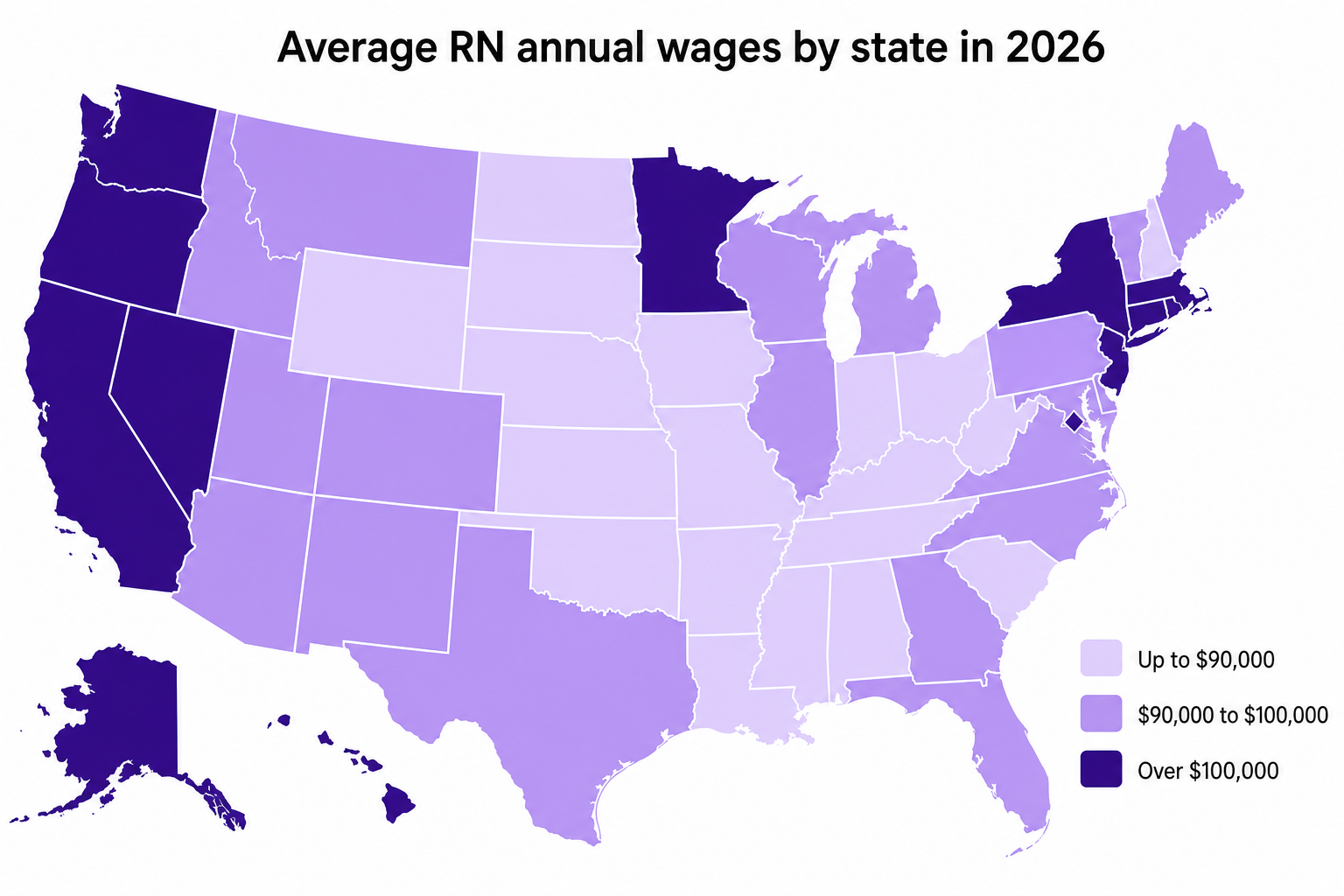
This comprehensive RN salary guide answers the most common questions nurses ask, such as:
- How much do registered nurses make per year and hour in each state in 2026?
- Which states pay RNs the highest salaries?
- Which cities pay registered nurses the most?
- How much do new grad RNs make?
Also, discover how different aspects impact an RN’s earning potential, bumping income up or down the salary range.
Salary data for states, metropolitan areas, nonmetropolitan areas, and industries is based on the latest available data published by the U.S. Bureau of Labor Statistics in May 2026 and represents averages for employed RNs.
Average registered nurse salary by state
The following are the average hourly and annual RN wages by state, according to data published by the U.S. Bureau of Labor Statistics in May 2026. In most states, average wages increased from the previous year.
Staff RN vs. travel nurse vs. PRN pay comparison
How much do travel and PRN nurses make compared to staff RNs?
In general terms, long-term staff RNs earn the lowest hourly pay, whereas per diem nurses tend to earn the highest hourly rates. Travel nurses typically earn more per hour than long-term employees and often similar rates to PRN nurses, although they generally don’t make the rates that PRN clinicians can make when they pick up last-minute shifts.
Furthermore, there are many differences among these 3 groups regarding overall compensation, job benefits, and other advantages. For instance, long-term staff receive the most benefits, whereas per diem nurses receive none. On the other hand, per diem nurses have complete flexibility to curate their work schedules, whereas long-term staff nurses have practically none.
The following table shows general trends in RN pay and other differences among the 3 groups of registered nurses.
What is the average per diem RN salary in 2026?
First, per diem (PRN) nurses typically don’t earn a salary. Per diem nurses typically earn high hourly pay rates for flexible shifts that they pick up on a PRN basis, or as needed.
How much do PRN nurses make per hour?
PRN hourly pay rates are typically much higher than those of in-house RNs in the same city and work setting. For instance, in Des Moines, IA, W-2 RNs typically make $33.69–$41.68 per hour. However, RNs in this city who pick up PRN shifts with Nursa typically earn $61.01–$64.86 per hour.
Per diem/travel nurse pay rates by city vs. staff nurse salary
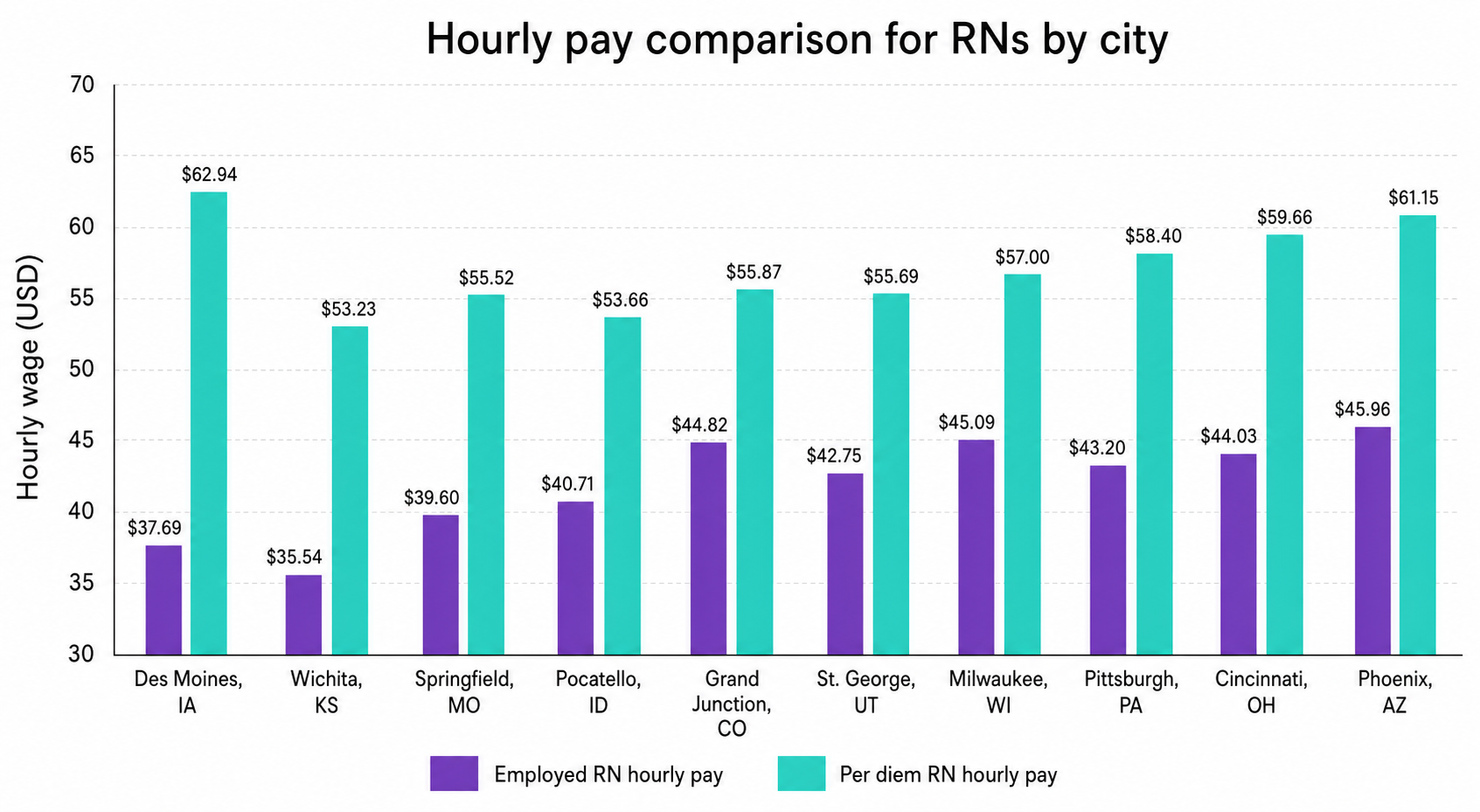
Compare how much registered nurses typically make per hour (average pay taken from the 25th and 75th BLS salary percentiles) as staff RNs vs. as per diem or travel nurses picking up shifts with Nursa in 2026.
Registered nurse salary by state, adjusted for cost of living
What is the average RN salary in California and other states when it’s adjusted for cost of living?
Looking at the average nurse salary in the U.S. alone doesn’t tell the whole story. It is essential to know which states have the best RN salaries adjusted for cost of living. By adjusting for the cost of living, nurses can better compare the purchasing power of their wages across states.
Cost of living (COL) varies significantly across the country, so lists of the highest-paying states often don’t provide the full picture.
The table below adjusts each state’s average annual RN wage for local cost of living using the Bureau of Economic Analysis (BEA) regional price parities (RPP).
What does that mean?
Basically, a lower RPP value—less than 100—means lower prices, so wages in those states have more purchasing power.
Alternatively, a higher RPP value—more than 100—indicates higher prices, so wages have less purchasing power.
The COL-adjusted pay is calculated by dividing the BLS average wage by the RPP and multiplying the result by 100.
This adjustment helps compare nurse pay in affordable states versus high-cost states, giving a truer picture of RN salary trends in 2026.
Method notes: Calculations use full-precision 2024 Bureau of Economic Analysis regional price parities, displayed to one decimal place. RPP values are the latest available from the BEA and cover all consumption goods and services, including housing rents by state.
Best value states for RN salaries
Interestingly, most of the highest-paying states for RNs also offer the best cost-adjusted registered nurse salaries. In other words, although most of the following states have a high cost of living, the average RN salaries more than compensate, making them the best value states for registered nurses in 2026.
Worst value states for registered nurses
At the other end of the spectrum are the states where registered nurses make the lowest salaries, even after factoring in the cost of living.
Which states pay RNs the highest gross income?
Without factoring in cost-of-living adjustments, the following are the states where RNs rake in the highest pay. They are also the highest-paying states for travel nurses in 2026.
Which states pay RNs the lowest gross salaries?
This isn’t the kind of list you want to see your home state on, but it is important information nonetheless. The following are the states with the lowest average RN wages, excluding living wage considerations.
Top 50 highest-paying metro areas for RNs
The highest-paying states certainly have impressive salaries, but some cities significantly outpace their state averages for registered nurse pay in 2026.
Spoiler alert: Nearly half are in California.
Which are the highest-paying RN jobs?
Industry matters too—registered nurse salaries in specialized nursing fields or in outpatient care, for example, can differ significantly from the average RN salary.
Nationwide, most RNs work in general hospitals where they earn, on average, $104,420 annually. That said, there are many other industries in which RNs receive significantly higher salaries.
The following are the top 15 highest-paying industries for RN pay.
Which is the highest-paying nursing specialty?
The highest-paying nursing specialty for RNs is cardiovascular operating room (CVOR) nursing, a subspecialty of surgery nursing. It requires highly specialized surgical assistance skills for complex, high-stakes cardiac procedures like bypass surgery.
This specialized nursing subspecialty has an estimated average annual salary of $152,404.
What other factors increase the salary of RN jobs?
Aside from location, cost of living, and industry, many other factors influence RN pay.
You probably expect that the level of education, certifications, years of work experience, and nurse shift differentials influence registered nurse salaries, but did you know that gender and union membership can also significantly influence RN income?
Read on to discover how all of these factors and others can influence your earnings as an RN.

How does education impact RN salary?
Let’s start with RN education. If you have not yet started nursing school, you might not realize how many options you have to become an RN.
Aspiring RNs can complete Associate Degrees in Nursing (ADNs) or Bachelor of Science in Nursing (BSN) degrees. Although less common, RN diploma programs are also available through some hospitals.
Additionally, RNs can pursue a Master of Science in Nursing (MSN) or even a doctoral degree in nursing. An MSN candidate typically must complete a Bachelor of Science in Nursing before pursuing post-graduate education. However, accelerated nursing programs are also available for RNs with ADNs.
The following figures represent average RN income by educational degree, according to the Needed Pay Increases Arrive: Medscape RN/LPN Compensation Report 2023. Although the averages are higher in 2026, these figures illustrate the impact of education on RN salary and how an ADN vs. a BSN vs. an MSN degree typically affects a nurse's salary:
- Associate’s degree: $82,000
- Bachelor’s degree: $88,000
- Master’s degree: $100,000
Do BSN nurses always make more than ADN nurses?
The short answer is no. An ADN RN in California will most likely earn a much higher wage than a BSN RN in Alabama. An ADN RN working in a city may also earn more than a BSN RN working in a rural community. Even within the same city, an ADN RN with more work experience or working in a higher-paying setting, such as an outpatient care center, may reasonably earn more than an entry-level BSN RN or one working in a lower-paying setting, such as home health.
How does work experience affect RN salary?
As with all professions, RNs can increase their salary by accruing professional experience. The typical range for a new grad entry-level RN salary is generally up to $68,940* annually, but after 5-10 years of experience, RN salaries can climb above the national average.
*Note: According to the latest BLS data, the lowest 10th percentile of RNs nationwide earns up to $68,940 annually.
How much do RNs make with 5 or more years of experience?
The following averages show the registered nurse salary growth by experience that can be expected in 2026, according to the Medscape RN/LPN Compensation Report:
- 21 years or longer: $100,000
- 11 to 20 years: $101,000
- 6 to 10 years: $90,000
RN salaries tend to grow the most over the first 10 years of practice. Between 11 and 20 years of practice, RN salaries tend to plateau.
How do RNs supplement their income?
Over half of RNs (51%) pursue supplemental income in addition to their base salaries. Here are the ways that RNs typically supplement their income:
- Working extra shifts/overtime, weekends, and/or extra holidays: 55%
- Acting as preceptors: 27%
- Working “on call” shifts: 24%
- Taking on charge nurse responsibilities: 23%
- Working a second job or another income-producing activity (non-nursing): 22%
- Teaching classes: 14%
- Other: 14%
RN total compensation package in 2026
According to the Medscape RN/LPN Compensation Report, average base compensation for RNs was $94,000 in 2025 (most recent data available in 2026).
Average additional compensation included:
- Productivity/incentive pay: $400
- Annual bonus: $700
- Overtime: $2,000
- Other pay: $1,000
Based on this report, total annual compensation reaches $99,000.
What are nurse overtime pay rates?
Overtime is compensation for hours worked beyond an employee’s regular schedule. Employers must pay an employee 1.5 times their regular pay rate for each extra hour.
How does RN pay vary by community type?
Rural communities often experience the most acute shortages of healthcare professionals, and the lack of competitive pay often exacerbates the gaps between supply and demand. The following are average RN salaries by community type:
- Urban: $102,000
- Suburban: $100,000
- Exurban: $92,000
- Rural: $86,000
*Exurban communities are farther out than suburbs, but are more populated than rural areas.
Do union-member registered nurses make more money?
Membership in a nurses’ union also significantly affects a registered nurse’s income. Here are average RN salaries based on union membership, according to the most recent Medscape RN/LPN Compensation Report that covered this data:
- Union members: $106,000
- Non-union RNs: $93,000
The average union nurse salary in 2026 is likely to have increased, as have average RN salaries overall. However, these figures help illustrate the difference in pay between the two groups. Union membership not only boosts RN pay but also impacts job security and overtime policies.
Is there a gender pay gap in nursing?
Although nursing is generally considered a female-dominated field, female RNs typically earn less than their male RN colleagues. With the following average salaries for male and female RNs, the gender pay gap continues to be a concern:
- Male RN average salary: $104,000
- Female RN average salary: $94,000
What is the minimum wage for registered nurses?
The current federal minimum wage is $7.25 per hour—unchanged since 2009. However, the minimum wage varies by state, as does the average RN salary.
The highest minimum wage in the United States is $17.95 per hour in the District of Columbia.
That said, the minimum wage doesn’t apply to registered nurses, since the lowest-paid 10th percentile of registered nurses in the United States earns up to $33.14 per hour, and the lowest-paid 10% in the lowest-paying state (South Dakota) earns up to $25.98.
CNA vs. LPN vs. RN vs. NP vs. CRNA salary in 2026
How do RN salaries compare to those of other nursing professionals?
Certified nursing assistants (CNAs) earn the lowest salaries, as expected from a support occupation. Licensed practical or vocational nurses (LPNs/LVNs) earn the next-highest salaries. Further up the salary tier come registered nurses, whose average annual wage has reached 6 figures.
Nurse practitioners (NPs) and certified registered nurse anesthetists (CRNAs) earn the highest wages of all nursing professionals. Their average salaries reflect post-graduate education, several years of work experience, and working in highly specialized roles.
.jpg)
Will the average RN salary increase in 2026?
RN salaries have increased steadily over the years, and this trend is expected to continue in 2026 and beyond.
The following averages show the RN salary trend over the past 5 years, according to the latest Medscape RN/LPN Compensation Report:
- 2021: $83,000
- 2022: $86,000
- 2023: $89,000
- 2024: $95,000
- 2025: $99,000
As long as nurses are in demand—and there is no end to the nurse staffing shortage in sight—RNs are well-positioned to negotiate better salaries, benefits, and working conditions.
Here are some ways that healthcare leaders are trying to attract and retain nurses:
- Higher salaries
- More flexible work schedules
- Nurse signing and retention bonuses
- Relocation packages
- Tuition assistance
- Incentives for pursuing certifications and other career development opportunities
- More attractive benefits, such as better retirement plans and childcare discounts
How to increase your nurse salary in 2026
As we have seen in this state-by-state salary guide, RN income is a complex issue influenced by numerous factors, including residence, education, work experience, and union membership.
Here are some tips you can follow to make more money as an RN:
- Work in health-related positions before RN licensure, such as working as a CNA during nursing school.
- Complete a BSN followed by an MSN or a doctoral degree in nursing.
- Pursue certifications in the highest-paying nurse specialties.
- Move to a high-paying state with a relatively low cost of living.
- Supplement your income by picking up extra shifts or acting as a nurse preceptor.
Do all well-paying RN jobs require higher education?
Higher education typically leads to higher pay across professions. However, earning higher degrees is not the only way to increase RN pay.
Whether you’re evaluating registered nurse salary by state or considering per diem RN rates as a supplement, the factors affecting RN salary remain consistent: location, education, experience, setting, specialty, and schedule.
Nurses can significantly increase their hourly rates without pursuing higher education by picking up travel and PRN jobs.
Increase your income with PRN shifts and block booking
Nursa is a healthcare staffing app that connects nurses directly with facilities to fill open PRN shifts or block-book shifts over an extended period—similar to travel nursing.
RNs can browse open shifts near them and request the ones that fit their schedules, needs, and interests.
Picking up PRN jobs or block booking shifts is a great way to supplement an RN income. Many RNs also work PRN full-time for greater flexibility and work-life balance.
Picking up jobs through Nursa offers many advantages over traditional travel nursing contracts. RNs can make high pay rates without leaving the comfort of their homes or making longer-term commitments.
With PRN nursing, RNs commit to one shift at a time and can request only the highest-paying jobs. Similarly, with block booking, RNs can choose to travel or stay local, see pay rates upfront, and only request the jobs that fit their needs.
Sign up with Nursa and check out per diem RN rates on shifts near you.
Sources:
- Occupational Employment and Wage Statistics (OEWS) Maps
- Occupational Employment and Wage Statistics (OEWS) Profiles
- Paycheck Pulse: Medscape RN/LPN Compensation Report 2025
- Gains Made but a Ways to Go: Medscape RN/LPN Compensation Report 2024
- Needed Pay Increases Arrive: Medscape RN/LPN Compensation Report 2023
- U.S. Department of Labor: State Minimum Wage Laws
- Real Personal Consumption Expenditures by State and Real Personal Income by State, 2024S


