A 10-minute break is enough time to train. That may sound unrealistic at hour 7 of a 12-hour shift, but bodyweight exercises for nurses on break need nothing more than a wall, a sturdy chair, and a few minutes. Done consistently, they build the leg endurance, hip strength, and core control that long shifts and patient transfers demand.
Exercising mid-shift can feel counterintuitive when you're already tired. But the research says otherwise: short bouts of movement can boost energy, ease pain and fatigue, and lift mood, with some benefits showing up after a single session. This guide covers 5 beginner moves, 5 advanced progressions, and 5 stretches that fit into a real break.
Why a few minutes of movement pays off
Healthy living means that any amount of exercise is worth it, even if it doesn't seem like much. The World Health Organization is direct about this point:
“Any amount of physical activity is better than none; all physical activity counts.”
The Centers for Disease Control and Prevention (CDC) takes it a step further, putting a number on it:
“An estimated 110,000 deaths per year could be prevented if U.S. adults ages 40 and older increased their moderate-to-vigorous physical activity. Even 10 minutes more a day would make a difference.”
That reframes what can be accomplished during a short break. Micro-workouts for nurses are not a watered-down version of real training. The payoff also arrives fast. The CDC reports that some brain benefits show up right after a single session of moderate-to-vigorous activity, including reduced short-term feelings of anxiety in adults.
A 2024 systematic review, Physical Activity and Mental Health: A Systematic Review and Best-Evidence Synthesis of Mediation and Moderation Studies, analyzed 247 studies (more than 2.4 million participants) and found “strong evidence” that physical activity influences self-efficacy, self-esteem, and resilience, further supporting the correlation between physical activity and mental health.
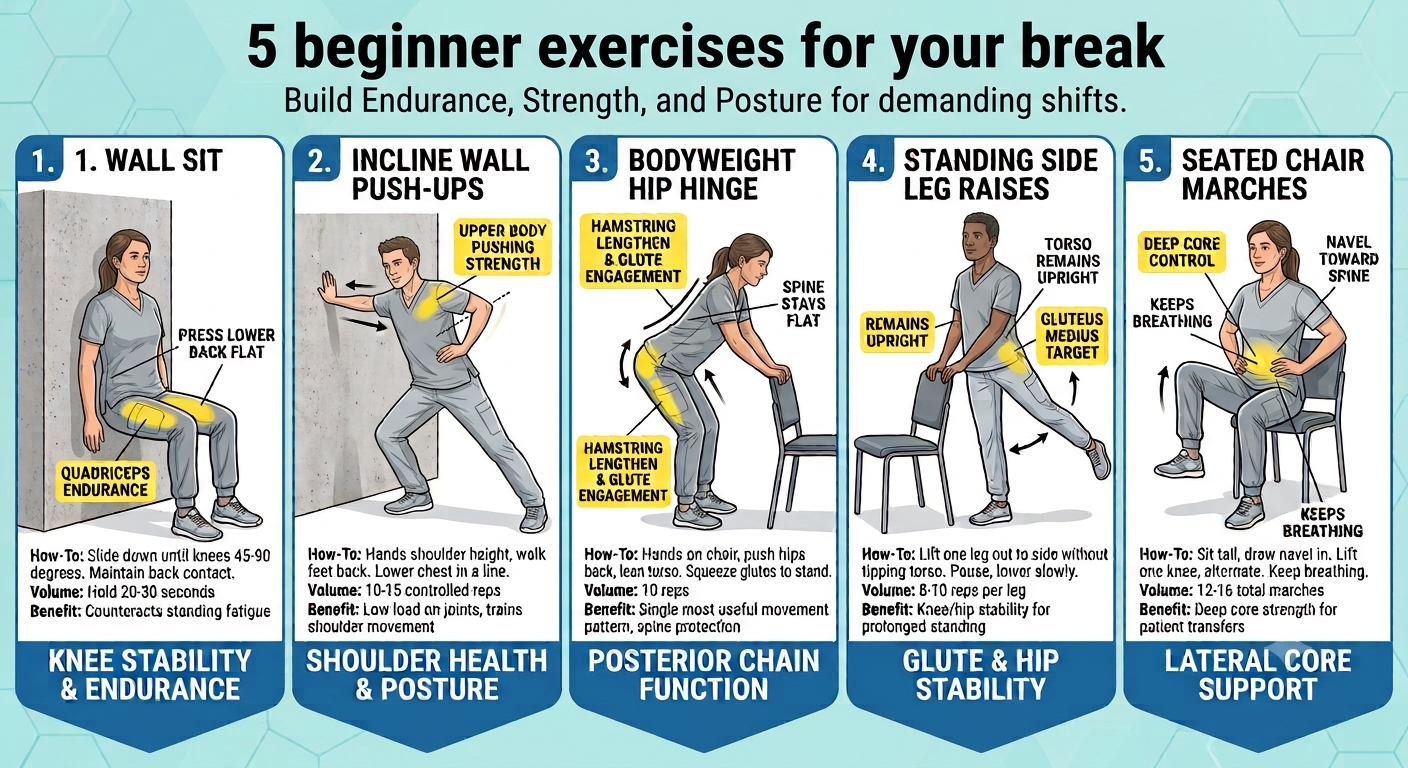
5 Beginner exercises for your break
Start here if you are new to training or returning after time off. This break room fitness routine builds a base without leaving you shaky for the back half of your shift. Each move is a bodyweight workout for nurses in the most literal sense, using only your own mass and a wall or chair.
- Wall sit: This isometric hold builds quadriceps endurance, which is often what fails first during long periods of standing. Press your back flat against a clear wall and slide down until your knees bend somewhere between 45 and 90 degrees (or as far as you can). Keep your lower back in contact with the wall and hold for 20-30 seconds. Come up before your form breaks, not after.
- Incline wall push-ups: Pressing against a wall builds upper-body pushing strength, with far less shoulder and wrist load than a floor push-up. Place your hands on the wall at shoulder height, slightly wider than your shoulders, and take a step back with your feet. Lower your chest toward the wall with your body in a straight line, then press back for 10-15 controlled reps. These double as posture exercises for nurses, training the shoulder blades to move well after hours of charting and leaning over beds.
- Bodyweight hip hinge: Learning to hinge at the hips instead of rounding your back is the single most useful pattern on this list. Stand with feet hip-width apart and knees soft, hands resting on a chair back. Push your hips straight back while your torso leans forward and your spine stays flat. Stop when you feel your hamstrings lengthen, then squeeze your glutes to stand. Try to do 10 reps.
- Standing side leg raises: This one targets the gluteus medius, which drives glute and knee stability for standing all day. Hold a chair or wall, stay upright, and lift one leg out to the side without letting your torso tip. Pause at the top, lower slowly, and complete 8-10 reps before switching legs.
- Seated chair marches: A seated march builds deep core control, and deep core control is what gives you core strength for patient transfers. Sit tall at the front edge of a sturdy chair with both feet flat. Draw your navel gently toward your spine, lift one knee toward your chest, lower it, and alternate for 12-16 total marches. Keep breathing rather than bracing.
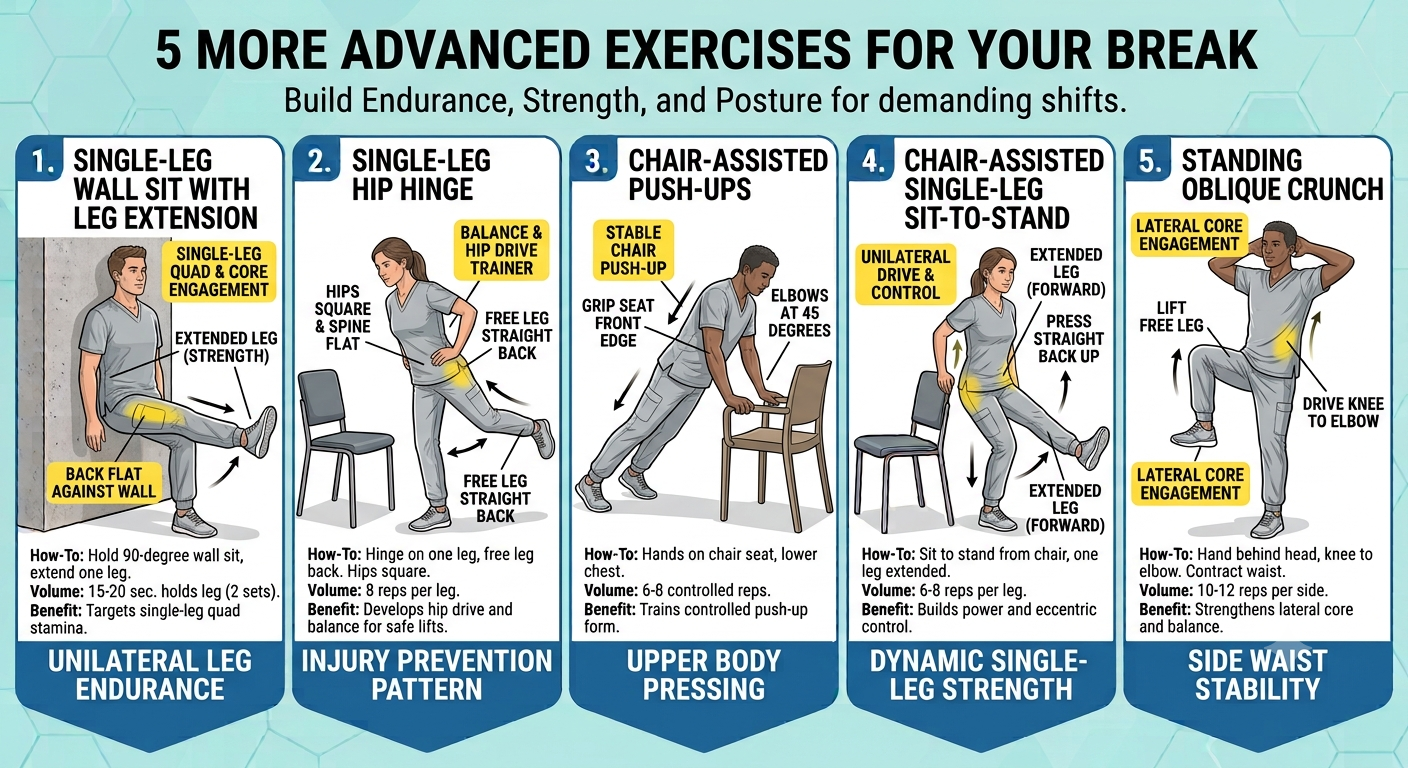
5 Advanced exercises for your break
Advanced exercises are to be attempted once the beginner exercises become easy and your form holds up even when you are tired. These are advanced bodyweight exercises for men and women alike that demand real control.
Think of this tier as a form of calisthenics built on single-leg work and slower tempos. Training this way maintains strength and joint mobility without any equipment..
- Single-leg wall sit with leg extension: Hold a wall sit at roughly 90 degrees, then extend one leg straight out and hold for 15-20 seconds with your back flat against the wall. Aim for 2 sets per leg.
- Single-leg hip hinge: This is the most directly useful move here for safer patient lifting and injury prevention, because it trains balance and hip drive simultaneously. Stand on one leg with a soft knee. Lean forward and send the free leg straight back, keeping your hips square and your spine straight and as flat as possible. Lower until your hamstring loads, then squeeze your glute to return. Aim for 10 reps per leg.
- Chair-assisted push-ups: Brace a non-rolling chair against a wall and grip the front edge of the seat. Step your feet back into a straight line from head to heels, then lower your chest toward the seat with elbows at about 45 degrees. Press back up for 10 reps.
- Chair-assisted single-leg sit-to-stand: Stand just in front of a sturdy chair with one leg extended forward off the floor. Drive through the heel of your grounded foot and lower under control until your glutes touch the seat, then press straight back up without bouncing. Do 6-8 reps per leg.
- Standing oblique crunch: Balance on one leg with a soft knee and place your opposite hand behind your head. Lift the free leg and drive that knee up toward your elbow, contracting through the side of your waist. Lower with control for 10-12 reps per side.
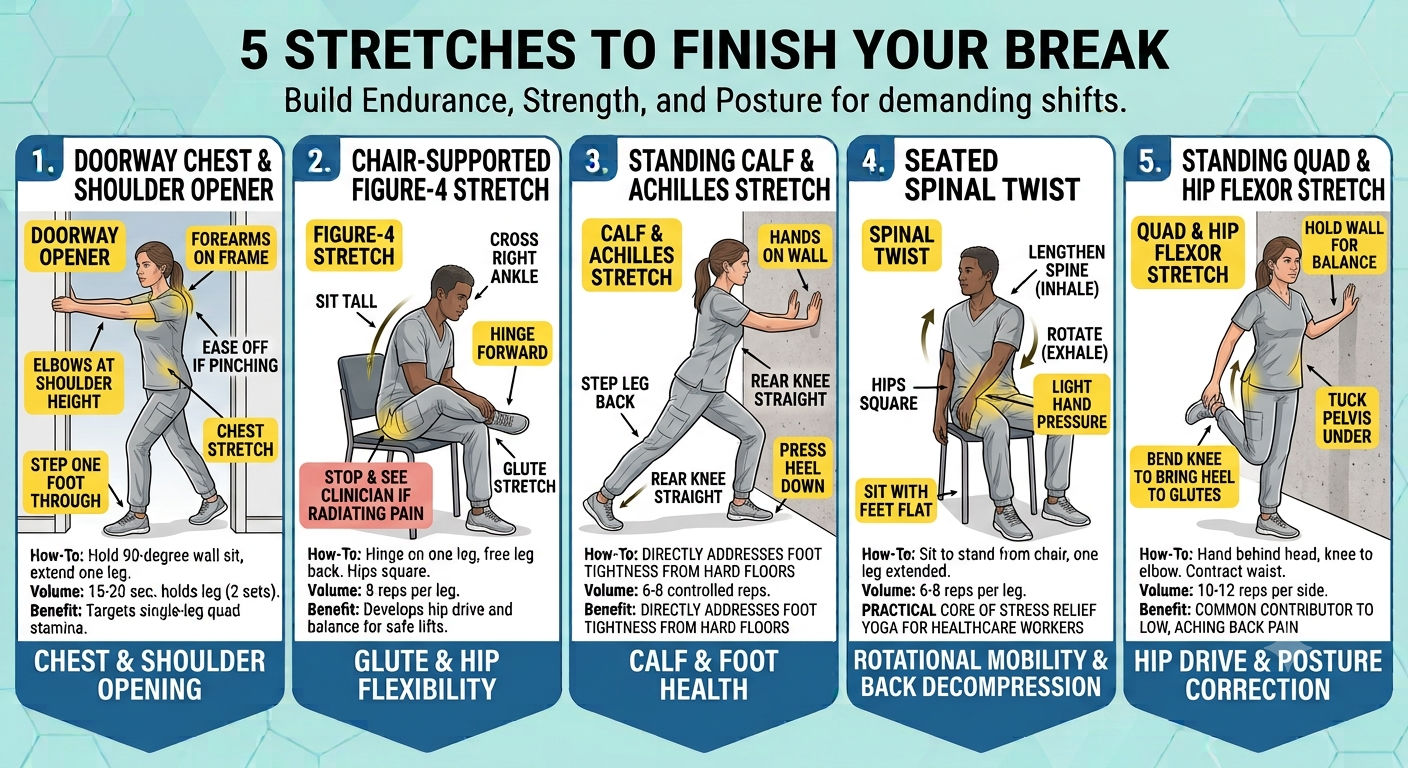
5 Stretches to finish your break
Finish every session here. Consistent pre- and post-shift stretching does more for how you feel at hour 11 than any single exercise above. Hold each of these for 20-30 seconds per side and breathe through them.
- Doorway chest and shoulder opener: Place your forearms on a doorframe with elbows at shoulder height, then step one foot through until you feel a stretch across your chest. Ease off if you feel pinching inside the shoulder joint.
- Chair-supported figure-4 stretch: Sit tall, cross your right ankle over your left knee, and hinge forward from the hips with a flat back. Stop and see your healthcare provider if you feel pain radiating down your leg rather than a stretch in your glute.
- Standing calf and Achilles stretch: Put both hands on a wall, step one leg back with the rear knee straight, and press that heel into the floor. This one directly addresses the foot and calf tightness caused by hard flooring.
- Seated spinal twist: Sit with your feet flat and hips square, lengthen your spine on the inhale, then rotate your upper body on the exhale using light hand pressure on your thigh. Rotational mobility work like this doubles as a gentle lower-back decompression after hours of loaded standing.
- Standing quad and hip flexor stretch: Hold a wall for balance, bend one knee to bring your heel toward your glutes, and tuck your pelvis slightly under. Tight hip flexors pull the pelvis into an anterior tilt, which is a common contributor to that low, aching back pain at the end of a shift.
How to use this routine on a real break
Get the most out of your day by treating these exercises as a menu, not a mandated checklist to get through. Nobody finishes 15 movements in 10 minutes, and nobody should try. Your starting point is determined by your current fitness level, strength, injury history, and the number of hours you have been on your feet.
Here is how to make a 10-minute nurse workout fit without rushing it.
- Start with 20 slow calf raises to move blood out of your lower legs before you stretch anything.
- Pick 3 exercises from the beginner or advanced list and run 1-2 sets of each.
- Close with 2 or 3 stretches, holding each for 20-30 seconds.
- Exhale on the effort and inhale on the return, and stop any movement that causes sharp pain.
- Keep 5 minutes clear at the end to eat and drink something healthy.
This structure turns quick break room exercises into a viable habit rather than an unattainable project. On a brutal shift, do the calf raises and one stretch. It still counts.
Everything here qualifies as a “no-equipment workout” for shift workers. You need a wall, a sturdy chair that does not roll, and a doorway.
When to skip the workout and just rest
Knowing when not to train is part of training well. Some shifts take everything you have; a chair and a healthy snack are the right choice. Sometimes, taking a day off from exercising is a benefit, not a detriment.
Sit down and prioritize food and water if you feel dizzy, lightheaded, or nauseated. Skip anything that produces sharp, shooting, or radiating pain. Talk to your healthcare provider first if you are managing an active injury or are pregnant or postpartum.
Then come back tomorrow. Consistency across months beats intensity on any single break, and 10 minutes still counts.
The secret to exercising properly is quality over quantity
To really benefit from exercising on your break, it comes down to quality over quantity: you are better off doing 5 perfect standing side leg raises than 15 bad ones.
Proper form produces the results you are looking for, strengthening the target muscles the way they are meant to. Bodyweight exercises are ideal for training and developing your stabilizer muscles, which are essential for proper posture and injury prevention.
Movement is only half the equation. Your diet is essential for muscle recovery, so pair these exercises with meals and snacks rich in vitamins, minerals, protein, and omega fatty acids.
Ready to plan your next break? Check out our healthy meal prep ideas for nurses and quick power snacks for busy PRN nurses, then pick 3 moves from the lists above for tomorrow's shift.
Sources: