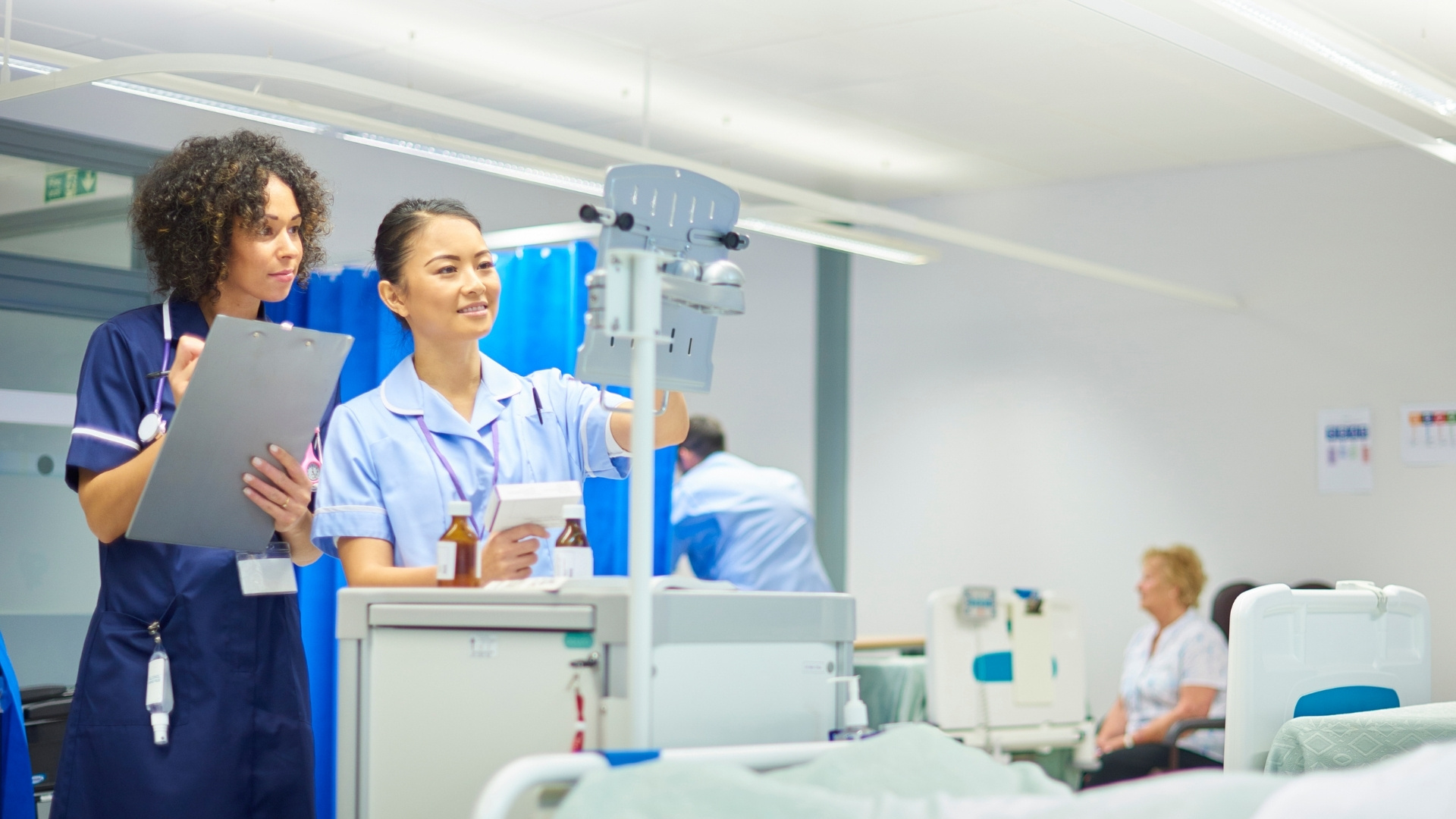
Picture a starched white cap, pinned so tightly it left a mark by the end of a 12-hour shift. If you wore one, you probably still remember the bobby pins. If you didn't, you've likely seen one in a retirement party photo.
The cap is one of many obsolete nursing tools that have quietly left the nursing unit. Below, we cover old nursing tools, why each one went, and what nurses use in its place today.
The uniform: Caps, pins, and belts
Caps, pins, and belts are 3 pieces of retired nursing equipment that left the unit as scrubs took over.
The history of nursing caps and pins starts with rank: the cap showed where a nurse trained. Each nursing school had a distinct cap design, and some added stripes to mark a student's progression or seniority.
The use of nursing caps began to disappear in the 1970s. The first reason was practical. Caps slipped during patient turning, caught on privacy curtains or overhead intravenous (IV) lines, and obstructed emergent bedside procedures. As more men entered the profession, moving away from a gendered headpiece also made sense.
Infection control was the second reason. White caps were made of starched fabric that was rarely laundered as often as the rest of the uniform, which made them hard to keep clean under modern hygiene standards.
Nurses also once wore their school pin on the uniform collar every shift, and some programs issued a belt in school colors or with a custom buckle. Both faded from daily use with the move to scrubs, which don’t have rigid collars for a pin and no structured waistline for a belt. School pins remain cherished keepsakes presented at pinning ceremonies, but they now usually stay home.
Today, scrubs and a badge reel do the identifying. ID badges display a nurse's name, photo, and credentials, giving patients clear information at a glance.
Multicolor click pens and shift charting
For decades, the 4-color retractable click pen was a staple in many nurses' pockets. A single click gave you black, blue, red, or green ink.
At many facilities, each ink color matched a specific shift—for instance, blue or black for days, green for evenings, and red for nights. Because conventions varied by facility, float nurses had to learn the local color code fast.
Paper charting demanded neat, legible handwriting. A sloppy entry could lead to misread orders, and fixing an error meant drawing a single line through the text, marking "error," and adding your initials and the time. Many nurses also kept a folded report sheet in their pockets to track vital signs and tasks until they could sit down at the station.
Today, paper flowsheets have given way to the electronic health record (EHR). Entries receive an automatic timestamp and user signature, so the record clearly shows who documented what and when.
The ward bell
Before electronic call lights, patients rang a small handheld brass bell or pulled a cord connected to a bell mounted on the hallway wall.
On a busy unit, nurses learned to triage by ear. They could tell which bed was ringing, gauge urgency by how long the bell sounded, and note who had rung twice. However, a bell left no objective record:
- If a request was missed, no one could easily verify when the patient had called or how long they had waited.
- In long, echoing hallways, pinpointing a sound was difficult, so nurses often checked several rooms before finding the right patient.
The move from the ward bell to the nurse call system changed that. Electronic systems replaced most ward bells during the mid-20th century.
Modern systems log each request, display room numbers on station monitors, and route alerts straight to a nurse's phone or wearable badge. Many also let patients choose a request type, such as pain relief, water, or bathroom help, so the right team member responds first.
Metal hemostats and trauma shears
Veteran nurses often carried their own metal Kelly clamps and bandage scissors from shift to shift. Some received them in nursing school, while others bought them at medical supply shops.
These personal instruments were reusable. They went through the hospital's central sterile processing department, and nurses often marked theirs with colored tape or nail polish so clamps came back to the right pocket.
Today, bedside care relies on single-use sterile instruments packaged in procedure kits. This shift removed a potential source of cross-contamination and freed staff from tracking personal instruments.
Kardex wheels and metal chart racks
The Kardex card system in nursing served as the information hub of paper-based units. The Kardex was a flip file of index cards—one per patient—often mounted in a rotating metal holder at the nurses' station.
Each card held a snapshot of the care plan, including diagnosis, diet orders, activity level, allergies, IV fluids, and scheduled treatments. Nurses wrote Kardex entries in pencil so notes could be erased and updated as orders changed. Nearby sat the chart rack, a metal stand holding a binder chart for each patient on the unit.
Why did the Kardex card system disappear?
A Kardex card or binder chart could only be used by 1 person at a time. If a physician took the chart to write progress notes, the nurse had to wait to review updated orders. Old pencil notes could also smudge or linger after orders changed.
The EHR took over both care planning and documentation. Adoption accelerated after the Health Information Technology for Economic and Clinical Health (HITECH) Act of 2009 offered hospitals incentives to adopt certified digital systems. Today, the care plan travels with the patient record, updates in real time, and opens on several workstations at once.
Mercury sphygmomanometers
The wall-mounted mercury sphygmomanometer was the gold standard for blood pressure measurement through most of the 20th century. Nurses learned to read the column at eye level, watching the silver line drop while listening for Korotkoff sounds.
Blood pressure readings are still recorded in millimeters of mercury (mmHg), a unit that has outlived the device itself.
The mercury sphygmomanometer phase-out
Mercury is a neurotoxin, and a cracked glass column or damaged reservoir created a serious spill hazard. A 1998 agreement between the American Hospital Association (AHA) and the U.S. Environmental Protection Agency (EPA) aimed to virtually eliminate mercury waste from hospitals, thereby accelerating the phase-out of mercury sphygmomanometers.
Aneroid dial cuffs and automated digital monitors took their place. Automated machines handle most routine vital sign rounds today, while manual aneroid cuffs remain common for double-checking abnormal readings.
Urine glucose testing
Urine glucose testing before glucometers was indirect: nurses estimated blood sugar from urine rather than blood.
To run the test, nurses added a Clinitest tablet to a test tube with diluted urine. The tablet fizzed, boiled, and changed color—from blue to green, brown, or bright orange—depending on how much glucose was present. Dipstick strips later made the process faster, but the core limitations stayed the same.
Why did urine glucose testing fall out of use?
Urine testing had 2 major clinical limitations:
- Built-in time lag: Glucose spills into urine only after blood sugar exceeds the renal threshold for glucose, typically around 180 milligrams per deciliter (mg/dL). Urine stored in the bladder also reflects blood sugar from hours earlier.
- Imprecise values: Results were recorded as broad ranges, such as 1+ or 2%, rather than exact numbers. This made sliding-scale insulin dosing imprecise.
Fingerstick glucometers changed diabetes care when they appeared in the 1970s and became widespread in hospitals during the 1980s.
Continuous glucose monitoring (CGM) systems, first approved in 1999, now track glucose trends through wearable sensors under the skin. Today, nurses check a real-time blood glucose value before giving insulin.
Tudor Edwards oxygen spectacles
Designed by British surgeon Arthur Tudor Edwards in 1938, Tudor Edwards oxygen spectacles were an early low-flow oxygen-delivery device used in the mid-20th century.
The device looked like an eyeglass frame without lenses. Oxygen tubing ran along the frame to small prongs that rested inside or just below the nostrils. Patients wore them like regular glasses, which many found less confining than early rubber face masks.
However, the spectacles had practical drawbacks:
- The rigid frame was hard to adjust to different face shapes.
- The frames slipped easily during sleep or movement, pulling the oxygen outlets away from the nostrils.
- Nurses had to realign the frame repeatedly during rounds to maintain consistent oxygen flow.
The plastic nasal cannula replaced Tudor Edwards spectacles. Made from lightweight, flexible tubing, the cannula adjusts to fit most patients and delivers reliable oxygen flow. Patients can also eat, talk, and wear their own glasses comfortably.
Glass syringes
Glass syringes had precision ground-glass plungers and barrels. After each use, central supply staff or unit nurses washed, reassembled, and sterilized them in autoclaves or boiling water. The routine was labor-intensive, glass barrels chipped easily, and inadequate sterilization could spread bloodborne pathogens like hepatitis between patients.
Glass syringes vs. disposable syringes
Advances in plastics manufacturing settled the question of glass syringes vs. disposable syringes. Becton, Dickinson and Company (BD) introduced its first disposable plastic syringe, the Plastipak, in 1961.
Plastic syringes arrived sterile, required no reprocessing, and were discarded after one use, quickly becoming the bedside standard.
Reusable spinal needles
The history of reusable spinal needles follows a similar cycle. Between lumbar punctures, spinal needles were cleaned, autoclaved, and resharpened by hand on a whetstone. Staff checked needle points for burrs by drawing them across cotton or gauze, since a hooked tip would snag the fibers, making punctures more painful.
Single-use sterile stainless steel needles removed the need for sharpening and reduced cross-contamination. The Needlestick Safety and Prevention Act of 2000 strengthened safety standards by requiring employers to use safer devices, such as retractable needles and safety shields, to protect healthcare workers. Today, most needles go straight into a rigid sharps container after a single use.
Pagers and intercom wall phones
Not long ago, reaching a physician meant calling an operator to send a numeric page, then waiting by the nurses' station phone for a callback. If you stepped away to answer a call light, you could miss the return call and have to start over.
Overhead paging filled the communication gap, with unit secretaries announcing staff names over hallway speakers. Intercom wall phones connected patient rooms to the station.
Hospital pagers vs. secure messaging
Pagers have been largely replaced by encrypted messaging apps on hospital-issued smartphones and wearable badges. These tools let nurses text providers directly, attach clinical photos or lab trends, and see when a message has been read.
However, pagers haven't vanished. Many code teams and disaster response staff still carry them because pager networks often reach through thick walls, basements, and shielded areas more reliably than cell or Wi-Fi signals.
The phone list for picking up extra shifts
Picking up an extra shift used to mean putting your name on a paper call list in the break room. When someone called out sick, the unit manager or staffing coordinator worked through a phone tree. Agency nurses often got calls at 5 a.m. for a shift starting at 7 a.m.
This phone list method had several drawbacks:
- You rarely knew the exact pay rate, unit assignment, or patient load until you agreed.
- Turning down early-morning calls could move you down the list for future shifts.
- Many nurses kept their phones on the nightstand on days off, unsure when a staffing call might interrupt their rest.
Today, many nurses pick up shifts through mobile platforms. PRN shift apps let clinicians browse open shifts in advance, compare local facilities, and see pay rates up front.
What these swaps had in common
Most of the vintage nursing equipment on this list left the bedside for a similar reason: its replacement made care safer, faster, or easier to document.
Single-use needles, sterile kits, and plastic syringes cut cross-contamination and sharps injuries. The EHR kept care plans accessible while creating an auditable record. Nurse call systems turned unmonitored bells into tracked requests.
The tools of the profession continue to change, but the core goal stays the same: safe, attentive care for each patient in need. If you enjoy the history of nursing equipment, our article on nursing superstitions makes a fun companion read.
Sources: