

New Castle is a historic city in New Castle County, located on the Delaware River about six miles south of Wilmington. Residents are close to ChristianaCare's Christiana Hospital and Wilmington Hospital, along with the medical centers of Philadelphia.
New Castle
Delaware
Jump to section on this page

Anchor Link
Go Beyond a Single Job
Choose Multiple Per Diem Shifts on Your Schedule
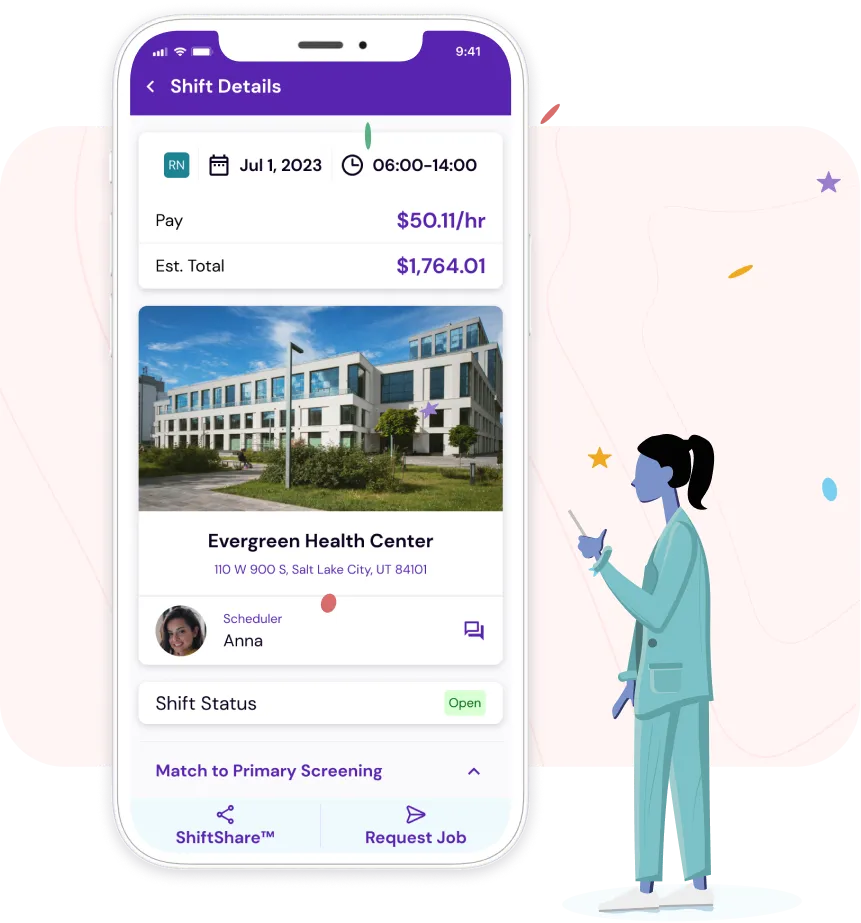
Nursa isn't just about finding a job; it's about crafting your ideal work schedule by selecting shifts. Once you create a Nursa profile, you will experience the convenience of scheduling shifts in real time.
Loading shifts…
Zip codes located within New Castle, DE:
Loading…
Completed! We will notify you when we have desired shifts for you.
Until then, you can continue with the app to signup or login.
Continue
Until then, you can continue with the app to signup or login.
Oops! Something went wrong while submitting the form.
See More Shifts and Apply Now
Explore and find where you would like to work
Search ShiftsPer Diem JobsSelect your license and location to find the best PRN jobs
Select your license and the location you want to work in, and we'll show you the best PRN jobs available nearby.
New Castle is one of America's oldest colonial towns, with cobblestone streets, historic homes, and riverfront parks. The New Castle Court House and Battery Park reflect its role as Delaware's original capital.

Per diem nursing shifts in New Castle, Delaware
New Castle sits on the Delaware River about ten minutes south of Wilmington, and it is one of the oldest towns in the country. The historic district still has cobblestone streets, colonial brick rowhouses, and a town green laid out in the 1650s.
It is also a short drive from one of the largest hospital campuses on the East Coast. That combination makes picking up per diem nursing shifts in New Castle, Delaware a practical setup for a lot of clinicians.
You get a quiet, walkable town to come home to and a serious healthcare market fifteen minutes away. This guide covers what PRN work actually looks like here, what Delaware requires of you, and what the area is like once you clock out.
What working PRN shifts is actually like
The short version: you decide when you work. Nobody builds a schedule for you and nobody keeps you past the end of a shift.
Nursa is a marketplace app where facilities post the shifts they need covered. You look at what is open, claim what fits your week, and show up. That is the whole arrangement.
The flexibility is the point. Some clinicians assemble a full week out of claimed shifts and treat it as their main work. Others pick up two or three a month around a part-time job, nursing school, or family.
You can also scale up and down as life changes. A nurse finishing a degree in the spring might claim almost nothing, then work heavily through the summer. Nobody has to approve that shift.
Variety keeps your skills sharp
Working the same unit for years quietly narrows what you can do. You get fast at that building's routine and slower at everything else.
PRN work pushes the opposite direction. One week you are on a skilled nursing floor, the next you are in assisted living or doing home health visits across New Castle County.
That rotation keeps your assessment skills current and gets you comfortable with different charting systems. It also lets you try a setting for a few shifts before deciding whether you want more of it.
Real control over your personal life
This is the part clinicians talk about most. If your kid has a recital on a Thursday, you do not claim a Thursday shift. There is no request form and no manager weighing whether coverage allows it.
Holidays work the same way. You can take Thanksgiving off entirely, or work it on purpose because the rates climb.
The trade is that you own your own consistency. No one is tracking whether you have enough hours booked, so you have to plan a little. Most people settle into a rhythm within a month or two.
What types of facilities post PRN shifts
New Castle County holds most of Delaware's population and most of its healthcare work. The settings run wider than people expect.
Facilities that post PRN shifts in this area typically include:
- Skilled nursing facilities caring for residents after surgery or a hospital stay.
- Long-term care buildings serving residents who need daily clinical oversight.
- Assisted living and memory care communities.
- Hospitals, from community campuses to large acute care centers.
- Hospice programs, both inpatient and in-home.
- Home health agencies covering patients across the county.
- Urgent care and outpatient clinics.
- Behavioral health and rehabilitation facilities.
Each setting asks something different from you. Skilled nursing runs on rhythm and efficiency, with heavier resident loads and a medication pass that has to stay on schedule.
Hospital work moves faster with lighter ratios and higher acuity. If your background is medical-surgical, telemetry, or emergency, those shifts keep you sharp and usually sit at the top of the local rate range.
Assisted living is calmer and more relationship-driven. Go back to the same community a few times and residents start knowing your name, which a lot of clinicians find is the best part of the work.
Home health puts you in a car instead of a hallway. You handle wound care, medication teaching, and skilled assessments between houses, working independently in a way that suits some people and not others.
What sets this platform apart from others
Plenty of apps promise shifts. A few things actually make a difference day to day.
Pay that shows up fast
Facilities set their own rates when they post, and those rates track how urgently they need someone. Because you are filling a gap rather than sitting in a budgeted position, PRN rates often beat what the same building pays staff for identical hours.
Nursa Direct lets you access your wages once a completed shift is verified instead of waiting out a normal pay cycle. When income arrives shift by shift, getting paid days earlier changes the whole month.
You can see what you are walking into
Rates are visible before you claim. No negotiation afterward and no surprise adjustment later.
Facilities carry ratings from clinicians who have actually worked there, and you can leave your own after a shift. That feedback loop tells you things a rate never will.
Real-time notifications push new postings to your phone as they go live, filtered to your preferences. The good last-minute shifts fill quickly, so seeing them first matters.
Support and a place to ask questions
Nursa Support handles the account and shift problems that come up, which keeps you from troubleshooting alone at 6 a.m. before a shift.
The Nursa Community forum is where clinicians compare notes. New PRN workers ask what a setting is really like, experienced ones answer, and the whole thing runs on people who have done the work.
Facilities also tend to view the platform favorably, which matters more than it sounds. When schedulers trust the source, they post more and they request people back.
How picking up PRN shifts works
Setup takes one sitting and you can do all of it from your phone.
- Sign up and add your personal information.
- Verify your nursing license so the app can confirm it is active and in good standing.
- Complete your clinician profile with your work history, specialties, and preferred settings.
- Upload your credentials, including certification cards, immunization records, and required screenings.
- Request a PRN shift that fits your schedule.
- Complete your background check, which the shift request kicks off.
Gather your documents before you start. You will want your license or certification number, your BLS card and any other certifications, tuberculosis screening results, immunization records, and a photo ID.
Photograph everything in advance. Nothing stalls the process like realizing your immunization records are in a folder at your parents' house.
Once you are cleared, claiming work is straightforward. The facility approves your request, the shift lands on your schedule, and you work it like any other day on the floor.
Build one habit right away. Put reminders on your calendar about two months ahead of every credential expiration, because a lapsed card blocks you from claiming anything until you renew it.
It also helps to figure out your target before you start. Decide how many hours you want and what you need to bring in weekly, then work backward. Clinicians who skip that step tend to grab everything in month one and burn out in month two.
Delaware licensing and recommended certifications
Good news for anyone moving here or living near a border: Delaware participates in the Nurse Licensure Compact.
That means a multistate license issued by another compact state lets you practice in Delaware without applying for a separate one. For a state this small, that is a meaningful advantage.
It matters locally too. Maryland and New Jersey are both compact states, and New Castle sits within a short drive of both. Pennsylvania's status has been in flux, so verify where it currently stands before counting on it.
If your home state is not in the compact, you will need a Delaware license through the Board of Nursing. Registered nurses and licensed practical nurses both go through that office, and nursing assistants are certified through the state as well.
Confirm current requirements directly with the Delaware Board of Nursing rather than relying on secondhand figures. Renewal cycles, continuing education rules, and nursing assistant training hour minimums all get updated periodically.
Certifications worth carrying
Your license lets you practice. Certifications decide which shifts you can actually claim.
- Basic Life Support (BLS) is required almost everywhere, across settings and roles. Most facilities want American Heart Association certification specifically, so check before paying for a course.
- Advanced Cardiovascular Life Support (ACLS) is expected for nurses in hospital, emergency, telemetry, and critical care work.
- Pediatric Advanced Life Support (PALS) applies if you work pediatric, emergency, or mixed-population units. Kids decompensate on a different curve than adults, and PALS trains you to catch it.
- Dementia and memory care training comes up often in assisted living and skilled nursing, and memory care units frequently require it.
- Crisis prevention and de-escalation training pays off in behavioral health and emergency settings.
The practical argument for holding more than your role strictly needs is access. Every certification widens the pool of shifts you qualify for, and a wider pool means fewer weeks with nothing workable on the board.
Local job trends in New Castle County
Healthcare is one of the largest sectors in Delaware, and most of it sits in New Castle County. The county holds the bulk of the state's population and nearly all of its major hospital capacity.
ChristianaCare runs the biggest operation, with its main campus in Newark about fifteen minutes from New Castle and a second hospital in Wilmington. The Newark campus is among the larger hospitals on the East Coast by bed count.
Wilmington adds more. A Catholic health system hospital, a children's hospital, and a veterans medical center all operate within a short drive, alongside behavioral health and rehabilitation facilities scattered through the county.
Skilled nursing and assisted living have grown steadily alongside that. Delaware has drawn retirees for years thanks to no sales tax and relatively low property taxes, and an aging population keeps demand for long-term care clinicians climbing.
What that means for PRN work
Density is the advantage. New Castle County is small geographically, so a clinician living in New Castle can reach most of the state's healthcare capacity in under half an hour.
That compresses your commute math in a way most markets do not. A shift in Newark, Wilmington, or Middletown is a reasonable drive, which means you are rarely stuck choosing between a bad shift and no shift.
Rates get a push from geography too. Delaware sits between the Philadelphia and Baltimore markets, and local facilities compete for clinicians who could drive across a state line instead. They price accordingly.
Seasonality follows the usual pattern. Respiratory season from December through February raises census and call-outs at the same time, which tightens coverage everywhere and pushes urgent postings up.
What to do on your days off
New Castle punches well above its size here, and most of it is walkable.
The historic district is the obvious start. The Green has been there since the 1650s, and the old courthouse served as Delaware's colonial capitol. Brick sidewalks, eighteenth-century houses, and almost no traffic.
Battery Park runs along the Delaware River at the edge of the district, with a walking path, open lawn, and views out toward New Jersey. It is the easy option after a night shift when you do not have much left in the tank.
Jessop's Tavern on Delaware Street leans hard into the colonial theme and does it well. There are a handful of other local spots within a few blocks, which is about the right scale for a quiet evening.
Separation Day each June marks Delaware's break from Britain and Pennsylvania, and the whole town turns out for it. It is the biggest thing on the local calendar.
Getting outside
Fort Delaware State Park sits on Pea Patch Island in the middle of the river, reachable by ferry from nearby Delaware City. The Civil War fort held Confederate prisoners and the island is a heron rookery, which makes for an odd and memorable afternoon.
Lums Pond State Park is about twenty minutes south, built around the largest freshwater pond in the state, with trails, paddling, and a ropes course. Brandywine Creek State Park north of Wilmington has rolling hills and old stone walls.
The Delaware Greenway trail system runs along Route 9 and the river corridor, which is good for cycling on a flat, quiet route.
Wilmington and beyond
Wilmington is ten minutes up the road. The Riverfront has a riverwalk, restaurants, minor league baseball at Frawley Stadium, and the Delaware Children's Museum.
The city also has the Delaware Art Museum, the Grand Opera House, and the Brandywine Valley museums just north, including Hagley, Winterthur, and Longwood Gardens across the Pennsylvania line.
Christiana Mall pulls shoppers from three states because Delaware has no sales tax, which is a genuine perk when you need new shoes and scrubs on the same trip.
Philadelphia is about forty minutes by car, and regional rail from Wilmington gets you there without driving. Baltimore is roughly an hour. The Delaware beaches at Lewes and Rehoboth run about an hour and a half south, which makes a long weekend easy.
A note on the commute
Most clinicians here drive. Interstate 95 and Route 13 handle the north-south traffic, and Route 141 connects west toward Newark.
Traffic backs up around Wilmington at rush hour and on the approach to the Delaware Memorial Bridge, so shifts starting at 7 a.m. or ending at 7 p.m. put you in the thick of it. Night shifts avoid both entirely.
DART First State runs bus service through New Castle County, and regional rail connects Wilmington to Philadelphia. Route timing does not always line up with shift changes, but it is a real option for some commutes.
Share this page:


No items found.
Featured Facilities in this City
Searching for other types of per diem nursing jobs? Find nurse and nursing assistant jobs in similar types of healthcare facilities here.
Facility Types
See All


Pick Up a Job Today
Find per diem PRN job opportunities in your area. High paying CNA, LPN and RN and many more licences are available now.
Join Nursa
Post Your Jobs Today
Facilities who use Nursa fill 3 times as many open per diem shifts, on average, compared to trying to fill the shifts themselves.
Post Jobs