

Parkville is a small city in Platte County, located along the Missouri River about 10 miles northwest of downtown Kansas City. Residents are close to hospitals in the Northland, including Saint Luke's North Hospital, and the major health systems of Kansas City.
Parkville
Missouri
Jump to section on this page

Anchor Link
Go Beyond a Single Job
Choose Multiple Per Diem Shifts on Your Schedule
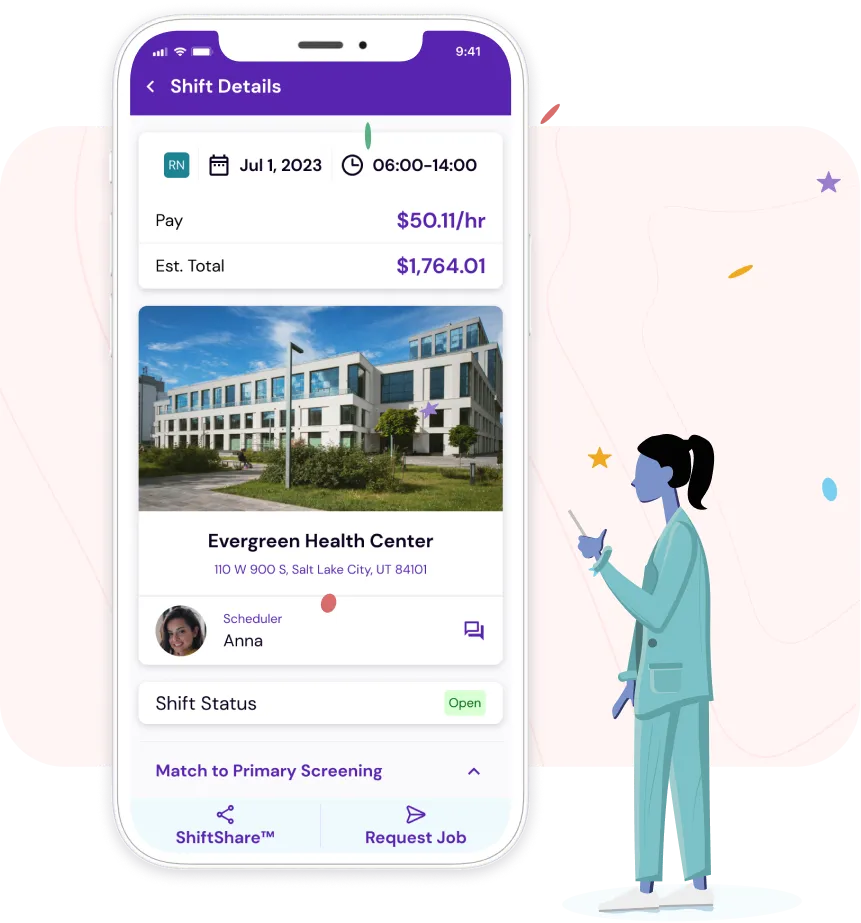
Nursa isn't just about finding a job; it's about crafting your ideal work schedule by selecting shifts. Once you create a Nursa profile, you will experience the convenience of scheduling shifts in real time.
Loading shifts…
Zip codes located within Parkville, MO:
Loading…
Completed! We will notify you when we have desired shifts for you.
Until then, you can continue with the app to signup or login.
Continue
Until then, you can continue with the app to signup or login.
Oops! Something went wrong while submitting the form.
See More Shifts and Apply Now
Explore and find where you would like to work
Search ShiftsPer Diem JobsSelect your license and location to find the best PRN jobs
Select your license and the location you want to work in, and we'll show you the best PRN jobs available nearby.
Parkville offers a charming historic downtown with shops, restaurants, and riverfront parks. It is home to Park University, known for its scenic hilltop campus.

Per diem nursing shifts in Parkville, Missouri
Picking up per diem nursing shifts in Parkville, Missouri is a smart move for any nurse who wants more say over their week. Parkville sits along the Missouri River just northwest of Kansas City, close enough to major hospital systems that shifts are rarely hard to find, but small enough that the pace still feels manageable.
This guide walks through what PRN work actually looks like day to day, which facilities post shifts nearby, and what to know about getting licensed in Missouri. It also covers what makes Parkville a solid home base for a nurse, nursing assistant, clinician, or any other healthcare professional who wants flexible shifts without giving up a normal life outside of work.
Parkville is a small river town built around Park University and a walkable downtown, with easy access to the wider Kansas City metro area just a short drive away. That mix of small-town feel and big-city access makes it an easy place to settle into between shifts.
Nursa is the app behind most of what's covered here, so it's worth naming upfront: it's a staffing marketplace that connects clinicians directly with facilities that need coverage, without the usual back-and-forth of a traditional staffing agency.
What is it like to work PRN in Parkville?
Working PRN means picking up shifts one at a time instead of locking into a fixed schedule. A nurse decides which days work, which facility to try, and how many hours to take on that week.
That kind of control changes how work fits into life. A parent can build shifts around school pickup. A student at Park University can pick up hours between classes. Someone easing back in after time off can start slow and add more as they're ready.
Variety is part of the draw too. One week might mean a shift at a hospital on Kansas City's north side, the next a stretch at a long-term care facility a little further out. Every setting runs a little differently, and that variety keeps the work from feeling stale.
Nurses who try PRN shifts often say the biggest shift isn't the paperwork or the new units. It's the mental one. Instead of asking for time off, they simply choose not to pick up a shift that week. No approval needed, no schedule fights with coworkers.
That shift in mindset takes some adjusting to. A clinician coming from a traditional staff role is used to a set calendar handed down from a manager. PRN work flips that. The nurse becomes the one setting the calendar, which feels freeing at first and takes a little getting used to after that.
Balance looks different for everyone. Some clinicians work four days a week and take three off. Others stack shifts for a few weeks, then take a longer break. PRN work through an app bends around whichever pattern actually fits a person's life, rather than forcing them into someone else's shift rotation.
Location plays into that flexibility too. Parkville's spot just outside Kansas City means a clinician can take a shift close to home one day and drive a little further into the metro area the next, without either option feeling out of reach. That kind of range matters when someone's trying to fit shifts around a second job, school, or just wanting an actual evening free.
There's also a mental shift that comes with getting comfortable in new places quickly. A nurse who works PRN for a few months usually gets faster at reading a new unit, finding the supply room, and figuring out the pecking order on a floor. That skill carries over everywhere, and it tends to make every future shift a little smoother than the last.
Being close to a bigger metro area gives clinicians here an added edge too. A nurse who wants to try a large teaching hospital one month and a quieter suburban facility the next can do both without needing to relocate or plan around a long commute.
Personal life fits into the picture more easily too. A nurse training for a race, finishing a degree, or raising young kids can build a week around what actually matters that month, rather than fitting life into whatever schedule a facility hands down. That kind of control is hard to overstate once someone's actually lived with it for a while.
Which healthcare facilities use the app?
One reason PRN shifts stay interesting is the range of places willing to post them. Around Parkville and the wider Kansas City metro area, facilities across nearly every care setting rely on per diem staff to fill gaps.
Common facility types include:
- Long-term care communities that need steady coverage for residents with ongoing care needs.
- Skilled nursing facilities looking for licensed staff to handle rehab and recovery care.
- Hospitals that need extra hands during busy stretches or when full-time staff call out.
- Hospice providers that need compassionate, steady care for patients and families.
- Home health agencies that send clinicians directly into a patient's home.
- Urgent care clinics that need coverage during peak hours or weekend rushes.
- Assisted living communities that need support with daily care routines.
Each type comes with its own rhythm. A hospital shift might move fast and require quick decisions, while an assisted living shift often runs at a calmer, more conversational pace built around residents' daily routines rather than acute emergencies.
This range matters for a simple reason: it means a nurse isn't boxed into one type of setting. A clinician who wants hospital experience can pick that up, then try a slower-paced long-term care shift the following week.
Home health shifts deserve a special mention here. They look different from anything facility-based, since a clinician is working one-on-one in someone's actual home rather than moving between rooms on a unit. Some nurses prefer that quieter pace, while others find they miss the energy of a busier floor. Trying both is the easiest way to figure out which fits better.
Around Parkville specifically, that mix shows up in real ways. The Kansas City metro's density of hospitals and care communities means a clinician isn't relying on just one or two buildings for shifts. A slow week at one facility rarely means a slow week overall, since there's almost always another type of setting posting something new nearby.
The area's mix of small-town neighborhoods and nearby suburban growth also means outpatient clinics and occupational health settings post their share of shifts too, giving clinicians another option beyond the usual hospital and long-term care rotation.
Urgent care shifts deserve a mention too, since they run differently from a hospital emergency department. The pace is usually faster and more predictable, with a steady stream of walk-in patients rather than the unpredictable surges of a trauma floor. For a clinician who likes quick assessments and a defined shift length, these shifts can be a nice change of pace.
What makes this PRN platform stand out?
Not every way to pick up per diem shifts works the same way, and a few things set this app apart from the usual staffing routine.
Pay speed is one of the biggest. Instead of waiting through a standard pay cycle, clinicians can access wages fast after a completed shift. That matters when bills don't wait for a two-week cycle to catch up.
Pay rates tend to run higher than what a comparable full-time role would offer, since facilities are covering an immediate gap rather than a long-term contract. Nurses can see the rate before they claim a shift, so there's no guessing involved.
Transparency runs through the whole process. Shift details, facility ratings, and pay rates are all visible upfront. Clinicians can also rate their own experience at a facility after a shift, which helps other nurses know what to expect before they sign up.
There's also a clinician community built into the app, where nurses can trade notes, ask questions, and get support from people who've worked the same kinds of shifts. Combined with a dedicated support team for troubleshooting issues, it feels less like a cold booking app and more like a network built around actual nurses.
That community piece turns out to matter more than it sounds. A nurse new to per diem work can ask the community what a specific facility is really like before ever claiming a shift there. Small details, like which unit runs short-staffed on weekends or which facility has the smoothest check-in process, get shared freely instead of staying locked inside one hospital's break room.
Facilities tend to trust the platform too. A strong track record with local hospitals and care communities means shifts get filled fast, and clinicians walk into facilities that already know what to expect from per diem staff. Real-time shift notifications round things out, alerting a nurse the moment something opens up nearby so good shifts don't slip by.
None of this works without both sides trusting the process. Facilities want reliable clinicians who show up ready to work, and clinicians want facilities that treat per diem staff fairly instead of as an afterthought. Building that reputation takes time, and it shows up in how quickly shifts get claimed and how often nurses come back to the same facility on purpose.
Cancellation policies and shift details are laid out clearly too, so there's no confusion about what happens if plans change on either side. A clinician can see exactly what a shift pays, what the unit expects, and what happens if they need to cancel, all before ever committing to it.
How does the app work?
Getting started takes less time than most people expect. Here's the basic flow:
The whole thing is designed to feel less like paperwork and more like getting set up once, then moving on to actually picking shifts. Most of it can be done from a phone in one sitting.
- Sign up and create a basic profile with your contact information.
- Verify your active nursing license so the app can confirm you're cleared to work in Missouri.
- Complete a full clinician profile, including your work history and areas of experience.
- Upload your credentials, such as BLS certification and any other required documents.
- Request a PRN shift, which kicks off a background check before that first shift can be worked.
Each step exists for a real reason. License verification confirms a clinician can legally practice. The credential upload gives facilities confidence before a nurse even walks in the door. The background check gives facilities the same peace of mind they'd expect from any new team member, even for a single shift.
None of these steps take long individually, but together they build the kind of trust a facility needs before letting someone new handle patient care. Skipping ahead isn't an option, and that's actually a good thing. It's what keeps the whole system reliable for both sides.
Once that's done, shifts near Parkville show up right in the app, ready to claim. Most clinicians say the whole setup, start to finish, takes far less time than a typical job application would.
There's also room to keep the profile updated as things change. Adding a new certification, updating availability, or switching preferred facility types all happen in the same app, so a nurse never has to start from scratch just because their goals shifted.
Missouri licensing rules for nurses
Every nurse working in Parkville needs an active license through the Missouri State Board of Nursing.
Registered nurses complete an accredited nursing program, either an associate degree or a bachelor's degree, then pass the NCLEX-RN exam before applying to the state board. Licensed practical nurses follow a similar path through a shorter, state-approved practical nursing program, then sit for the NCLEX-PN.
Both paths lead to the same state board for final approval, and both require the license to stay current through periodic renewal. It's a straightforward system once someone's been through it once, but it's worth reading the fine print the first time rather than assuming every state handles licensing the same way.
Missouri is a member of the Nurse Licensure Compact, which allows RNs and LPNs with a compact license from another member state to practice in Missouri without applying for a separate state license. This matters for per diem nurses who may relocate to the Parkville area or split time between states, since it removes a layer of paperwork that would otherwise slow down their ability to pick up shifts.
Kansas, right across the state line, is also a compact member, which makes it easier for clinicians in this area to consider shifts on both sides of the metro without extra licensing steps.
Renewal cycles matter too. Missouri requires continuing education to keep an RN or LPN license active, and letting that lapse means shifts stop until the license gets reinstated. Setting a reminder well ahead of a renewal date is a small habit that saves a lot of hassle later.
Nursing assistants follow a different track. In Missouri, a certified nurse assistant completes a state-approved training program, then passes a competency exam before their name lands on the state's nurse aide registry. That registry status needs to stay active through regular work hours, which per diem shifts count toward.
It's worth checking a facility's specific paperwork requirements too, separate from the state license itself. Some skilled nursing facilities and hospitals ask for a recent physical exam or proof of certain immunizations before a clinician's first shift. Getting that sorted ahead of time means one less delay once a shift gets claimed.
Certifications that help with PRN shifts
Beyond the core license, a few certifications make a real difference in how many shifts a nurse can pick up.
Basic Life Support (BLS) certification is close to universal. It confirms a clinician can handle CPR and basic emergency response, and most facilities won't schedule a shift without it on file.
Pediatric Advanced Life Support (PALS) matters for anyone hoping to work shifts involving kids, whether that's an emergency department or a pediatric unit. Facilities with pediatric patients often list it as a requirement rather than a nice-to-have.
Wound care and IV therapy certifications are worth considering too, especially for clinicians aiming at skilled nursing or long-term care shifts, where those skills come up often and can set a candidate apart when a facility is comparing a few clinicians for the same open shift.
Advanced Cardiovascular Life Support (ACLS) opens doors too, particularly for shifts in intensive care, telemetry, or emergency settings. It signals a nurse can handle advanced cardiac emergencies without hesitation.
A Trauma Nursing Core Course (TNCC) certification is worth a look for anyone eyeing emergency department shifts specifically. It's not always required, but it tends to stand out when a facility is choosing between a few similarly qualified clinicians for the same open shift.
These certifications typically need renewal every two years. Staying ahead of that deadline keeps a nurse eligible for the widest possible range of shifts, rather than getting stuck sitting out a good opportunity because a card expired.
Picking certifications based on the kind of shifts a nurse actually wants pays off. Someone chasing hospital or urgent care shifts should prioritize ACLS and PALS early. Someone focused on long-term care might get more value out of a dementia care certification instead.
Cost and timing matter here too. Most of these courses run a few hours to a full day, and hospitals across the Kansas City metro regularly offer them. Spacing renewals out across the year, instead of letting them all expire at once, keeps a clinician from scrambling to reschedule shifts around a missing card.
Local trends in nursing shifts
The Kansas City metro area carries a strong concentration of hospitals and care facilities, and that shapes what per diem work looks like around Parkville. Saint Luke's North Hospital sits just a short drive away, and larger systems throughout the north Kansas City area extend that range even further.
That density means steady demand for per diem coverage. Facilities in this part of Missouri deal with the same staffing pressure most of the country sees right now, and per diem shifts are one of the more practical ways they fill gaps without adding long-term contracts.
An aging population across Platte County and the wider metro also keeps demand strong in long-term care and home health settings specifically. Nurses and nursing assistants comfortable with that kind of work tend to find no shortage of shifts nearby.
Parkville's own growth adds another layer. New housing along the river and near Park University means local clinics and urgent care centers keep opening, which spreads demand for per diem coverage across more locations rather than concentrating it in just one or two large hospitals.
Parkville itself is small and walkable, centered on its historic Main Street and the Missouri River. That's part of why nurses use it as a base rather than a destination on its own. Housing costs run lower than in much of the Kansas City area closer to downtown, which stretches per diem wages further, especially for someone still building up steady shifts.
Commutes stay manageable too. Most of the facilities mentioned above sit within twenty to thirty minutes of Parkville, and highways like Interstate 29 and Highway 45 make getting into the rest of the metro straightforward, even during a busy shift week.
Kansas City International Airport also sits close by, which matters for clinicians who travel for continuing education, family visits, or a change of scenery between stretches of shifts.
The overall picture for a clinician weighing Parkville against other towns nearby comes down to trade-offs most people can live with. It's quieter than a spot right in downtown Kansas City, but never so far out that a facility feels out of reach. That balance is exactly what makes it work for people picking up shifts on their own schedule.
Ways to unwind after a shift in Parkville
PRN work gives clinicians more say over their days off, and Parkville has enough nearby to make good use of that time. English Landing Park, right along the river downtown, offers walking trails, a splash pad, and a weekly farmers market during the warmer months, all within easy reach of the historic Main Street shops.
The Parkville Nature Sanctuary adds a quieter option for a short hike, with wooded trails that make for an easy reset after a long shift. Park University's campus sits just up the hill, hosting occasional events and lectures open to the community.
For something a bit further out, the small town of Weston offers wineries, a historic distillery, and antique shops for a slower day trip, all about twenty minutes north of Parkville. Platte Landing Park, just across the river, adds more trails and river views for anyone who wants to keep exploring the outdoors.
Kansas City itself is only about twenty minutes away, with the Country Club Plaza, the National WWI Museum, and the Nelson-Atkins Museum of Art all offering a bigger city day when someone wants a change of pace. Zona Rosa, a large outdoor shopping and dining center, sits closer still on the north side of the metro.
For a quieter reset, plenty of nurses in the area just take a slow morning at a local coffee shop before running errands. After a demanding shift, sometimes the best plan is no plan at all.
Line Creek Trail, a bit further into the northland, adds another paved option for a longer walk or bike ride on a day off, connecting a string of smaller parks for anyone who wants to cover more ground.
The seasons shape those choices too. Warm summers make the riverfront parks and trails easy to enjoy, while fall brings comfortable temperatures and color across the wooded hills near the Missouri River. Winters run cold, with occasional snow that pushes more clinicians toward indoor options like a museum trip or a quiet night in.
Whatever the pace someone's looking for, Parkville's location gives clinicians options. A short drive covers everything from a quiet riverfront walk to a full day in downtown Kansas City, which makes it easier to actually use time off instead of losing it to a long commute.
Share this page:


No items found.
Featured Facilities in this City
Searching for other types of per diem nursing jobs? Find nurse and nursing assistant jobs in similar types of healthcare facilities here.
Facility Types
See All


Pick Up a Job Today
Find per diem PRN job opportunities in your area. High paying CNA, LPN and RN and many more licences are available now.
Join Nursa
Post Your Jobs Today
Facilities who use Nursa fill 3 times as many open per diem shifts, on average, compared to trying to fill the shifts themselves.
Post Jobs