.jpg)
In a healthcare environment shaped by increasingly divergent views and contradictory information, ethical dilemmas in nursing are becoming a complex daily reality.
A study titled “Nurse moral distress: A survey identifying predictors and consequences”, published by the International Journal of Nursing Studies, revealed that more than half of the nurses surveyed experienced “ethical dilemmas several times a month to daily,” highlighting that these challenges are a common occurrence.
What are ethical dilemmas in nursing?
Ethical dilemmas in nursing arise when a nurse is faced with a decision that challenges either their personal or professional values or conflicts with those of the patient, their loved ones, or the institution.
In many cases, there is no “right” or “wrong” decision.
To help navigate today’s nurse ethical decision-making, the ANA establishes a Code of Ethics for nursing, serving as a standard and framework for ethical conduct. Relying on these guidelines, along with a supportive work environment and strong nurse leadership, enables nurses to resolve complex situations with compassion and ethical integrity.
Whether you are an RN, an LPN, a nursing student, or a manager, you will no doubt encounter (if you have not already) situations that put your judgment and values to the test. Being fully informed and having the right tools, resources, and frameworks readily available enables you to make the best choices for your patients with confidence, while ensuring the most ethical conduct possible.
Below are some practical guidelines and evidence-based information to help you address these situations in a compassionate and professional manner.
Understanding ethical dilemmas in nursing
Ethics in nursing are based on a set of principles that include, among others, autonomy, beneficence, nonmaleficence, and justice. However, the choice between what is “correct” when these principles come into contradiction is not always straightforward.
This is what creates an ethical dilemma.
Many ethical dilemmas can occur in nursing. These can arise from conflicting ideas regarding the patient, the patient's family, other colleagues, healthcare institutions, or even technology and health records.
For example, nurses may face end-of-life care dilemmas where the patient’s wishes directly conflict with those of family and loved ones or find themselves enforcing a medical decision that leads to cultural and religious conflicts.
Key nursing ethical principles
Here are some key ethical nursing principles and common ethical nursing dilemmas associated with them:
Why do ethical dilemmas occur in nursing?
Ethical dilemmas can occur in nursing for a variety of different reasons:
- Patient refuses treatment despite medical advice, exercising autonomy
- Conflicting ideas and interests among loved ones
- Limited resources and understaffing in care situations
- Life and death decisions and their associated emotional burdens
- Cultural or religious beliefs that directly affect medical decisions
- Unclear, incomplete clinical information regarding a patient or treatment
- Unsafe practices or potential malpractice by a colleague
Nurses can resolve these ethical dilemmas by following the guidelines stipulated in the ANA Code of Ethics and other relevant policies, seeking guidance and advice from colleagues and superiors, and utilizing committees and hospital policies for support.
Real-life examples of ethical dilemmas in nursing
Nurses will face various types of decisions that challenge their ethical principles.
Some of the more common examples of ethical dilemmas that arise are as follows.
1. Clinical autonomy vs. beneficence
How do nurses balance personal beliefs and patient needs?
Sometimes a patient refuses to take the treatment that the medical team has prescribed for them. Even though beneficence, the act of doing what is best for the patient, calls for treatment, the patient may still exercise their right to autonomy and refuse it.
Nurses must ensure that patients are informed of the pros and cons of a given treatment plan, but ultimately must respect patients’ wishes.
2. Confidentiality vs. reporting
This arises when confidentiality in nursing comes into direct conflict with the ethical need to report a concerning situation. Instances such as abuse, unsafe practices, or a public health threat may outweigh patient confidentiality.
3. End-of-life care dilemmas
Dilemmas concerning end-of-life care are common, as Do not resuscitate DNR orders, advance directives, or palliative care may conflict with the patient's or family’s wishes.
4. Limited resources & staffing
Healthcare resource allocation often puts nurses in difficult ethical positions, such as rationing care during shortages or triaging patients. These decisions may directly challenge the principles of justice and equity in patient care.
5. Nurse-patient conflicts over care goals or cultural beliefs
Cultural and religious beliefs can directly conflict with patient well-being, affecting nurse-patient relationships.
6. Reporting medical errors or unprofessional conduct
If a nurse witnesses malpractice or unprofessional conduct by a colleague or superior, they may face the difficult decision of whether to report it. Whistleblowing in healthcare is legally protected; however, it can still lead to tension and uncomfortable dynamics within the work setting.
7. Technology, privacy, and digital health records
The growing use of technology and digital tools in healthcare is giving rise to a new set of ethical dilemmas. Nurses must learn how to handle confidentiality and conflicts related to patient privacy, data security, informed consent in nursing, and algorithm bias.
Moral distress and professional impact
Is burnout caused by ethical stress in nursing?
Nurses often experience moral distress in their work settings. Moral distress in nursing occurs when nurses are compelled to take action or make decisions that conflict with their moral values or what they intrinsically believe to be right. Or they might be unable to follow the correct course of action due to factors such as limited resources, regulations, or conflicting situations.
Ethical dilemmas can have a direct impact on nurses' well-being, leading to moral distress. This, in turn, can lead to emotional fatigue and burnout.
A study titled “The relationship between moral distress, burnout, and considering leaving a hospital job during the COVID-19 pandemic: a longitudinal survey” found that nursing was the medical profession with the highest level of moral distress, and that this was directly correlated with burnout.
Moral distress and ethical stress also have an impact on facilities, affecting job satisfaction, turnover, and retention rates.
Situations that cause distress in nursing
Based on various academic studies, the following chart illustrates the most distressing situations that nurses have reported experiencing. This ranking is based on the Moral Distress Scale (MDS).
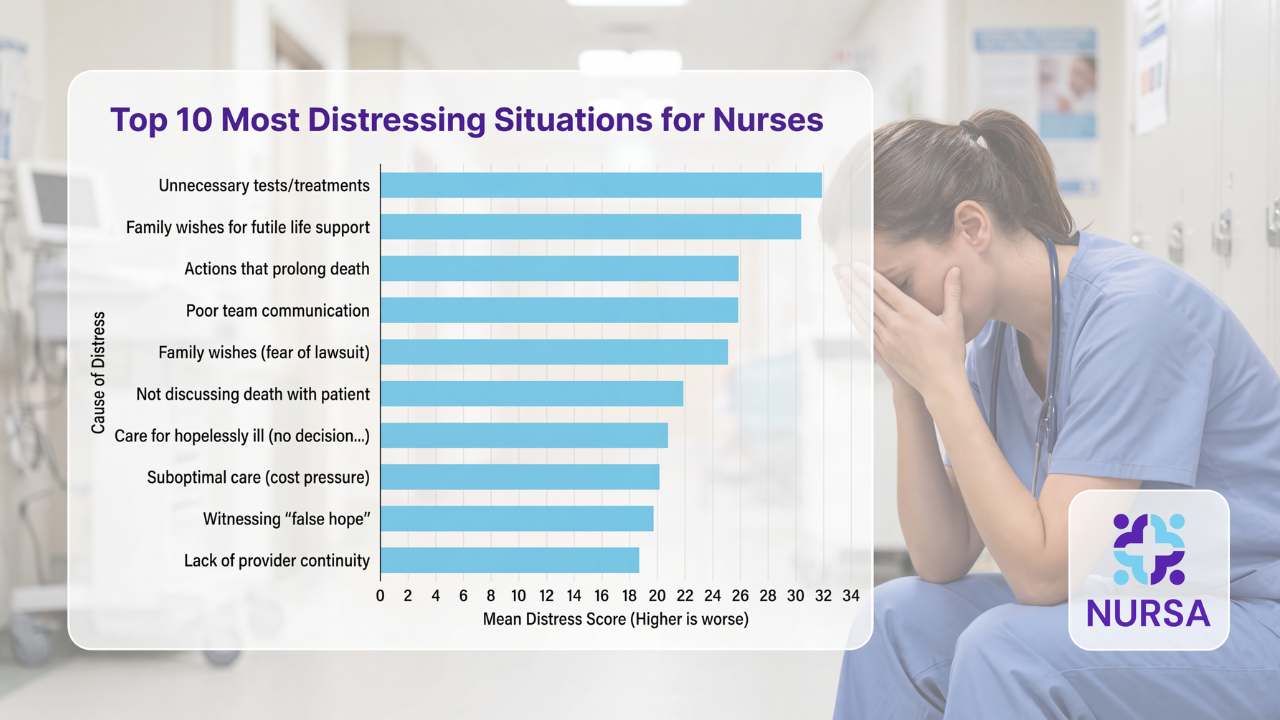
What frameworks help nurses make ethical decisions?
Because ethics ultimately come down to personal values, it is essential to have authoritative guidelines and structured solutions in place to guide decision-making. These guidelines can help medical professionals navigate complex situations and make informed decisions.
ANA Code of Ethics
The ANA Code of Ethics comprises 10 provisions that serve as a reference point and structured framework to support nurses in decision-making. These guidelines outline the duties and responsibilities of nurses as well as the professional values of their trade.
How does the code of ethics guide nurses?
The code of ethics can help guide nurses by providing a recognized professional framework that helps:
- Clarify professional obligations
- Maintain professional integrity
- Navigate conflicts with patients
- Advocate for patients rights
Implementing a stepwise approach
Clear, straightforward steps to follow in uncomfortable situations can alleviate the burden on your conscience and keep you focused on finding solutions.
A stepwise approach to resolving ethical dilemmas in nursing can be structured in the following easily manageable steps:
- Ask: Identify whether you are dealing with an ethical dilemma and where conflicts lie.
- Assess: Gather all factual information regarding the situation and analyze your options.
- Act: Take action based on the most ethical option available.
- Evaluate: Reflect on the outcome and whether the problem was resolved.
Peer support and training
Colleagues and peers can be a valuable source of support in navigating ethical dilemmas. Collaboration can be done on an informal basis, providing experience and emotional support, or more formally through ethics committees, where a multi-disciplinary team can issue more structured guidance.
Training and continuing education are also critical. This enables nurses to stay current with the latest trends, guidelines, and best practices in ethical nursing dilemmas, helping them to build resilience and handle situations confidently while better preparing themselves for future events.
Coping strategies for nurses facing ethical issues
Facing ethical issues can be emotionally draining and unsettling. Although there is no magic formula for coping with these stressful situations, there are several strategies that can help mitigate difficulties:
- Debriefing: Immediate debriefing allows for reflection and learning for future events.
- Reaching out to colleagues: Sharing with colleagues provides different perspectives and allows for emotional and professional support.
- Personal journaling: Self-reflection and journaling provide a personal outlet and a tool for personal growth.
- Psychological support: In more distressing cases, professional mental health support can help manage stress and overwhelming emotions.
- Support groups: Sharing with peer groups outside the workspace can provide validation and long-term support.
Organizational, leadership, and policy support
Dealing with an ethical dilemma should not be done alone; effective nurse advocacy requires a supportive environment.
Working in a supportive environment with open communication is crucial for mitigating the moral distress that results from making difficult ethical decisions. Without a healthy team culture, strong nursing leadership, and supportive organizational structures and policies, nurses are more likely to feel isolated, which can lead to an increased incidence of burnout.
- Team culture: Being able to openly communicate with colleagues and superiors for emotional and professional support
- Strong leadership: Having supportive and well-informed guidance and mentorship, as well as a role model in complex situations
- Organizational structures and policies: Providing straightforward reporting procedures, access to ethics committees, and training and continuing education around ethical matters
Current healthcare trends and the reality of nurse burnout
Trends in healthcare today are shaped by new 21st-century challenges, including technology, equity, social justice, and healthcare resource shortages.
As the general public continues to consider nursing as one of the most trusted professions of our day, nurses are reporting increasing distress and burnout. This distress is directly linked to staffing shortages and organizational barriers in nursing.
Resources on ethical dilemmas in nursing
- American Nurses Association (ANA): The most authoritative source of nursing ethics in the U.S., including The Code of Ethics for nursing, along with additional resources, helping guide and support nurses on a daily basis
- The Markkula Center for Applied Ethics: Provides a clear, step-by-step “Framework for ethical decision making”
- American Association of Critical-Care Nurses (AACN): Leading voice on moral distress, providing a framework, tools, and resources to help nurses build resilience and a healthier professional outlook
- National Nurses United (NNU): Top resource for systemic action when dilemmas and distress are caused by policies
- International Council of Nurses (ICN): Offers a global perspective and publishes its own Code of Ethics, handling ethical dilemmas effectively and with compassion
Protecting your practice: Preventing burnout and moral injury
As a caregiver, you will have to make challenging decisions regarding ethics. Having the necessary awareness, ongoing training, and support, as well as following structured guidelines, will help you make choices that align with your values and respect your professional integrity, while also protecting yourself from moral distress and burnout.
Have you encountered a challenging ethical dilemma in your professional life? You may be experiencing moral injury.
Read about moral injury to learn how to identify and cope with this in your work setting.
Sources:
- Nurse Moral Distress: A Survey Identifying Predictors and Potential Interventions
- What is the Code of Ethics for Nurses?
- Addressing 21st Century Nursing Ethics: Implications for Critical Care Nurses - PMC
- Americans' Ratings of U.S. Professions Stay Historically Low
- The Relationship Between Moral Distress, Burnout, and Considering Leaving a Hospital Job During the COVID-19 Pandemic: A Longitudinal Survey
- Nurses Ranked Most Trusted Profession for the 21st Year Amid the Nursing Shortage