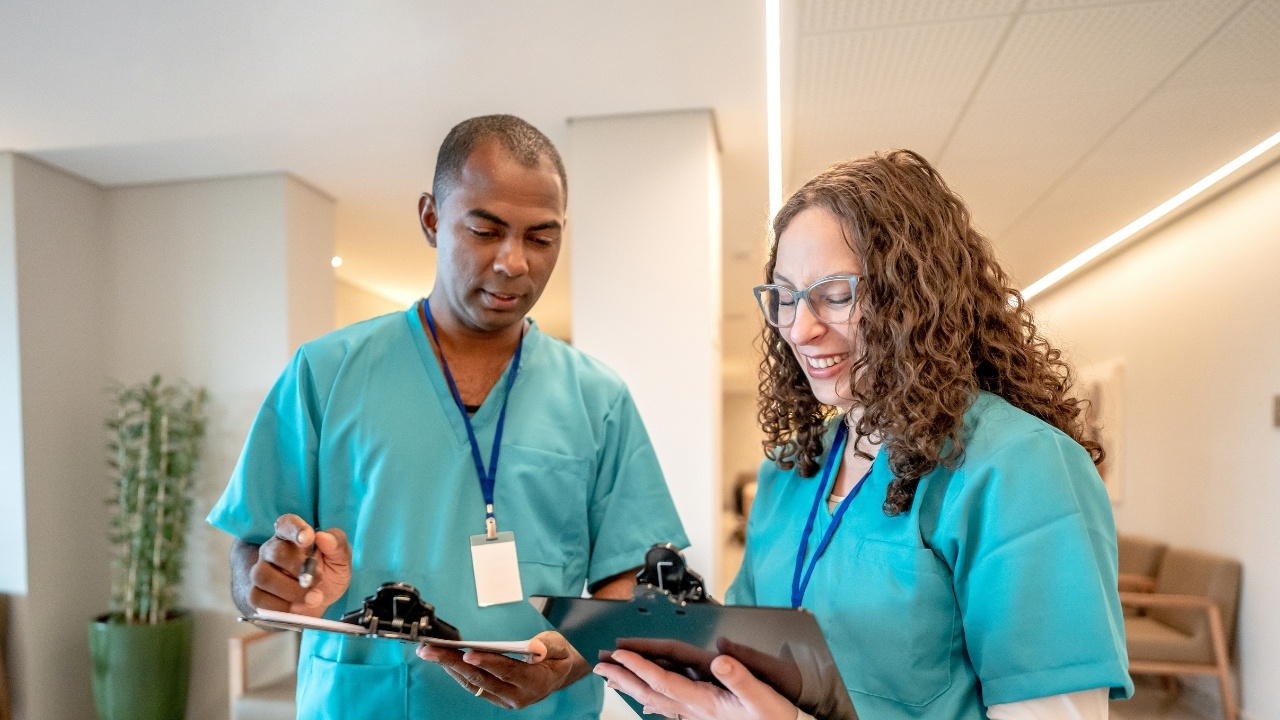
Urgent care nursing is a high-growth specialty focused on treating non-life-threatening acute conditions within a 24-hour window.
Driven by the expansion of “retail health” and AI-assisted triage, urgent care nurses in the U.S. are earning an average of $93,070 (registered nurses) to $160,562 (nurse practitioners).
The role is a premier alternative to high-stress ER environments, offering better work-life balance and a diverse patient mix. In addition, these healthcare settings are usually less expensive for patients and relieve overburdened emergency rooms.
Whether you are a newly graduated nurse or an experienced nurse ready for a career change, read on to learn everything there is to know about urgent care nursing to help you decide whether this specialty is right for you.
What does urgent care mean in medical terms?
Urgent care is medical treatment required urgently—within 24 hours—but not meant to treat life-threatening conditions.
Facilities that provide urgent care have moved beyond simple “walk-in clinics” to become a primary entry point for U.S. healthcare.
American spending on urgent care medical services has increased significantly (50% increase over 5 years), mainly due to increased use. According to an article in the Managed Healthcare Executive:
“Urgent care visits increased to 34.5% over five years, increasing from 90 visits per 1,000 people in 2018 to 156 visits per 1,000 people in 2022. In comparison, primary care visits grew by less than 5% and emergency room visits declined slightly.”
“Minute clinics” and “quick care" centers are now often integrated with AI-driven diagnostic tools, allowing nurses to spend more time on patient education and less on manual data entry. Thus, urgent care centers are alternatives to both primary care physicians' offices, which are not open around the clock and require previous appointments, and emergency rooms, which are not meant to treat non-emergency conditions.
Urgent care is also a good option for people with illnesses or injuries without other symptoms or for people without other underlying health conditions.
The following are examples of conditions that could be treated in an urgent care center:
- Fever or flu
- Sore throat or cough
- Breathing difficulties, such as mild to moderate asthma
- Diarrhea, vomiting, or dehydration
- Urinary tract infections
- Accidents and falls
- Cuts that might need stitches
- Minor broken bones and fractures in fingers or toes
- Sprains and strains
- Diagnostic services, such as X-rays and laboratory tests
- Skin rashes and infections
- Eye irritation and redness
- Moderate back problems
What does UC stand for?
The abbreviation UC stands for urgent care. Similarly, UCC stands for urgent care center.
Urgent care centers or clinics are usually staffed with physician assistants, nurse practitioners (NPs), and other nurses. These clinics generally have set hours and established lists of conditions that they treat.
Consequently, urgent care clinics are often less expensive than emergency rooms and have shorter wait times.
What is an urgent care unit in a hospital?
Traditionally, hospitals focused on ERs, but many hospital campuses now host “fast track” or “integrated UC” wings to manage non-emergent flow.
These centers may also be referred to as:
- Minute clinics
- Quick care clinics
- After-hours walk-in clinics
- Minor care clinics
- Minor emergency centers
Although some of these centers may use the word “emergency” in their names, these centers should not be confused with emergency rooms.
One significant difference between emergency rooms and urgent care centers is that UCCs are not mandated by law to see, treat, or stabilize patients independently of the patient’s ability to pay.
This means that legally, UCCs can turn away patients.
What is the role of an urgent care registered nurse?
An urgent care registered nurse (RN) collaborates with other healthcare team members to provide therapeutic patient- and family-centered, ethical, culturally sensitive, and evidence-based care.
A UC registered nurse collects and assesses patient data to develop, execute, and evaluate care plans in coordination with patients, family members, and other healthcare team members. They are guided by factors related to effectiveness, safety, and fiscal accountability when planning and delivering care. They also might delegate and supervise care.
What does an urgent care registered nurse do?
As part of the general role of providing care in collaboration with other healthcare team members, urgent care registered nurses have many specific responsibilities.
You aren't just treating patients; you are managing a high-tech workflow. Core responsibilities include:
- Advanced triage: Using AI-powered predictive tools to flag high-risk patients (e.g., potential sepsis or stroke) for immediate ER transfer
- Diagnostic mastery: Initiating and monitoring IV infusions, performing rapid lab tests, and assisting in minor procedures (stitches, splinting)
- Care coordination: Collaborating via telehealth with specialists to ensure a “continuum of care” after the patient leaves the clinic
How to become an urgent care nurse?

Nurses with varying levels of education and work experience can find employment in urgent care settings. Licensed practical nurses (LPNs) who have completed 1-year nursing programs can work in urgent care.
Registered nurses who have completed either a 2-year Associate Degree in Nursing (ADN) or a 4-year Bachelor of Science in Nursing (BSN) can find employment in urgent care.
Finally, nurse practitioners (NPs), registered nurses who have pursued higher education and advanced certifications, can also work in urgent care. Becoming a nurse practitioner requires either a master’s or a doctorate in nursing, as well as national certification, which together require an additional 3-6 years.
It must be noted that each urgent care center may have different requirements or preferences. For example, many UCCs prefer hiring RNs with BSNs rather than ADNs, and many require at least 6 months of prior nursing experience.
Another common job requirement is the Basic Life Support (BLS) certification. Furthermore, pursuing more advanced nursing certifications gives nurses a competitive edge when applying to urgent care nursing positions.
What about an urgent care nurse certification?
Although there isn’t a specific certification for urgent care nurses, many certifications are relevant to this specialty.
For example, registered nurses could pursue the Ambulatory Care Nursing Certification (AMB-BC™) offered by the American Nurses Credentialing Center (ANCC).
Additionally, urgent care nurses could pursue certifications in family practice and emergency care, as urgent care overlaps significantly with these specialties in treating male and female patients of any age.
The Board of Certification for Emergency Nursing (BCEN) offers many certification options for registered nurses, including the following:
- Certified Emergency Nurse (CEN)
- Certified Pediatric Emergency Nurse (CPEN)
- Trauma Certified Registered Nurse (TCRN)
Other certification options for nurses include AI-Health Literacy micro-credentials (showing you can work alongside AI triage agents).
Urgent care training for nurse practitioners
Given the similarities among urgent care, family practice, and emergency care, a nurse practitioner considering working in urgent care settings should consider pursuing certification as an emergency nurse practitioner (ENP) or a family nurse practitioner (FNP).
The American Academy of Nurse Practitioners Certification Board (AANPCB) offers nurse practitioners both of these certification options:
- Family Nurse Practitioner (FNP)
- Emergency Nurse Practitioner (ENP)
In addition, the American Nurses Credentialing Center (ANCC) also offers nurse practitioners the Family Nurse Practitioner Certification (FNP-BC™).
Urgent care job market
Demand for UC nurses is peaking amid the “retail health” boom. Major retailers (such as CVS and Walgreens) and private equity-backed groups have expanded into rural and suburban areas.
Salary benchmarks (national averages)
Urgent care nurse salaries vary significantly based on several factors, including location, years of experience, and the specific hiring facility.
Salaries have risen by approximately 12% since 2024 to keep pace with nursing shortages and inflation.
Why choose urgent care nursing?
Urgent care is certainly not for everyone. Some would rather spend more time with patients to really get to know them, such as in long-term care (LTC) facilities. Others are drawn to more complex cases, such as those seen in intensive care units (ICUs).
What is urgent care nursing like?

There is no one better than an urgent care nurse to explain what this specialty is like. This UC nurse shared the following testimonial on an urgent care nursing thread on Reddit:
“Most of my past bedside nursing experience is in the ED setting. Let me say that the urgent care is much much better. No ambulances…no unstable patients (stroke, chest pain, etc). For the most part everyone can ambulate pretty well, and if they are unstable at all we just transport them to the ED. Frankly I don't even like being a nurse but the UC is probably one of the easier departments out there.”
Another urgent care nurse on Reddit helps us imagine a day in an urgent care center through this description:
“The patient load and flow is similar to a fast track side of an ED (I used to work in a peds ED). We can see anywhere between 30 to 70 patients a shift, so it can be extremely variable. Aside from the general patient, many urgent cares do occupational medicine, like drug screenings, breath alcohol testing, DOT physicals. That was something new to me coming from the hospital.”
Is urgent care nursing hard?
Real-world feedback from the nursing community suggests a “mixed-bag” reality:
“In 2026, UC is much better than the bedside. No unstable codes (usually), and you aren't stuck with the same patient for 12 hours. But, you have to be fast. We see 40+ patients a shift now.”
- The pros: Better hours, and there’s no “heavy” lifting compared to medical-surgical, and a high degree of autonomy.
- The cons: Resource gaps: if a patient crashes, you, the doctor, and the AED are the only defense until the ambulance arrives.
What makes a “top-tier" UC nurse?
Technically, a newly graduated nurse is ready to work in urgent care. Nevertheless, there are additional soft skills and specific knowledge and abilities that potential employers look for in urgent care nurses.
The following are skills, knowledge, and abilities that aspiring urgent care nurses should strive to develop:
- Tech literacy: Efficiency with AI-assisted Electronic Medical Records (EMR)
- Clinical judgment: Ability to spot a “silent killer” (like an atypical MI) in a patient who just thinks they have “heartburn”
- Compassionate efficiency: Capability with high patient volumes without losing the “human touch”
Final thoughts on urgent care nursing
Does urgent care nursing sound like a good fit for you?
If so, hopefully this ultimate guide to urgent care nursing answered all your questions about this nursing specialty. On the other hand, if urgent care does not seem right for you, continue exploring other nursing specialties until you find your perfect match!
Sources:
- American Nurses Credentialing Center: Ambulatory Care Nursing Certification (AMB-BC™)
- AIDH: Virtual care in urgent healthcare: challenges, opportunities, and the critical role of nurses
- Reddit: r/nursing
- Urgent Care Vs. The Emergency Care: Know Your Options | Uncategorized
- Higher use, not higher prices, drove a 50% spike in urgent care spending | Managed Healthcare Executive