



CNA salary state by state: Updated 2026
Certified nursing assistants (CNAs) in the United States earn an average of $20.53 per hour, or $42,700 per year.
Most CNAs are paid biweekly, meaning they typically receive two paychecks per month. Based on a national average CNA salary of $42,700 annually, this works out to approximately $3,556 per month or about $1,642 biweekly.
What is the median CNA salary nationwide?
The median CNA annual wage is $41,970 or $20.18 per hour. This means 50% of nursing assistants nationwide make more than this figure, and 50% make less.
However, numerous factors determine CNA pay, from the state and city where nursing assistants work to the time of their shifts.
This ultimate guide to certified nursing assistant pay covers everything there is to know about CNA income:
- How much do CNAs get paid in different states? (What’s the average CNA hourly wage in California? How much do certified nursing assistants make in New York?)
- Can CNAs earn overtime pay?
- What is the average CNA salary for entry-level vs. experienced?
- What factors influence a CNA’s salary the most?
Find the answers to these questions and more in this state-by-state guide to CNA salary.
Salary data for states, metropolitan areas, nonmetropolitan areas, and industries is based on the latest available data published by the U.S. Bureau of Labor Statistics (BLS) in May 2026 and represents averages for employed CNAs.
What is the average CNA salary by state in 2026?
Would you like to know how much nursing assistants earn per hour or per year in your state?
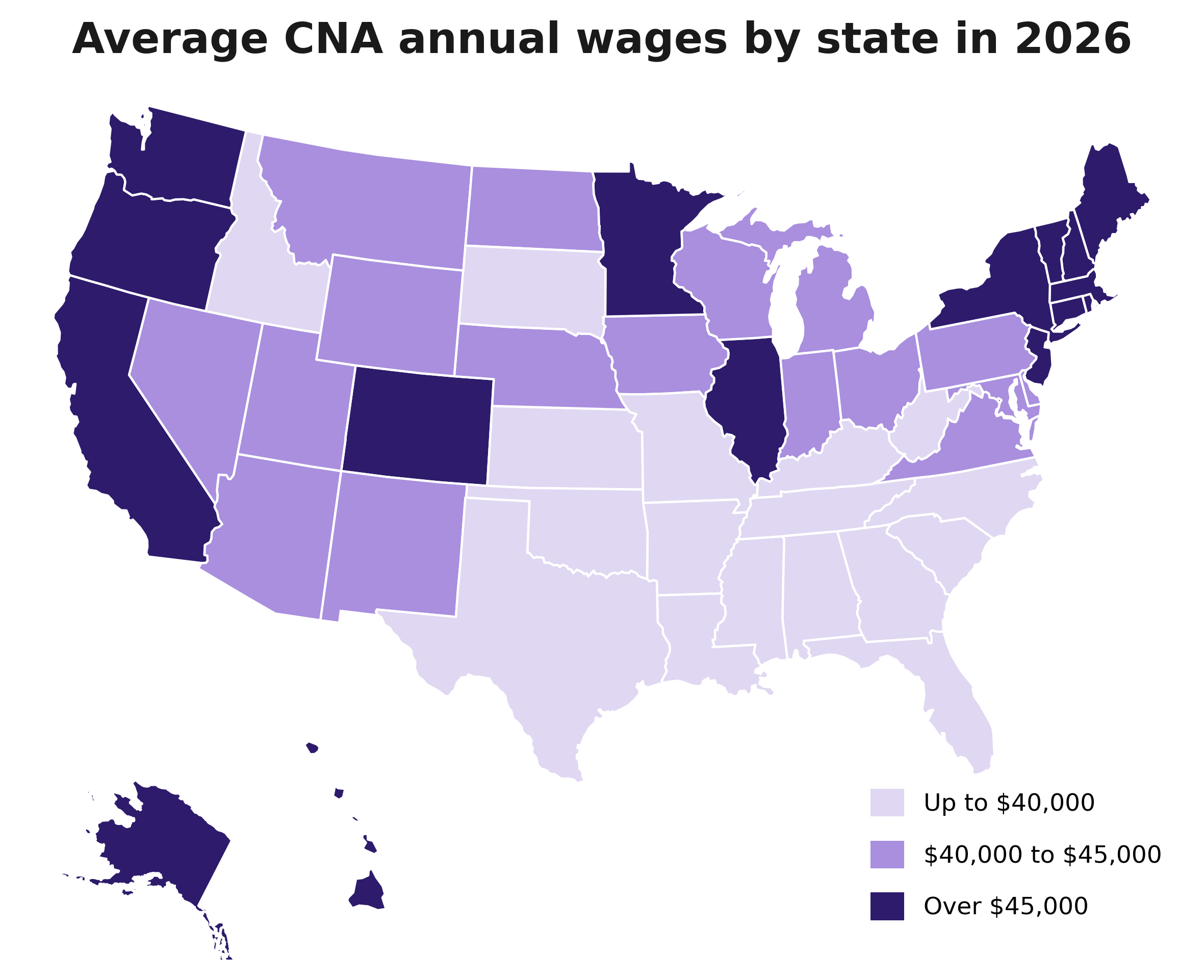
Here is a certified nursing assistant salary comparison by state, including the District of Columbia.
The following are the average hourly and annual CNA wages by state. In most states, average wages increased from the previous year.
Staff CNA vs. PRN pay comparison
How much do per diem CNAs make compared to staff CNAs?
Long-term CNAs tend to earn lower hourly rates than per diem nursing assistants. Sometimes, PRN CNAs can also pick up last-minute shifts, which can also increase their hourly pay.
However, there are many differences between staff CNAs and PRN CNAs regarding:
- Compensation
- Job benefits
- Other advantages
For example, per diem nursing professionals don’t receive benefits. On the other hand, per diem CNAs have complete flexibility over their work schedules.
The following table shows general trends in CNA pay and other differences among staff CNAs vs. PRN CNAs:
What is the average per diem CNA salary in 2026?
First, PRN nursing professionals don’t earn a salary. Instead, per diem CNAs typically earn high hourly pay rates for flexible shifts that they pick up on an as-needed basis.
How much do PRN CNAs make per hour?
PRN hourly pay rates are typically higher than those of in-house CNAs in the same city and work setting. Take a look at the next table, which offers examples.
Per diem CNA pay rates by city vs. staff salary
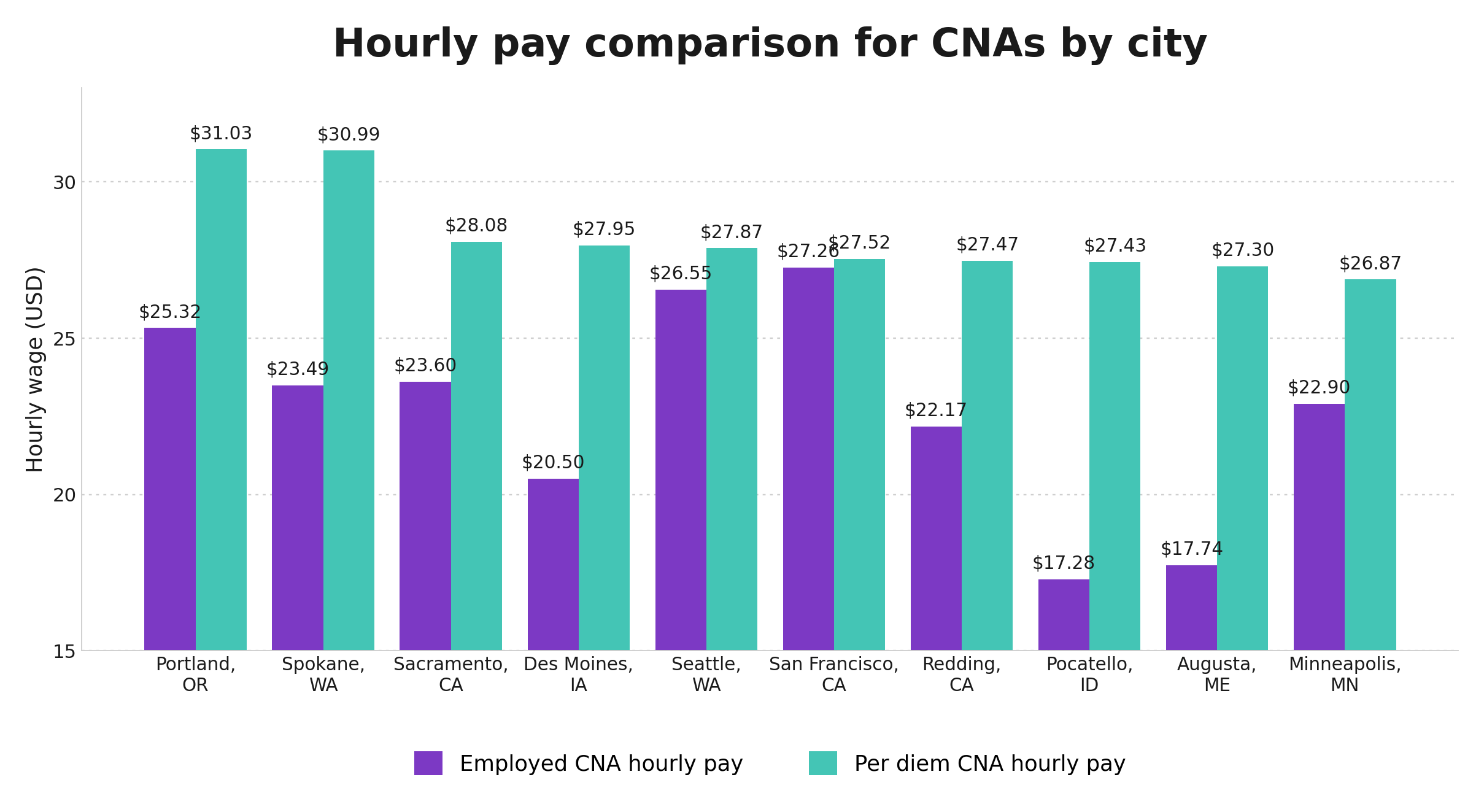
The following table compares how much CNAs typically make per hour as staff CNAs vs. as per diem CNAs picking up shifts with Nursa in 2026.
CNA salary and cost of living comparison
What is the salary for CNAs when compared to the cost of living in that region?
Just looking at the average CNA salary alone won’t tell you the whole story. You need to know whether each state also offers a good salary, adjusted for the cost of living.
By adjusting for cost-of-living differences, nursing assistants can better compare the purchasing power of their wages across states.
Cost of living (COL) varies significantly across the country, so lists of the highest-paying states often don’t provide the full picture.
The table below adjusts each state’s average annual RN wage for local cost of living using the Bureau of Economic Analysis (BEA) regional price parities (RPP).
What does that mean?
Basically, a lower RPP value—less than 100—means lower prices, so wages in those states have more purchasing power.
Alternatively, a higher RPP value—more than 100—indicates higher prices, so wages have less purchasing power.
The COL-adjusted pay is calculated by dividing the BLS average wage by the RPP and multiplying the result by 100.
This adjustment helps compare nurse pay in affordable states versus high-cost states, giving a truer picture of RN salary trends in 2026.
How to use the table
A higher cost-adjusted annual wage suggests CNAs have greater purchasing power in that state, even if the raw salary seems lower.
For instance, while states like Washington offer high average wages, their high cost of living reduces the true value of those wages compared to states with lower costs.
Method notes: Calculations use full-precision 2024 Bureau of Economic Analysis regional price parities, displayed to one decimal place. RPP values are the latest available from the BEA and cover all consumption goods and services, including housing rents by state.
Highest-paid CNAs in 2025
According to the latest data from the U.S. Bureau of Labor Statistics, the national average annual wage for CNAs is $42,700. However, the average annual CNA salary covers a wide range of income groups. For example, the highest-paid 10% earn over $52,230 annually.
In the following sections, you’ll find the answers to these questions and more:
- Which states pay the highest CNA salaries?
- How do CNA salaries vary by city?
- What industries pay CNAs the most?
Which are the highest-paying states for CNAs?
CNAs income also varies between states. Here’s how much CNAs make annually in the top best-paying states for CNAs:
Which are the highest-paying cities and areas for CNA jobs?
Are you considering packing your bags and traveling to one of the highest-paying states for CNAs?
Then, you’ll want to know which specific areas within these states offer certified nursing assistants the highest average salaries. The following are the average pay rates in the top 15 highest-paying metropolitan and nonmetropolitan areas for CNAs:
Which are the highest-paying CNA jobs by industry?
Location is not the only factor determining CNA earning potential.
Nursing assistant pay varies by facility type (setting), and CNA salary is also different in the government vs. the private sectors. Therefore, CNA wage differences by industry can be even more significant than by state.
Take a look at the top 15 CNA salaries by healthcare industry:
Remember that the national average annual wage for CNAs is $42,700.
How much do CNAs make working in hospitals vs. nursing homes?
The median annual wages for CNAs working in different settings are as follows:
- Outpatient care centers: $48,460
- Nursing care facilities (skilled nursing facilities): $42,280
- Continuing care retirement communities and assisted living facilities for the elderly: $41,090
- General medical and surgical hospitals: $43,350
Clearly, hospitals are higher-paying settings for CNAs. However, more nursing assistants work in nursing care facilities than in hospitals.
The overwhelming majority of CNAs nationwide are employed in nursing care facilities and hospitals. Here is the breakdown of the top 3 employment settings for CNAs nationwide:
- Nursing care facilities (skilled nursing facilities) employ 36.87% of CNAs.
- General medical and surgical hospitals employ 30.56% of CNAs.
- Continuing care retirement communities and assisted living facilities for the elderly employ 11.12% of CNAs.
What is the starting salary for a CNA?
If you’re just starting your career as a certified nursing assistant, it’s important to understand that entry-level salary can vary significantly depending on location and the type of healthcare facility or industry you choose.
Factors such as cost of living, regional demand for CNAs, and the specific healthcare sector (for example, hospitals, nursing homes, or outpatient clinics) all play a role in determining starting pay.
In most cases, entry-level CNAs tend to earn within the lower end of the CNA salary spectrum. The following table shows the annual salary for the lowest-paid 10% of CNAs by state, which is a helpful indicator of the CNA starting pay rates across the country.
These figures can help you set realistic expectations for starting pay as you begin your CNA journey, and also assist you in comparing entry-level opportunities in different states.
CNAs in the lowest-paid 10% by state make up to the following figures:
What is the minimum wage for nursing assistants?
The lowest-earning 10% of CNAs earn $13.01 hourly in Mississippi, which is lower than some states’ minimum wage, but higher than the current federal minimum wage of $7.25 per hour (not increased since July 2009).
The following table compares the average hourly rates for CNAs in each state, the hourly average for the lowest-earning CNAs (10th percentile), and each state’s minimum wage:

Note: Where there is no state minimum wage, the federal minimum wage of $7.25/hr is shown.
Even in the lowest-paying states for CNAs, nursing assistants can expect to earn significantly more than the minimum wage in their states.
CNA career path: How to turn $43K into six figures
For certified nursing assistants weighing their next move, the numbers make a strong case for advancing.
Moving up to a licensed practical/vocational nurse (LPN/LVN) takes under a year and delivers a sizable raise, while continuing on to a registered nurse (RN) more than doubles a CNA's baseline earnings.
The path takes time and training, but the payoff compounds at every step, and the biggest gains come from advancing all the way to RN. In short, transitioning to licensed nursing opens the door to significantly higher pay, and the largest gains come from advancing all the way to RN.
To get the highest possible salary in the nursing field, consider pursuing one of the highest-paying nurse specialties.
Look at the following table that has the CNA vs. LPN vs. RN salary comparison:
Is becoming a CNA worth it?
CNAs earn a good income in relation to the investment required for certification. Whether or not it is worth it is a personal question you’ll have to determine for yourself. It may be helpful to know that the average salary for CNAs has steadily increased over the last few years (since 2022):
What increases the salary of CNA jobs?
CNAs can earn higher salaries if they work in certain cities or states, such as Oregon, Maine, or Washington.
Compared with other healthcare positions, working as a CNA doesn’t offer a very high salary. However, it is arguably the best way to enter the nursing profession. Here are some reasons why:
- You can complete CNA training in as little as 4 weeks, and the training could even be free.
- Working as CNAs gives aspiring nurses valuable firsthand insight into the nursing profession and healthcare as a whole.
- CNAs can easily find flexible and high-paying per diem shifts.
Pursuing higher education
However, the higher the level of education, the higher the pay. Therefore, those CNAs who want to continue working in the nursing field long term should consider transitioning to RNs.
The good news is that the time you spend working as a CNA is by no means time lost because it can give you the necessary first-hand experience to decide if nursing is the best career choice for you.
Furthermore, a 2016 study found that RNs with Bachelor of Science in Nursing (BSN) degrees who previously worked as CNAs had higher entry-level salaries (between $3,400 and $7,700 more per year) than those without this health-related work experience.
In other words, working as a CNA on your way to becoming an RN is a very smart financial move.
In the shorter term, earning additional certifications—such as medication aide, EKG technician, or phlebotomy—can further increase a CNA’s income potential, opening up higher-paying opportunities within healthcare facilities.
Taking advantage of shift differentials
How does shift work affect CNA salaries?
CNAs who work non-standard hours, such as nights, weekends, or holidays, typically make more money than their counterparts working day shifts Monday through Friday.
What is the pay rate for CNAs working night shifts?
Shift differentials can boost CNA salaries, especially for night or weekend shifts. For example, CNAs working night shifts may earn $1–$3 more per hour than daytime rates, depending on the facility and location.
Nursing assistants can take advantage of these shift differentials to earn the same amount of money, or even more, by working fewer hours.
Picking up PRN or travel shifts for CNAs with block booking
Another smart financial move is to pick up PRN jobs for nursing assistants.
Working per diem has many advantages besides significantly higher hourly rates.
First, if you work as a CNA while in nursing school, you will appreciate the flexibility that per diem work offers: You can pick up shifts around your school schedule, take time off to study during exams, and work full-time over school breaks.
Second, per diem CNA work doesn’t tie you to a specific facility. If you enjoy working at a facility, you can request more shifts there and even accept a full-time position. On the other hand, if you hate a facility, you never have to go back.
Want to know what the hourly wage for a per diem CNA is?
Explore hourly wages for per diem CNA shifts near you.
Sign up with Nursa to work on your own terms, picking up high-paying PRN shifts when and where you want.
Sources:
- Occupational Employment and Wage Statistics (OEWS) Maps
- Occupational Employment and Wage Statistics (OEWS) Profiles
- BLS: Occupational Employment and Wage Statistics - Nursing Assistants
- US Department of Labor: Consolidated Minimum Wage Table
- NCSL: State Minimum Wages
- U.S. Bureau of Labor Statistics: Occupational Outlook Handbook
- Bureau of Economic Analysis Regional Parities Pricing
- Becker’s Hospital Review: Nursing home RNs, nurses aides averaging 11% pay increase, survey finds


