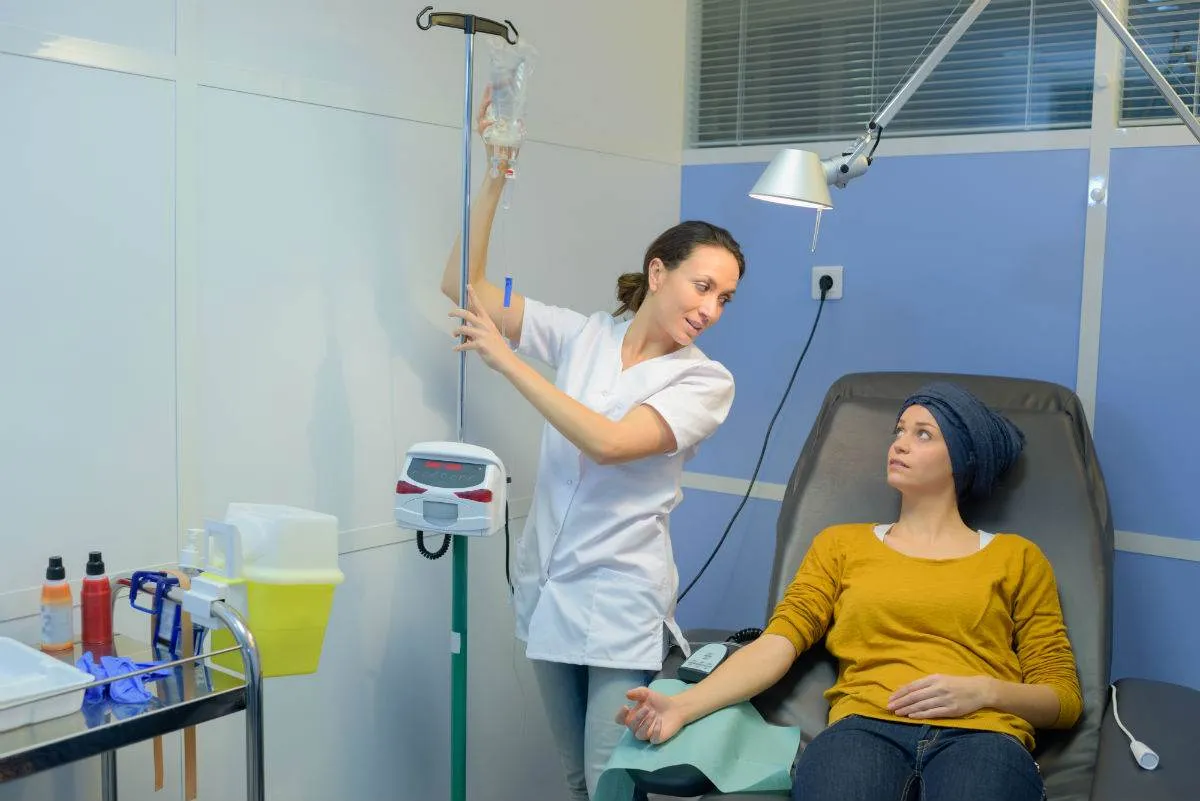
Whether you are a new nurse trying to find the perfect nursing specialty for you or an experienced nurse ready for a change, this guide covers everything you need to know about chemotherapy nursing:
- How to become a chemo nurse
- Chemo infusion nurse salary
- Chemotherapy nurse responsibilities
What does chemo stand for?

Chemo—and the more technical abbreviation CTX—stands for chemotherapy, the treatment that uses drugs to halt the growth of cancer cells or kill these cells altogether.
This treatment may be administered intravenously, orally, or topically, and may be given alone or in combination with other treatments.
What does chemo mean in medical terms?
Besides the previous basic definition of chemotherapy, here are other aspects of chemo that everyone working in oncology must know.
First of all, chemotherapy is not always used for the same purpose:
- It may be used as the primary or only cancer treatment.
- It may be used after other treatments, such as surgery, to kill any remaining cancer cells.
- It may also be used to shrink a tumor before surgery or radiation.
- Chemo may be used to relieve symptoms by killing some cancer cells.
A little-known fact is that chemo is not only used to treat cancer. Some chemotherapy drugs are also effective in treating conditions such as bone marrow diseases and immune system disorders.
Side effects of different drugs for chemotherapy
Furthermore, although most people know that chemotherapy can have significant side effects, it may come as a surprise that there are different types of chemo drugs and that each has its potential complications.
Here are common side effects of chemotherapy drugs:
- Nausea
- Vomiting
- Diarrhea
- Hair loss
- Loss of appetite
- Fatigue
- Fever
- Mouth sores
- Pain
- Constipation
- Easy bruising
- Bleeding
Thankfully, many of these side effects can be treated or, in some cases, prevented.
Late side effects of chemotherapy
Most side effects disappear when treatment ends. That said, some side effects can be long-lasting or can take months or years to manifest.
Possible late side effects of chemotherapy include the following:
- Damage to lung tissue
- Heart problems
- Infertility
- Kidney problems
- Nerve damage
- Risk of a second cancer
How can you administer chemo?
Chemotherapy infusions can be given through a vein in the patient’s arm—the image most people have of chemo treatments—but they can also be given through a device in the patient’s chest, directly in the abdomen, in the central nervous system, or in the bladder.
Other ways chemo can be administered include:
- Chemotherapy can be given as a shot, whereby the drugs may reach the tumor directly.
- It can be taken as a pill or capsule.
- It can be applied as a topical cream to areas of skin affected by skin cancer.
- Chemo may also be administered directly during surgery, either directly to the cancerous cells or to the area where the cancer was.
What is a chemo infusion room in a hospital?
Chemo rooms, or infusion areas, may be found in different healthcare settings.
Of course, patients may be staying in hospitals or other inpatient healthcare settings where they receive the infusions, but they also may receive chemo in outpatient units, doctors’ offices, or even in their own homes—think chemo pills or creams.
Regardless of the location, these rooms have very similar characteristics:
- They usually have large chairs, similar to oversized recliners.
- There are usually regular chairs as well for family members or friends.
- There is usually a TV.
- Most offer ways to increase privacy, such as a curtain that can be pulled around the patient’s chair.
- Some infusion areas may have special rooms for patients receiving day-long treatments or for those who are very ill.
- Aside from the nurses caring for patients and managing their infusions, there may be nursing assistants, techs, doctors, and social workers.
- Patients may be sleeping, talking, watching TV, using their personal devices, or even working.
- Most treatment centers provide snacks, and many people bring their own.
What is chemo-infusion nursing?
Chemotherapy infusion nursing is a specialized field of oncology nursing focused on the safe administration of antineoplastic agents and the management of complex side effects.
Lately, this role has expanded to include bio-immunotherapy and targeted vesicle delivery, moving beyond traditional cytotoxic drugs to include treatments that “reprogram” the immune system.
What is the role of a chemotherapy infusion nurse?
So, what does a chemo nurse do?
Aside from providing nursing care, a chemo nurse's main role is to administer oncology treatments.
Here are some typical duties and responsibilities of a chemo-infusion nurse:
- Provide nursing care for assigned patients.
- Administer chemotherapy, blood components, fluid and electrolyte replacements, and other oncology treatments as prescribed by a physician.
- Perform nursing assessments and triage patient care needs for new and ongoing patients.
- Provide education to patients, families, and caretakers.
- Act as an information resource to students, other healthcare professionals, patients, and the public.
- Provide family support as required, including applicable referrals and bereavement counseling.
- Follow the established policies, procedures, and objectives, including quality improvement, safety, environmental, and infection control standards.
- May train and guide other nursing and support staff engaged in clinical activities.
- May participate in research and related activities.
How much does a chemo-infusion nurse make?
Salary for oncology nurses has seen a steady 4-6% annual increase over the last 3 years, driven by the aging population and the complexity of new cancer therapies.
National averages
- Average annual salary: $112,000
- Top 10% (senior/certified): $141,000+
- Hourly rate range: $48.00 – $68.00 per hour
Pay by work setting
Salary data sourced from the U.S. Bureau of Labor Statistics (BLS)
Geographic hotspots
California remains the highest-paying state (averaging $135,000+), followed closely by Wisconsin, New York, and Massachusetts, where "urban pay premiums" are common.
Want to learn more about the factors that influence RN salary?
How to become a chemo infusion nurse
Starting January 1, 2026, the Commission on Cancer (CoC) implemented revised standards (Standard 4.2) for oncology nursing credentials.
The new requirements are as follows:
- RN licensure: Must hold an active RN license, Associate Degree in Nursing (ADN), or Bachelor of Science in Nursing (BSN). Note that many Magnet hospitals now require a BSN for oncology roles.
- Clinical hours: To sit for the Oncology Certified Nurse (OCN®) exam, you need 2,000 hours of adult oncology nursing practice within the last 48 months.
- The competency rule: All nurses providing direct oncology care must now demonstrate either a current specialty certification or complete 18 Nursing Continuing Professional Development (NCPD) hours in oncology per accreditation cycle.
Furthermore, depending on the hospital or other healthcare facility, there may be a minimum work experience requirement, typically ranging from 6 months to over 2 years.
Relevant work experience may include inpatient nursing, ambulatory care, oncology, chemotherapy, and skills with venous access devices (VADs) and intravenous lines (IVs).
Finally, chemo-infusion nurses are usually required to have basic life support (BLS) or another cardiopulmonary resuscitation (CPR) training course completed with up-to-date credentials.
Responsibilities and skills
As a chemo-infusion nurse, your day is a mix of high-stakes pharmacology and deep emotional support.
- Dose verification: Perform “double-checks” with a second RN to ensure the chemotherapy math is correct.
- Vascular access: Be an expert in port-a-caths, PICC lines, and managing extravasation (when chemo leaks into the skin).
- Symptom management: Administer the pre-med cocktail (antiemetics and steroids) to prevent nausea before it starts.
- Genomic education: Explain how a patient’s specific genetic markers (like HER2 or BRCA) can influence the choice of a low-dose protocol.
How technology is changing the room
The modern infusion room is no longer just a row of recliners. You will likely work with:
- Smart-pump integration: Infusion pumps that sync directly with the patient's electronic health record (EHR) to prevent dosing errors.
- Wearable monitoring: Patients often wear biosensors that track vital signs in real time, alerting you to early signs of infusion reactions (such as anaphylaxis or a cytokine storm) before symptoms become visible.
- Scalp cooling systems: Many infusion centers now integrate cold caps into the treatment bay to help patients retain hair during treatment.
Why choose chemo-infusion nursing?
Nursing is the backbone of healthcare, and every specialty is essential. Therefore, there is no such thing as the best nursing specialty; this depends on your particular strengths, interests, and preferences. Most nurses choose this specialty for the following reasons:
- Deep patient bonds: You see the same patients for weeks or months, becoming a cornerstone of their support system.
- Schedule stability: Most outpatient infusion centers offer 4 10-hour shifts or 5 8-hour shifts with no weekends or holidays.
- High demand: The oncology staffing trend shows a critical shortage of certified nurses, giving you immense leverage in salary negotiations and sign-on bonuses.
Still aren’t sure if chemo-infusion nursing is for you?
Read our ultimate guide to oncology nursing to learn more.
Sources:
- U.S. Bureau of Labor Statistics (BLS): Occupational Outlook for Registered Nurses
- Oncology Nursing Certification Corporation (ONCC): 2026 Eligibility and OCN Exam Blueprint
- American College of Surgeons (ACS): Commission on Cancer (CoC) Revised Standard 4.2 (Effective 2026)
- PMC: Double checking: a second look