

Storrs is a community in the town of Mansfield in eastern Connecticut, home to the main campus of the University of Connecticut. Residents have access to Windham Hospital in nearby Willimantic, with UConn Health and other major medical centers in the Hartford area.
Storrs
Connecticut
Jump to section on this page

Anchor Link
Go Beyond a Single Job
Choose Multiple Per Diem Shifts on Your Schedule
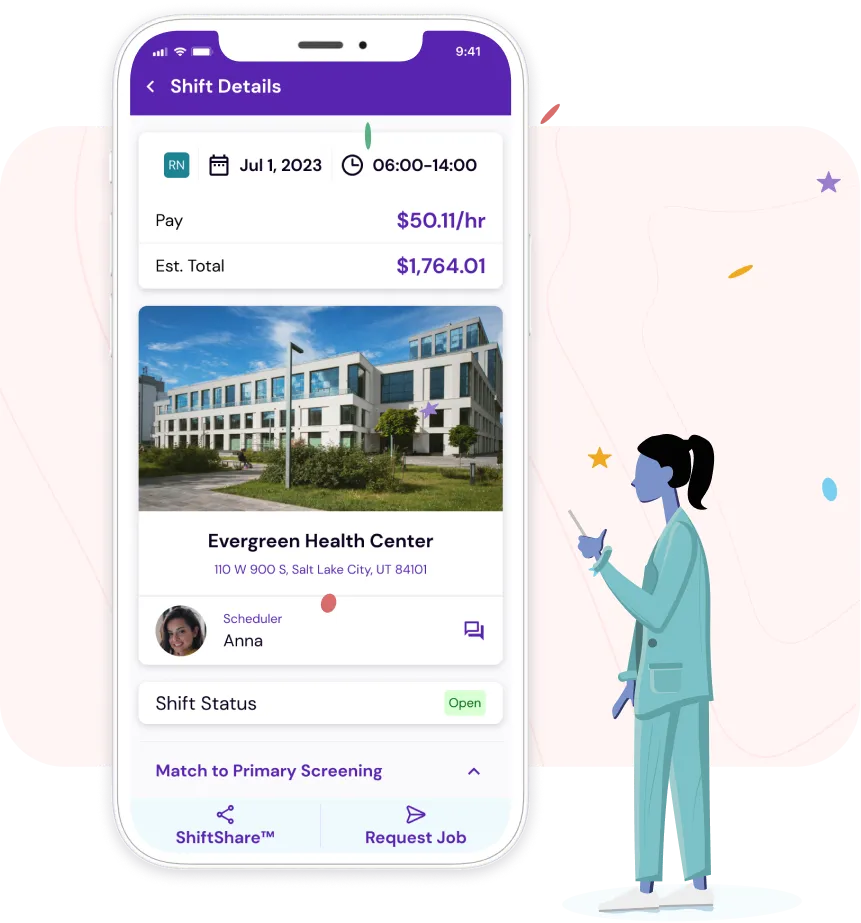
Nursa isn't just about finding a job; it's about crafting your ideal work schedule by selecting shifts. Once you create a Nursa profile, you will experience the convenience of scheduling shifts in real time.
Loading shifts…
Zip codes located within Storrs, CT:
Loading…
Completed! We will notify you when we have desired shifts for you.
Until then, you can continue with the app to signup or login.
Continue
Until then, you can continue with the app to signup or login.
Oops! Something went wrong while submitting the form.
See More Shifts and Apply Now
Explore and find where you would like to work
Search ShiftsPer Diem JobsSelect your license and location to find the best PRN jobs
Select your license and the location you want to work in, and we'll show you the best PRN jobs available nearby.
Storrs offers a vibrant college-town atmosphere with UConn sports, campus events, and the walkable Storrs Center downtown. The surrounding countryside provides farms, forests, and trails.

Per diem nursing shifts in Storrs, Connecticut
What the eastern Connecticut market looks like
Storrs sits in the town of Mansfield, in the rolling hills of eastern Connecticut, about half an hour from Hartford and a similar distance from the Rhode Island line. It is the home of the University of Connecticut, and the campus defines the place.
Clinicians considering per diem nursing shifts in Storrs, Connecticut are working a market that runs differently from the state's shoreline and Fairfield County corridors.
This is the quieter, more rural half of Connecticut. A community hospital sits ten minutes away in Willimantic, another twenty minutes north in Stafford Springs, and more in Vernon, Manchester, Norwich, and Hartford within half an hour.
There is also a behavioral health hospital in Mansfield itself, which is unusual for a town this size. This guide covers how per diem work functions here, what Connecticut requires of you, and what the area offers on your days off.
How per diem work functions
Per diem means "per day." Instead of committing to a set number of weekly hours with one employer, you claim individual shifts as facilities post them. Each listing shows the date, hours, setting, and pay rate before you decide anything.
Facilities need this model because staffing demand will not hold still. Census climbs without warning. A nurse calls out two hours before a night shift. A long-term care unit loses two aides in a month and cannot replace them quickly.
Eastern Connecticut sharpens that pressure. The region is less densely populated than the rest of the state, and facilities here have a smaller pool of available clinicians to call. When a building runs short, it pays above its standard rate to close the gap fast.
Who can pick up PRN shifts
PRN shifts open across a wider range of roles than many people expect. Facilities in this region post for the following.
- Registered nurses (RNs) covering medical-surgical floors, emergency departments, behavioral health units, long-term care, and charge roles.
- Licensed practical nurses (LPNs) handling medication passes, treatments, and assessments in skilled nursing, assisted living, and clinic settings.
- Certified nurse aides (CNAs) providing direct resident care, which accounts for the highest volume of open postings in long-term care.
- Staff who administer medications in the settings Connecticut permits, under the rules that apply to their credential and workplace.
- Allied roles including respiratory therapists and rehabilitation staff at larger facilities.
If you hold an active Connecticut credential and keep your certifications current, there is usually something open within a reasonable drive.
Per diem compared to a staff position
A staff job gives you predictability. Set hours, a consistent paycheck, and whatever benefits the employer carries. What you give up is control of your calendar.
Someone else builds the schedule. Holidays rotate on a fixed cycle. Mandatory overtime arrives whether or not it works for your life.
Per diem reverses that. You choose the days you work, and no manager can hold you for a second consecutive shift. In exchange, you take on responsibility for your own consistency, your own credential renewals, and your own financial planning between shifts.
Many clinicians refuse to treat this as an either-or decision. They keep a part-time staff role for a stable floor and add claimed shifts on top. Others build a full week from per diem work alone.
Facility types around Storrs
The mix here leans toward community hospitals, long-term care, and behavioral health, with academic medicine available in Hartford and Farmington. Knowing what each setting demands helps you claim shifts that match your strengths.
Skilled nursing and long-term care
Skilled nursing facilities produce the steadiest volume of open shifts across eastern Connecticut. These buildings serve residents recovering from hospitalization, managing chronic conditions, or living with advanced cognitive decline.
Shifts follow a dependable rhythm. Mornings center on medication passes, assessments, wound care, and helping residents start the day. Evenings handle dinner, evening medications, and settling residents for the night. Overnights are quieter but demand independent judgment, since the team on the floor is smaller.
Resident-to-staff ratios run heavier than in hospitals. Organization and pace matter more here than advanced acute skills. A clinician who moves through a medication pass efficiently and documents as they go will do well.
Behavioral health
Eastern Connecticut has meaningful behavioral health capacity, including an inpatient hospital in Mansfield and programs across the region.
The work differs substantially from medical nursing. Assessment leans on observation and interaction rather than vital signs, de-escalation is a core skill, and the therapeutic relationship carries clinical weight.
Clinicians with behavioral health experience are genuinely scarce, and facilities in this region request them back consistently. If you have that background, it is worth keeping on your profile.
Hospitals and acute care
The hospitals serving this area operate as community facilities. They cover emergency, medical-surgical, surgical, and outpatient services, and the smaller ones handle a broad range with fewer specialty units to transfer patients into.
That breadth rewards nurses with solid general competence rather than narrow specialization. Hartford, about thirty minutes west, is where acuity climbs, with academic campuses and a children's hospital that pay at the top of the regional range.
Home health and hospice
Home health means driving between residences across Tolland and Windham counties, handling wound care, medication reconciliation, teaching, and skilled assessments.
Visits are scheduled, so the day has structure, but you practice independently between them. Rural roads add real drive time here, and agencies account for it.
Hospice carries different weight. You support patients at the end of life and the families walking through it with them. It is emotionally demanding and, for many nurses, the most meaningful work they do.
Connecticut licensing and credentials
Every shift in Storrs requires the correct Connecticut credential in active status. The Department of Public Health oversees nursing credentials in this state.
Registered nurse and practical nurse licensure
The Connecticut Board of Examiners for Nursing, operating under the Department of Public Health, licenses registered nurses and licensed practical nurses. Licensure requires graduation from an approved program and a passing score on the appropriate NCLEX examination.
Connecticut does not participate in the Nurse Licensure Compact. A multistate license from another state does not authorize you to practice here, and that is the single most important licensing fact for anyone moving to this area.
If you are licensed elsewhere, you will need to apply for Connecticut licensure by endorsement. Start that process early, because the timeline is long enough to disrupt a relocation plan if you leave it until after you arrive.
Connecticut licenses renew annually rather than on the two-year cycle most states use, which catches people out. The state also requires continuing education covering specified content areas rather than leaving the subject matter entirely open.
Confirm the current renewal period, fees, and continuing education requirements with the Department of Public Health before relying on any figure.
Certified nurse aide certification
Connecticut maintains a nurse aide registry through the Department of Public Health. Certification requires completing a state-approved training program that combines classroom instruction with supervised clinical practice, then passing a competency evaluation covering written knowledge and hands-on skills.
Connecticut's required training hours run above the federal minimum, so a program that satisfied another state's requirement may not satisfy this one.
Registry listings do not transfer between states the way a compact nursing license does, and since Connecticut is not in the compact, nothing transfers automatically for nurses either. An aide relocating here should contact the Department early.
Certification remains active for a defined period and requires documented paid work in a nursing-related capacity to renew. That matters specifically for per diem aides. An extended stretch without claimed shifts can put your renewal at risk, and reinstatement takes longer than maintaining it would have.
Medication administration
Connecticut handles this differently from states that maintain a broad medication aide registry. Rules for medication administration by unlicensed staff are tied to the specific setting rather than to a single statewide credential.
If you work as an aide and want to expand your scope, contact the Department of Public Health about what applies in the settings you want to work, particularly assisted living and residential care.
Do not assume a medication aide certification from another state carries over. Facilities will also layer their own policies on top of state requirements, so confirm both before claiming a shift where medication administration is part of the role.
Working across state lines
Storrs sits within about thirty minutes of both Rhode Island and Massachusetts, but the compact does not help you here.
Connecticut is not a member. Massachusetts is not a member. Rhode Island's status has been evolving and should be verified directly rather than assumed.
The practical effect is that southern New England is largely a non-compact region, unlike New Hampshire, Vermont, and Maine to the north. Clinicians who want facilities in more than one state here hold more than one license, and each one takes time to obtain.
Plan accordingly. If working across a border matters to you, start those applications well before you need them.
Certifications worth carrying
Licensure lets you practice. Certifications determine which shifts you can actually claim, and a deeper credential set reaches further into the better-paying assignments.
- Basic Life Support (BLS) certification is required across nearly every setting and role. Most facilities specify American Heart Association certification, so confirm what a facility accepts before paying for a course.
- Advanced Cardiovascular Life Support (ACLS) is expected for RNs in hospital, emergency, telemetry, and critical care assignments. It qualifies you to take an active role in resuscitation beyond compressions and basic airway management.
- Pediatric Advanced Life Support (PALS) applies to RNs working emergency or mixed-population units. Community hospitals see patients of every age, so pediatric competence matters even without a dedicated unit.
- Crisis prevention and de-escalation training carries particular weight in this region given the behavioral health capacity here. It is the first and safest intervention available in most situations.
- Dementia and memory care training is commonly requested by assisted living and skilled nursing facilities, and memory care units often require it before a shift can be claimed.
- National Institutes of Health Stroke Scale (NIHSS) certification is standard at stroke-designated hospitals across the state.
Each certification you hold expands the pool of shifts available to you. In a rural market with fewer total postings, qualifying for more of them is how you keep a schedule full.
What drives pay in this area
Per diem rates in eastern Connecticut generally exceed what the same facility pays staff employees holding equivalent credentials. The gap depends on role, setting, timing, and the pressure a facility faces when it posts.
Several patterns repeat consistently.
- Overnight and weekend coverage pays more than weekday daytime hours.
- Holiday shifts reach the highest rates of the year, particularly between Thanksgiving and New Year's Day.
- Postings published within 24 hours of the start time often carry a premium, because internal options have been exhausted.
- Higher-acuity settings pay more than lower-acuity settings for identical credentials.
- Respiratory season raises census and staff call-outs simultaneously from roughly December through February.
- Nor'easters and ice storms create sudden same-day gaps when staff cannot safely reach a facility.
Connecticut's lack of compact participation has a real effect on rates here. Because out-of-state clinicians cannot simply drive in and work, the available workforce is smaller than the geography suggests, which supports pay across the region.
Eastern Connecticut also competes with Hartford and the shoreline for the same nurses. Facilities in Willimantic or Stafford Springs have to price competitively or watch clinicians drive west instead.
Local demand runs steady year-round. The region has an older population than the state average outside the university, which keeps long-term care, home health, and hospice volume consistent regardless of season.
Why nursing professionals use Nursa
Nursa is a marketplace that connects nursing professionals directly with facilities posting open shifts. It works as a platform rather than a staffing agency, and that distinction determines who decides. No recruiter assigns you anywhere. You review what is posted, weigh it against your own criteria, and claim what fits.
Rates that reflect real demand
Facilities set their own rates when they post, and those rates track how urgently coverage is needed. Because you are closing a gap rather than occupying a budgeted position, per diem nursing jobs on the marketplace frequently pay more per hour than comparable full-time roles inside the same building.
You see the rate before you claim. Nothing gets renegotiated afterward and nothing changes on your pay.
Instant pay through Nursa Direct
Traditional payroll holds your wages for a week or longer after you have already worked. Nursa Direct gives you access to your pay once a shift is completed and verified, instead of waiting out a standard cycle.
When income arrives shift by shift, that timing matters. A car repair on Monday can be covered by a shift on Tuesday.
Control over your schedule
Nothing is assigned. You filter shifts by date, distance, role, and rate, then select what fits your week. Three twelve-hour shifts, two evenings plus alternating weekends, or one shift a month all work within the same system.
The arrangement adjusts as your circumstances change. Nursing students, parents working around a school calendar, and clinicians easing toward retirement all use the same tool differently.
A range of facility types
Shifts span long-term care, assisted living, hospitals, skilled nursing facilities, and home health settings. That range does more than widen your options.
Working one setting exclusively narrows your abilities over time. Rotating across settings keeps your assessment skills current and your documentation flexible, and it gives you a low-risk way to test a specialty before committing to it.
Real-time notifications and direct messaging
Well-paying last-minute postings fill quickly. Real-time shift notifications deliver new openings to your phone as they publish, filtered to your stated preferences, so you can respond before someone else claims them.
You also message facility schedulers directly in the app. Questions about the unit, the charting system, or where to park go to the person who knows the answer. On rural roads where a wrong turn costs fifteen minutes, confirming directions before you leave is worth doing.
How to get started on the platform
Setup takes less time than most clinicians expect, and you can complete nearly all of it from your phone in one sitting.
- Add your personal information to create your account.
- Verify your nursing license so the platform can confirm it is active and in good standing.
- Complete your clinician profile with your work history, specialties, and preferred settings.
- Upload your essential credentials, including certifications, immunization records, and any required screenings.
- Request a shift, which initiates your background check.
Have your documents ready before you start. You will want your license or certification number, your certification cards, tuberculosis screening results, immunization records, and a government-issued photo identification.
Photograph everything in advance so you are not stopping halfway through to find something. Connecticut's annual renewal cycle makes credential tracking especially important, so set calendar reminders 60 days ahead of each expiration.
Living and working in Storrs
Storrs works well for clinicians who want flexible shifts because the setting is quiet, the housing costs less than most of Connecticut, and several hospitals sit within half an hour.
Route 195 runs through the center of town, connecting south toward Willimantic and north toward Tolland and the interstate. Route 44 handles east-west travel, and Interstate 84 is about twenty minutes northwest.
Storrs Center, built in the past decade, gave the village an actual walkable downtown with restaurants, shops, and apartments next to campus. Before that, Storrs had a university and not much else.
The University of Connecticut anchors everything and runs a school of nursing, which keeps the town connected to the state's clinical pipeline. Basketball is a genuine local institution here, and the arena fills for both the men's and women's teams.
Why the location suits per diem work
Distance without traffic is the practical advantage. Willimantic is ten minutes, Stafford Springs twenty, and Vernon, Manchester, Norwich, and Hartford all within about thirty.
Those are real thirty-minute drives, not Fairfield County thirty-minute drives that take an hour. Eastern Connecticut has very little congestion outside of move-in weekend and game days.
The pace helps if you work nights. Mansfield outside the academic year is genuinely quiet, and the town empties considerably each summer when students leave.
Woods, water, and trails
Mansfield Hollow State Park sits minutes from town with a large lake, boat access, and trails through the surrounding woods. The Nipmuck Trail runs north through the area for longer hikes.
Horsebarn Hill on the university's agricultural land is the local landmark, a long open rise with pastures, cattle, and some of the better sunset views in eastern Connecticut. Students and residents walk it year-round.
Bigelow Hollow State Park in Union, about twenty-five minutes north, is one of the quieter and more striking parks in the state, with clear ponds and dense forest. Natchaug State Forest offers similar terrain closer in.
Two long rail trails cross the region. The Hop River trail runs west toward Manchester through a notch in the hills, and the Air Line trail follows an old railroad bed across the eastern part of the state.
Local culture and nearby towns
The university brings more than sports. There is a performing arts center that books touring music and theater, an art museum, and a puppetry museum connected to the university's long-running puppet arts program, which is genuinely one of a kind.
The campus dairy bar sells ice cream made from the university's own herd, and it has been a local institution for decades.
Willimantic, ten minutes south, is a former mill city with a brewery in a converted post office, a textile history museum, and a bridge famously decorated with large bronze frogs. Coventry has a well-regarded farmers market and the homestead of Nathan Hale.
The Mansfield drive-in theater still operates seasonally, which is increasingly rare in New England.
Getting further afield
Hartford is thirty minutes west with museums, a symphony, a theater, and minor league baseball. Two large casino resorts sit about half an hour south and book major touring acts year-round.
Mystic and the Connecticut shoreline are about forty-five minutes southeast, Providence is under an hour east, and Boston is roughly ninety minutes. New York is about two and a half hours southwest.
Practical considerations
Housing in Mansfield runs below the Connecticut average, though rentals near campus compete with student demand and turn over on the academic calendar. Many clinicians live in Willimantic, Coventry, Tolland, or Vernon, where costs drop further.
Winter requires planning. Eastern Connecticut gets nor'easters, ice storms, and heavy snow, and the rural roads here clear later than the highways. Keep your vehicle ready, allow real extra time for early morning and overnight drives, and check conditions before leaving.
There is no public transit suited to shift work outside the university system, so a reliable vehicle is a requirement. The upside is that parking is free and easy nearly everywhere except campus on a game day.
Take the next step
Per diem work rewards clinicians who stay organized, adapt quickly, and can walk into an unfamiliar building ready to contribute. Storrs offers short uncongested drives to several hospitals, housing below the state average, and a quiet setting between the hills and the woods.
Confirm your credential is current, gather your documents, complete your profile, and start tracking what opens nearby. The schedule is yours to build.
Share this page:


No items found.
Featured Facilities in this City
Searching for other types of per diem nursing jobs? Find nurse and nursing assistant jobs in similar types of healthcare facilities here.
Facility Types
See All


Pick Up a Job Today
Find per diem PRN job opportunities in your area. High paying CNA, LPN and RN and many more licences are available now.
Join Nursa
Post Your Jobs Today
Facilities who use Nursa fill 3 times as many open per diem shifts, on average, compared to trying to fill the shifts themselves.
Post Jobs