

Castleton is a town in Rutland County in western Vermont, located about 12 miles west of Rutland near Lake Bomoseen. Residents have access to Rutland Regional Medical Center, one of the largest hospitals in Vermont.
Castleton
Vermont
Jump to section on this page

Anchor Link
Go Beyond a Single Job
Choose Multiple Per Diem Shifts on Your Schedule
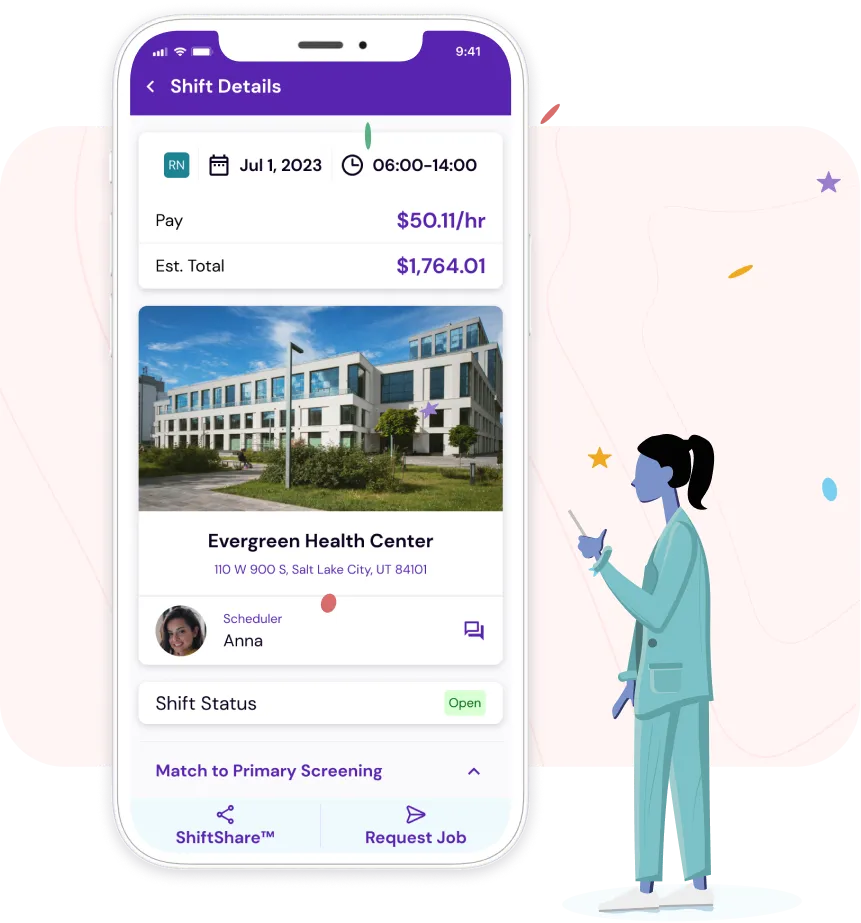
Nursa isn't just about finding a job; it's about crafting your ideal work schedule by selecting shifts. Once you create a Nursa profile, you will experience the convenience of scheduling shifts in real time.
Loading shifts…
Zip codes located within Castleton, VT:
Loading…
Completed! We will notify you when we have desired shifts for you.
Until then, you can continue with the app to signup or login.
Continue
Until then, you can continue with the app to signup or login.
Oops! Something went wrong while submitting the form.
See More Shifts and Apply Now
Explore and find where you would like to work
Search ShiftsPer Diem JobsSelect your license and location to find the best PRN jobs
Select your license and the location you want to work in, and we'll show you the best PRN jobs available nearby.
Castleton offers a quiet New England lifestyle and is home to the Castleton campus of Vermont State University. Nearby Lake Bomoseen, the largest lake entirely within Vermont, offers boating, swimming, and fishing.

Per diem nursing shifts in Castleton, Vermont
What the Rutland County market looks like
Castleton sits in western Vermont, about 15 minutes west of Rutland and roughly 10 minutes from the New York state line. Around 4,700 people live here, spread across the village, the surrounding hills, and the shoreline of Lake Bomoseen.
Clinicians evaluating per diem nursing shifts in Castleton, Vermont are looking at a rural market with one significant regional hospital and a wide distribution of smaller facilities.
Rutland holds the county's medical center, which is among the largest hospitals in the state. Beyond that, long-term care and assisted living capacity spreads across Rutland, Fair Haven, Proctor, Brandon, and the surrounding towns.
The state line matters here, and it is the first thing to understand before planning a schedule. This guide covers what per diem shifts involve for registered nurses, licensed practical nurses, and nursing assistants, what Vermont requires of each role, which certifications open more assignments, and what the area offers on days off.
How per diem work operates
Per diem means "per day." Rather than committing to fixed weekly hours with one employer, you claim individual shifts as facilities post them. Each listing shows the date, hours, unit, setting, and pay rate before you agree to anything.
Facilities depend on this because staffing demand does not hold steady. Census rises without notice. A nurse calls out two hours before a night shift. A long-term care unit loses two aides in a month and cannot replace them quickly in a county this size.
Vermont's scale sharpens that pressure. The entire state has fewer residents than many single cities, which means the pool of available clinicians is genuinely small. When a facility runs short, the options run out fast, and rates rise accordingly.
What RN per diem shifts involve
PRN shifts for registered nurses vary considerably by setting, and rural Vermont widens that variation.
At the regional medical center in Rutland, your assignment is defined by the unit. Medical-surgical, telemetry, emergency, and step-down assignments make up most per diem listings, and you handle assessments, medication administration, intravenous therapy, provider communication, discharge preparation, and continuous documentation.
Smaller Vermont hospitals operate as critical access facilities, and the work there is broader. With fewer specialty units to transfer patients into, a single shift can span emergency, medical-surgical, and observation patients. That rewards general competence and steady judgment over narrow specialization.
Skilled nursing looks different again. An RN there typically oversees a unit, supervises licensed practical nurses and nursing assistants, manages admissions and hospital returns, completes required assessments, coordinates with providers, and responds to any change in a resident's condition.
Home health puts an RN in a car covering long distances between hill towns and farms. You handle wound care, medication reconciliation, teaching, and skilled assessments, and you decide without a colleague nearby. Agencies generally want at least a year of experience for that reason.
Facilities pay RNs the most because the license carries the clinical judgment. When a patient's condition changes, the RN determines what it means and acts. A facility short one RN is missing a decision-maker.
What LPN per diem shifts involve
Licensed practical nurses work under RN or provider supervision. In Rutland County, that work concentrates in skilled nursing, long-term care, assisted living, clinics, and home care.
A typical shift centers on medication administration. On a long-term care unit, that can mean passing medications to 20 or more residents across a shift, with treatments, dressing changes, glucose checks, and continuous observation layered on top.
Documentation runs alongside the clinical work rather than after it. Falling behind during a shift compounds quickly, and the final hour becomes unmanageable.
LPNs are also the staff most likely to catch a problem first. You see the same residents repeatedly, you know their baseline, and you notice a change before it registers in a vital sign. Reporting that promptly to the supervising RN is one of the most clinically valuable things the role does.
Pace matters here more than in most positions. A medication pass running an hour behind pushes the entire unit out of sequence. Facilities request LPNs who move through a pass accurately and stay on schedule.
What LNA per diem shifts involve
Vermont handles this role differently than most states, and the difference is worth knowing before you apply anywhere.
Most states certify nursing assistants and list them on a registry. Vermont licenses them. The title here is licensed nursing assistant, or LNA, and the credential is issued by the Board of Nursing rather than tracked on a separate registry.
The work itself matches the CNA role elsewhere. Shifts center on direct resident care: bathing, dressing, toileting, repositioning, transfers, feeding assistance, and ambulation. You also record vital signs, document intake and output, and report anything unusual to the nurse covering the unit.
LNAs generate the highest volume of open postings across this region, and the work is the most physically demanding of the three roles. Assignments commonly run eight to twelve residents on a day shift in long-term care, and more on evenings and overnights.
The clinical importance of the role gets underestimated. LNAs spend more time with residents than anyone else in the building. Skin breakdown, decreased appetite, new confusion, unsteadiness that was not present last week, most of it reaches the care team through an assistant first.
Body mechanics deserve deliberate attention in per diem work. You move between buildings with different lift equipment, different transfer policies, and different layouts. Locate the mechanical lifts and confirm the transfer policy before your first resident.
How per diem compares to a staff position
Staff employment provides predictability: set hours, a consistent paycheck, and whatever benefits the employer carries. What you give up is control of your calendar. Someone else builds the schedule, holidays rotate on a fixed cycle, and mandatory overtime arrives regardless of your circumstances.
Per diem reverses that. You choose the days you work, and no manager can hold you for a second consecutive shift. In exchange, you take responsibility for your own scheduling consistency, your own credential renewals, and your own financial planning between shifts.
Many clinicians refuse to treat this as an either-or decision. They keep a part-time staff role for a stable floor and add claimed shifts on top. Others build a full week from per diem work alone.
Vermont license requirements by role
Every shift in Castleton requires the correct Vermont credential in active status. Vermont's structure differs from most states in two specific ways.
Registered nurse licensure
Vermont licenses registered nurses through the Board of Nursing, which sits within the Office of Professional Regulation in the Secretary of State's office. That placement surprises clinicians relocating here, since most states run nursing licensure through a health department or an independent board.
Licensure requires graduation from an approved nursing program and a passing score on the NCLEX-RN examination.
Vermont participates in the Nurse Licensure Compact. A multistate license from another compact state authorizes you to practice here without applying separately, which is a meaningful advantage in a small state.
Licenses renew on a multi-year cycle with continuing education requirements. Confirm the current renewal period, fees, and continuing education hours directly with the Office of Professional Regulation, since these get revised.
Licensed practical nurse licensure
LPN licensure runs through the same board and office. Candidates complete an approved practical nursing program and pass the NCLEX-PN examination, and the compact provisions apply equally.
LPNs interested in expanding their scope should look into intravenous therapy preparation. Vermont permits LPNs to perform certain IV-related functions after approved additional training, and facilities value that because it reduces how often they pull an RN away from another task.
Licensed nursing assistant licensure
This is where Vermont departs most sharply from other states. LNAs hold a license issued by the Board of Nursing, not a certification tracked on a state registry.
Licensure requires completing an approved nursing assistant program and passing a competency evaluation covering written knowledge and hands-on skills. Renewal happens on a set cycle and requires documented work hours in the role.
That work requirement matters specifically for per diem assistants. An extended stretch without claimed shifts can jeopardize renewal, and reinstating a lapsed license takes longer than maintaining it would have.
Because Vermont licenses rather than certifies, a CNA certification from another state does not transfer automatically. If you are relocating, contact the Office of Professional Regulation early to find out what your existing credential qualifies you for here.
Working across the New York line
Castleton sits roughly 10 minutes from New York, and the licensing picture changes completely at that border.
New York does not participate in the Nurse Licensure Compact. A Vermont multistate license does not authorize you to work in Whitehall, Granville, Glens Falls, or anywhere else on that side, and New York licenses nurses through its State Education Department rather than a health agency.
Clinicians who want facilities on both sides of the line generally hold both credentials. New Hampshire and Maine are compact states if you range east, though the drives are long. Verify each state's current status before planning around cross-border work.
Certifications facilities look for
Licensure lets you practice. Certifications determine which shifts you can actually claim, and a deeper credential set reaches further into the better-paying assignments.
- Basic Life Support (BLS) certification is required across nearly every setting and role. Most facilities specify American Heart Association certification, so confirm what a facility accepts before paying for a course.
- Advanced Cardiovascular Life Support (ACLS) is expected for RNs in hospital and emergency assignments. At a smaller Vermont hospital, where a code may be managed by a lean team, that training carries real weight.
- Pediatric Advanced Life Support (PALS) applies to RNs working emergency or mixed-population units. Rural emergency departments see patients of every age, so pediatric competence matters even without a dedicated pediatric unit.
- Trauma Nursing Core Course (TNCC) is valuable here. Ski injuries, highway trauma, and farm and logging accidents all arrive at regional emergency departments before transfer.
- Dementia and memory care training is commonly requested by assisted living and skilled nursing facilities, and memory care units often require it before a shift can be claimed.
- Crisis prevention and de-escalation training benefits clinicians in behavioral health and memory care settings, where verbal intervention is the first and safest option.
The practical argument for holding more certifications than your role strictly requires is access. In a rural market with fewer total postings, qualifying for a wider share of them is how you keep your schedule full.
What drives pay in this area
Per diem rates in Vermont generally exceed what the same facility pays staff employees holding equivalent credentials. The gap depends on role, setting, timing, and how much pressure the facility faces when it posts.
Several patterns repeat consistently.
- Overnight and weekend coverage pays more than weekday daytime hours.
- Holiday shifts reach the highest rates of the year, particularly between Thanksgiving and New Year's Day.
- Postings published within 24 hours of the start time often carry a premium, because internal options have been exhausted.
- Higher-acuity settings pay more than lower-acuity settings for identical credentials.
- Respiratory season raises census and staff call-outs simultaneously from roughly December through February.
- Winter storms create sudden same-day gaps when staff cannot safely reach a facility.
Vermont has a compound winter peak worth understanding. Respiratory season overlaps with ski season, and the resorts east of here draw large numbers of visitors from December through March.
That visitor volume raises emergency and orthopedic demand at exactly the point staffing is already stretched by illness and weather. Winter is consistently the strongest stretch of the year for claiming shifts in this part of the state.
The small clinician pool supports rates year-round. A facility short-staffed on a Saturday night in Rutland County does not have many alternatives to call.
Why nursing professionals use Nursa
Nursa is a marketplace that connects nursing professionals directly with facilities posting open shifts. It operates as a platform rather than a staffing agency, and that distinction determines who decides. No recruiter assigns you anywhere. You review what is posted, weigh it against your own criteria, and claim what fits.
Rates set by actual demand
Facilities price their own postings according to how urgently they need coverage. Because you are closing a gap rather than occupying a budgeted position, per diem nursing jobs on the marketplace frequently pay more per hour than comparable full-time roles inside the same building. The rate is visible before you claim and does not change afterward.
Instant pay through Nursa Direct
Conventional payroll holds earned wages for a week or longer. Nursa Direct provides access to your pay once a shift is completed and verified, rather than requiring you to wait for a standard pay cycle. When income arrives shift by shift, that timing directly affects how you manage expenses.
Control over your schedule
Nothing is assigned. You filter shifts by date, distance, role, and rate, then select what fits your week. Three 12-hour shifts, two evenings plus alternating weekends, or one shift a month all work within the same system, and the arrangement adjusts as your circumstances change.
Range of facility types
Shifts span long-term care, assisted living, hospitals, skilled nursing facilities, and home health settings. That range protects your clinical skills over time. Working a single setting exclusively narrows your abilities gradually, while rotating across settings keeps your assessment skills and documentation fluency intact.
Real-time notifications and direct messaging
Well-paying last-minute postings fill quickly. Real-time shift notifications deliver new openings to your phone as they publish, filtered to your stated preferences, so you can respond before someone else claims them.
You also message facility schedulers directly in the app. Questions about the unit, the documentation system, or where to park go to the person who knows. On rural Vermont roads in winter, confirming the entrance and parking before you leave is more than a convenience.
Setting up your account
Setup is short, and most clinicians complete it from a phone in a single sitting.
- Add your personal information to create your account.
- Verify your nursing license so the platform can confirm it is active and in good standing.
- Complete your clinician profile with your work history, specialties, and preferred settings.
- Upload your essential credentials, including certifications, immunization records, and required screenings.
- Request a shift, which initiates your background check.
Gather your documents before you begin. You will need your license number, certification cards, tuberculosis screening results, immunization records, and a government-issued photo identification.
Once active, set calendar reminders 60 days ahead of each credential expiration. A lapsed license blocks you from claiming shifts entirely, and sorting it out always costs more time than renewing would have.
Living and working in Castleton
Castleton suits clinicians who want flexible shifts for reasons that are mostly practical. The town is quiet, the cost of living is moderate by New England standards, and the regional hospital is 15 minutes away.
Route 4 runs east toward Rutland and Killington and west toward the New York line, connecting to the interstate system in New York. Route 30 handles north-south travel. There is no meaningful public transit for shift work, so a reliable vehicle is a requirement.
The Castleton campus of Vermont State University anchors the village and keeps the community more active than a town this size would otherwise be. The institution went through a system-wide restructuring in recent years, so the campus now operates under the Vermont State University name.
Facilities within reach
Rutland, 15 minutes east, holds the regional medical center and the largest concentration of acute care in western Vermont, along with skilled nursing and assisted living capacity.
Smaller facilities spread across Fair Haven, Proctor, Brandon, and the surrounding towns, generally within 20 to 30 minutes. Middlebury is about 45 minutes north with a community hospital and rehabilitation center, and Vermont's academic medical center in Burlington is roughly 90 minutes away.
Across the New York line, Glens Falls is about an hour, though working there requires New York licensure.
That spread is what makes prn nursing jobs practical to combine from a Castleton address, provided you account for the drives.
The lake and the mountains
Lake Bomoseen is the largest lake entirely within Vermont and it sits right in Castleton. Boating, swimming, and fishing run through the warm months, and ice fishing takes over in winter.
Bomoseen State Park and Half Moon Pond State Park both offer camping, trails, and quiet water. Lake St. Catherine State Park is a short drive south in Poultney.
Killington and Pico are about 30 minutes east and make up one of the largest ski complexes in the East, with mountain biking and hiking through the summer. The Green Mountain National Forest and the Long Trail run through the ridgeline beyond them.
Pine Hill Park in Rutland has an extensive trail network close in, and Birdseye Mountain rises just south of Castleton.
Local history and culture
Hubbardton Battlefield, a few minutes north, marks the only Revolutionary War battle fought entirely on Vermont soil. The site has interpretive trails and long views across the valley.
This is slate country. The quarries along the Vermont and New York border have produced roofing and architectural slate for well over a century, and the industry still shapes the landscape and the towns around it.
Rutland offers a restored downtown, the Paramount Theatre for touring performances, an art center, and a farmers market that runs year-round. The Vermont State Fair takes over the city each September.
Proctor has a marble museum and a nineteenth-century castle open to visitors. Foliage season in October brings the region's heaviest visitor traffic, and maple sugaring runs in late winter.
Practical considerations
Winter defines the practical planning here. Vermont gets substantial snow, extended cold, and back roads that stay slick well after the main routes clear.
Take it seriously. Keep your vehicle maintained with proper winter tires, carry emergency supplies, allow real extra time for early morning and overnight drives, and check conditions before leaving. Mountain roads and hill town routes can be considerably worse than what the forecast suggests for the valley.
Beyond winter, driving here is straightforward and traffic is minimal outside foliage season. Housing costs are moderate compared with Burlington or the resort towns, though Vermont rentals are tight in general and worth lining up early.
Getting started
Per diem work rewards clinicians who stay organized, adapt quickly, and can enter an unfamiliar building prepared to contribute. Castleton offers a lakeside setting, a quiet pace, and a regional hospital plus a spread of smaller facilities within a reasonable drive.
Confirm your license is current, gather your credential documents, complete your profile, and start tracking what opens nearby. The schedule is yours to build.
Share this page:


No items found.
Featured Facilities in this City
Searching for other types of per diem nursing jobs? Find nurse and nursing assistant jobs in similar types of healthcare facilities here.
Facility Types
See All


No items found.
No items found.
No items found.
No items found.
No items found.
No items found.

Pick Up a Job Today
Find per diem PRN job opportunities in your area. High paying CNA, LPN and RN and many more licences are available now.
Join Nursa
Post Your Jobs Today
Facilities who use Nursa fill 3 times as many open per diem shifts, on average, compared to trying to fill the shifts themselves.
Post Jobs