

Nutley is a township in Essex County in northern New Jersey, located about 10 miles west of New York City. Residents are close to Clara Maass Medical Center in Belleville and the major health systems of northern New Jersey, and the township is home to the Hackensack Meridian School of Medicine.
Nutley
New Jersey
Jump to section on this page

Anchor Link
Go Beyond a Single Job
Choose Multiple Per Diem Shifts on Your Schedule
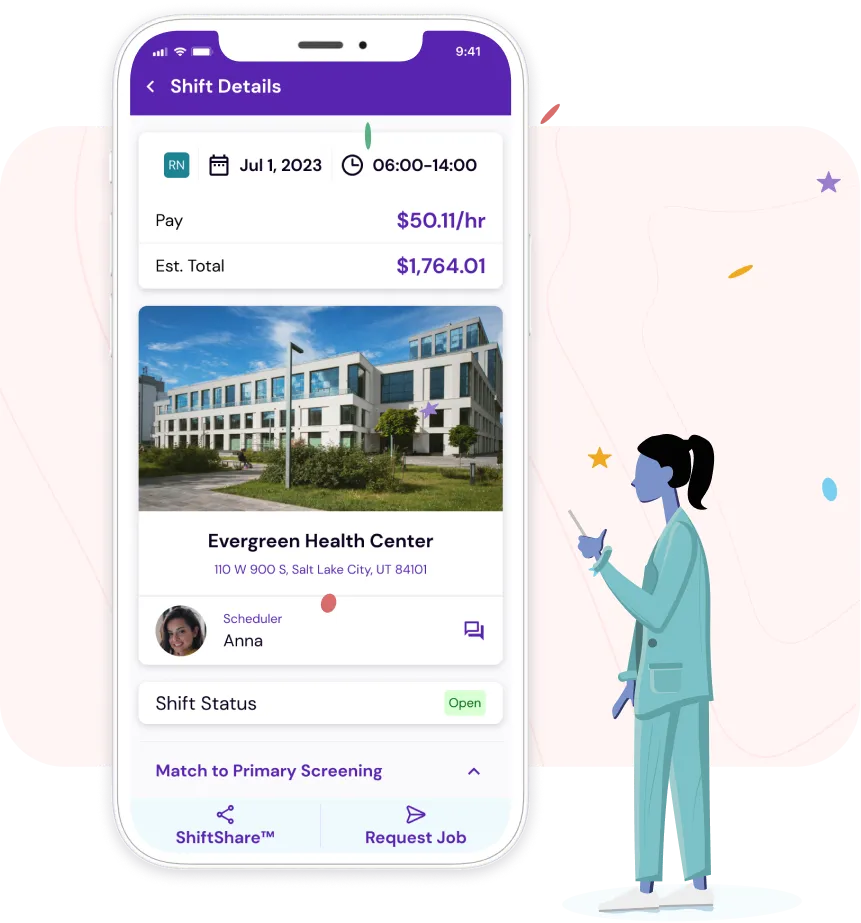
Nursa isn't just about finding a job; it's about crafting your ideal work schedule by selecting shifts. Once you create a Nursa profile, you will experience the convenience of scheduling shifts in real time.
Loading shifts…
Zip codes located within Nutley, NJ:
Loading…
Completed! We will notify you when we have desired shifts for you.
Until then, you can continue with the app to signup or login.
Continue
Until then, you can continue with the app to signup or login.
Oops! Something went wrong while submitting the form.
See More Shifts and Apply Now
Explore and find where you would like to work
Search ShiftsPer Diem JobsSelect your license and location to find the best PRN jobs
Select your license and the location you want to work in, and we'll show you the best PRN jobs available nearby.
Nutley offers a close-knit suburban community with tree-lined streets, local shops, and well-kept parks. Its parks and historic sites give it a small-town feel within the New York metro area.

Per diem nursing shifts in Nutley, New Jersey
Nutley is a township of about 29,000 people in Essex County, wedged between Newark, Belleville, Clifton, and Montclair. Manhattan is twelve miles east.
It is a settled suburban town with a real main street, and it sits inside one of the densest healthcare markets in the country. A hospital is five minutes away. Half a dozen more are within twenty.
Claiming per diem nursing shifts in Nutley, New Jersey means working that market on your own terms. It also means understanding one specific licensing limit, because the state line east of here is a hard stop.
Here is how the work runs, what New Jersey requires, and what the area offers when you are off.
What PRN shifts look like week to week
You choose your own days. That is the arrangement, and everything else follows from it.
Nursa is a marketplace app where facilities post open shifts. You browse what is available, claim what fits, and work it. No recruiter places you anywhere.
In a market with this many facilities, the ability to pick is worth more than usual. You are not taking whatever is offered, you are choosing among genuine options most weeks.
Shaping work around your life
Some clinicians build full-time hours entirely from claimed shifts. Others take four or five a month alongside a staff position or school.
Seton Hall's nursing college sits on a campus in Nutley and Clifton, and students who already hold credentials often pick up shifts around their class schedules. A semester and a fixed staff rotation do not mix well. PRN work does.
You can also change your pattern whenever you want. Heavy one month, light the next, no conversation with anyone required.
Rotating settings protects your skills
Stay on one unit for years and your range quietly narrows. You get fast at that building's habits and slower at everything outside them.
Moving between settings works against that. Skilled nursing one week, a hospital floor the next, then a home health day, and your assessments stay sharp while your charting stays adaptable.
It is also a low-risk way to test a direction. Work three shifts in rehabilitation or hospice before deciding whether you want that as a career.
Time off you do not have to request
Want a Friday free? Do not claim a Friday shift. That is the whole mechanism.
Holidays are the same. Skip them, or work them deliberately because rates climb over Thanksgiving and Christmas.
The tradeoff is that consistency is now your responsibility. Nobody tracks whether you have booked enough hours, so keep an eye on it.
Which facilities post shifts nearby
Northern New Jersey has an unusual concentration of healthcare, and Nutley sits near the middle of it.
Facilities posting PRN shifts around here typically include:
- Skilled nursing facilities caring for residents after surgery or hospitalization.
- Long-term care buildings serving residents who need daily clinical oversight.
- Assisted living and memory care communities.
- Hospitals, from community campuses to academic medical centers with trauma and pediatric capacity.
- Rehabilitation hospitals, including nationally known facilities in Essex County.
- Hospice programs, both inpatient and in patients' homes.
- Home health agencies covering Essex, Passaic, and Bergen counties.
- Behavioral health facilities and outpatient clinics.
Belleville has a medical center about five minutes away. Montclair, Passaic, and Newark each have hospitals within ten to fifteen minutes, and Paterson and Hackensack hold larger academic campuses about twenty minutes out.
A veterans medical center operates in East Orange, and the long-term care sector across these three counties is deep enough to supply steady work on its own.
Each setting asks different things. Skilled nursing runs on efficiency and a medication pass that cannot slip. Hospital work moves faster with higher acuity. Home health trades hallways for a car and a lot of independence.
Why this platform stands out
Every staffing app says it has shifts. A few specific things change how the work actually feels.
Transparent rates, fast wages
Facilities price their own postings according to how urgently they need coverage. Because you are covering an open gap rather than a budgeted position, PRN rates commonly land above what the building pays staff for identical hours.
Nursa Direct gives you access to your wages once a completed shift is verified, rather than holding them for a standard pay cycle. When money arrives shift by shift, a few days genuinely matters.
You know the deal before you claim
The rate is visible up front and does not change afterward.
Facilities carry ratings from clinicians who have actually worked there, and you leave your own once you have. In a market with this many buildings, that feedback is how you avoid wasting a shift somewhere that runs badly.
Real-time notifications send new postings to your phone as they publish, filtered to your preferences. Strong last-minute shifts here can disappear within the hour.
Support and a place to compare notes
Nursa Support handles account and shift issues, which beats sorting out a problem alone before a 6 a.m. start.
The Nursa Community forum is where clinicians trade notes on settings, rates, and what to expect from a particular kind of facility. The people answering have done the work themselves.
Facilities tend to regard the platform well too. Schedulers who trust the source post more shifts and request the same clinicians back.
Signing up and claiming a shift
Setup takes one sitting, all of it from your phone.
- Sign up and enter your personal information.
- Verify your nursing license so the app can confirm it is active and in good standing.
- Complete your clinician profile with your background, specialties, and preferred settings.
- Upload your credentials, including certification cards, immunization records, and required screenings.
- Request a PRN shift that fits your schedule.
- Complete your background check, which the shift request triggers.
Gather your paperwork before you begin. You need your license or certification number, your BLS card and any other certifications, tuberculosis screening results, immunization records, and a photo ID.
Photograph everything in advance so the process does not stall.
Once you are cleared, claiming is straightforward. The facility confirms your request, the shift lands on your schedule, and you work it like any other day.
Build one habit now. Set reminders roughly two months ahead of every credential expiration, because a lapsed card locks you out of claiming until it is renewed.
New Jersey licensing and certifications
New Jersey participates in the Nurse Licensure Compact, which is good news with one significant limit.
If you hold a multistate license from another compact state, you can practice in New Jersey without applying separately. Delaware participates, Maryland participates, and the compact reaches down the eastern seaboard from there.
New York does not participate. That is the limit, and it matters enormously twelve miles from Manhattan.
A New Jersey multistate license authorizes nothing in New York. Clinicians who want shifts in Manhattan, the Bronx, or anywhere else across the river need separate New York licensure, which runs through that state's Education Department rather than a health agency and takes time to obtain.
Pennsylvania's compact status has also been pending, so verify where it stands before counting on work across that border either.
Where New Jersey licenses come from
The New Jersey Board of Nursing sits under the Division of Consumer Affairs, which is part of the state's law and public safety department rather than health. Clinicians relocating here often look for a health department board and do not find one.
Licensure requires graduation from an approved program and a passing NCLEX score. Licenses renew on a two-year cycle with continuing education requirements, including specific content areas the state designates.
Confirm current renewal periods, fees, and continuing education requirements with the Board before relying on any figure.
Nurse aides and home health aides
New Jersey certifies nurse aides through the Department of Health. Certification requires an approved training program combining classroom instruction with supervised clinical practice, then a competency evaluation.
One requirement deserves particular attention if you work per diem. New Jersey ties nurse aide renewal to documented work in a licensed long-term care facility specifically, not simply any nursing-related work.
That distinction can catch aides who have been picking up shifts in other settings. Check what currently qualifies before your renewal window closes, because reinstating a lapsed certification takes longer than maintaining it.
New Jersey also credentials homemaker home health aides through the Board of Nursing rather than the health department, which is another agency split worth knowing if you want home care work.
Certifications worth carrying
Your license lets you practice. Certifications decide which shifts you can claim.
- Basic Life Support (BLS) is required nearly everywhere. Most facilities want American Heart Association certification specifically, so check before paying for a course.
- Advanced Cardiovascular Life Support (ACLS) is expected for nurses on hospital, emergency, telemetry, and critical care assignments.
- Pediatric Advanced Life Support (PALS) applies to pediatric, emergency, and mixed-population units. Northern New Jersey has significant pediatric capacity, so that credential opens real options.
- National Institutes of Health Stroke Scale (NIHSS) certification is standard at stroke-designated hospitals, and the region has many.
- Dementia and memory care training comes up constantly in assisted living and skilled nursing.
- Crisis prevention and de-escalation training helps in behavioral health and emergency settings.
Every certification widens the pool of shifts you qualify for, which matters in a market where good postings attract competition fast.
Healthcare work trends in northern New Jersey
Healthcare is one of the largest sectors in this part of the state, and consolidation has reshaped it considerably. Most hospitals here now belong to large systems rather than operating independently.
That shift has changed how staffing works. Systems move clinicians between campuses, standardize charting, and run centralized scheduling, which means a per diem nurse who learns one building's systems often finds the next one familiar.
Demand stays high regardless. New Jersey is densely populated, the population skews older in many of these towns, and long-term care, home health, and hospice volume holds steady year-round.
The medical and nursing education presence in Nutley and Clifton adds to the local picture. Having a school of medicine and a college of nursing on a redeveloped corporate campus in town is unusual, and it keeps clinical training activity close.
What that means for your rates
Competition works in your favor. Facilities here compete for clinicians who could just as easily drive to Hackensack, Paterson, Newark, or Bergen County, so no single building has much pricing leverage.
The New York limit cuts the other way, though. Because a New Jersey license does not reach across the river, the regional workforce is more contained than the geography suggests, which supports local rates.
Drive times are short but traffic is the variable. Most of these hospitals sit within twenty minutes in clear conditions, and considerably longer between roughly seven and nine in the morning and four and six in the afternoon.
That brackets both ends of a day shift. Night shifts avoid it entirely, which is one reason some clinicians here prefer them beyond the rate differential.
Seasonality follows the usual shape. Respiratory season from December through February drives census and call-outs up together, tightening coverage and pushing urgent postings higher.
How to spend a day off near Nutley
Nutley itself is walkable in a way a lot of Jersey suburbs are not. Franklin Avenue carries the local restaurants, bakeries, and shops, and the town's parks follow the Third River through the middle of it.
Memorial Park and Yanticaw Park both give you green space within minutes of home, which counts for something after a run of nights.
Branch Brook Park in Newark is about ten minutes south and holds the largest collection of cherry blossom trees in the country, larger than Washington's. The bloom in April is genuinely worth planning around, and the park is an Olmsted design open year-round.
Montclair, Newark, and Paterson
Montclair is ten minutes west with an art museum, a restored theater that books touring acts, and one of the better restaurant scenes in the state. Eagle Rock Reservation above it has a viewpoint looking straight across at the Manhattan skyline.
Newark is closer than people expect and has more than its reputation suggests. The performing arts center downtown is a major venue, the art museum holds a strong collection, and the Ironbound district is known across the region for Portuguese and Brazilian restaurants.
Paterson, fifteen minutes north, has the Great Falls, a seventy-seven foot waterfall in the middle of a city, now a national historical park. It is one of the more surprising sights in New Jersey.
Getting outside and getting away
The Essex County reservations give real hiking close in. South Mountain and Mills Reservation both have wooded trails, and Turtle Back Zoo in West Orange sits nearby.
The Meadowlands to the east hold a stadium, an enormous mall complex, and marsh trails that are better than they sound for birding.
Manhattan is about thirty-five minutes by bus or by train through Newark, which makes a day in the city easy without driving or parking. The Jersey Shore runs an hour to ninety minutes south, and the Delaware Water Gap is about ninety minutes west for hiking and paddling.
A practical note on driving
Transit here is better than most of the series, with bus service into Newark and Manhattan and rail connections nearby, but it rarely lines up with 7 a.m. and 7 p.m. shift changes. Most clinicians drive.
Parking is the thing to confirm before a shift. Urban hospital campuses in Newark and Paterson have garages with varying access rules, and sorting that out in advance beats circling before a night shift.
Winter brings snow and nor'easters that slow the region considerably, though nothing like northern New England. Build buffer time and check conditions before early starts.
Share this page:


No items found.
Featured Facilities in this City
Searching for other types of per diem nursing jobs? Find nurse and nursing assistant jobs in similar types of healthcare facilities here.
Facility Types
See All


Pick Up a Job Today
Find per diem PRN job opportunities in your area. High paying CNA, LPN and RN and many more licences are available now.
Join Nursa
Post Your Jobs Today
Facilities who use Nursa fill 3 times as many open per diem shifts, on average, compared to trying to fill the shifts themselves.
Post Jobs