

Waleska is a small city in Cherokee County in north Georgia, home to Reinhardt University and located about 45 miles north of Atlanta. Residents have access to Northside Hospital Cherokee in nearby Canton and the major health systems of the Atlanta area.
Waleska
Georgia
Jump to section on this page

Anchor Link
Go Beyond a Single Job
Choose Multiple Per Diem Shifts on Your Schedule
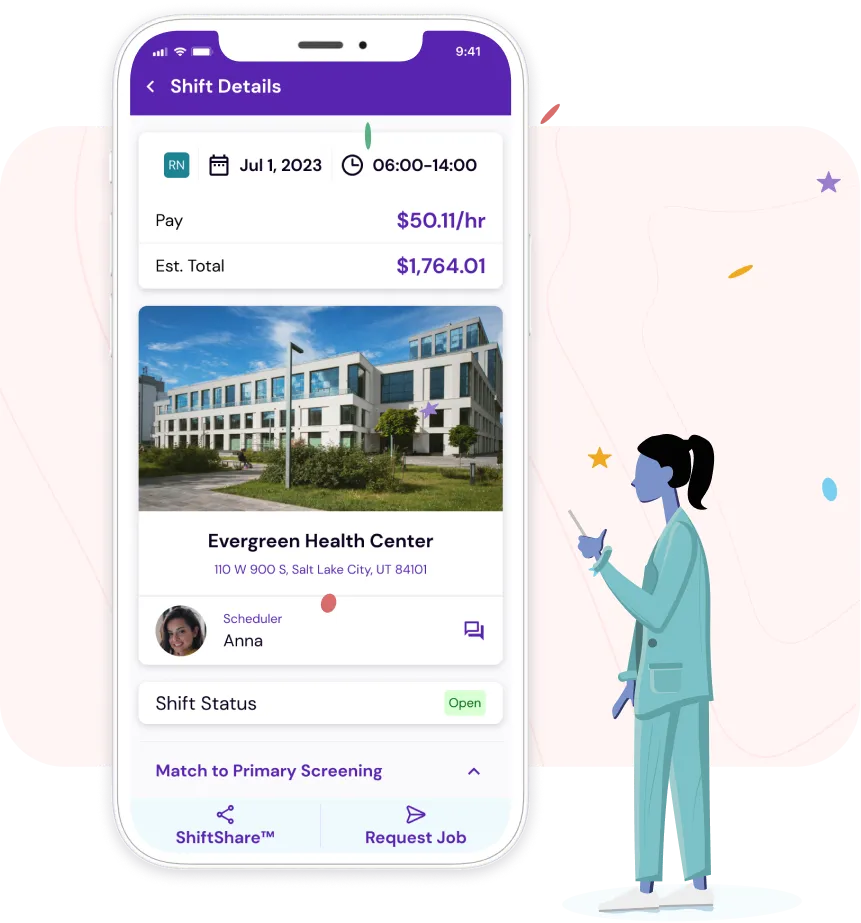
Nursa isn't just about finding a job; it's about crafting your ideal work schedule by selecting shifts. Once you create a Nursa profile, you will experience the convenience of scheduling shifts in real time.
Loading shifts…
Zip codes located within Waleska, GA:
Loading…
Completed! We will notify you when we have desired shifts for you.
Until then, you can continue with the app to signup or login.
Continue
Until then, you can continue with the app to signup or login.
Oops! Something went wrong while submitting the form.
See More Shifts and Apply Now
Explore and find where you would like to work
Search ShiftsPer Diem JobsSelect your license and location to find the best PRN jobs
Select your license and the location you want to work in, and we'll show you the best PRN jobs available nearby.
Waleska offers a quiet, rural lifestyle in the foothills of the Blue Ridge Mountains. Reinhardt University's campus anchors the community with events and activities throughout the year.

Per diem nursing shifts in Waleska, Georgia
What the north Georgia market looks like
Waleska is a small city in Cherokee County, about 45 miles north of Atlanta in the foothills below the Blue Ridge. Fewer than a thousand people live here, and Reinhardt University has anchored the community since 1883.
Clinicians evaluating per diem nursing shifts in Waleska, Georgia are working the northern edge of one of the fastest-growing metropolitan areas in the country.
Canton is fifteen minutes east with a newer hospital. Jasper is twenty minutes north, Cartersville twenty-five minutes west, and Marietta about forty minutes south with one of the largest hospitals in the state. Atlanta itself is roughly an hour.
This guide covers what per diem shifts involve for registered nurses, licensed practical nurses, and certified nursing assistants, what Georgia requires of each role, which certifications open more assignments, and what the area offers on days off.
How per diem work operates
Per diem means "per day." Instead of committing to fixed weekly hours with one employer, you claim individual shifts as facilities post them. Each listing shows the date, hours, unit, setting, and pay rate before you agree to anything.
Facilities depend on this because staffing demand refuses to hold still. Census climbs without warning. A nurse calls out two hours before a night shift. A long-term care unit loses three aides in a month and cannot replace them fast enough.
Cherokee County adds growth pressure on top of that. The county has been adding residents at a rapid pace for years, and healthcare capacity has been building to catch up. New facilities need staff, and they are recruiting from the same regional workforce as established ones closer to Atlanta.
What RN per diem shifts involve
PRN shifts for registered nurses vary considerably by setting, and this market runs from small community hospitals to large metropolitan campuses.
On a community hospital unit, your assignment is defined by the floor. Medical-surgical, telemetry, emergency, and step-down assignments make up most per diem listings in Cherokee and the surrounding counties. You handle assessments, medication administration, intravenous therapy, provider communication, discharge preparation, and continuous documentation within a defined patient load.
Drive south toward Marietta or Atlanta and acuity climbs. Those larger campuses carry trauma capacity, subspecialty units, and pediatric specialty care, and they pay at the top of the regional range for nurses with current acute care experience.
Skilled nursing looks different. An RN there typically oversees a unit, supervises LPNs and aides, manages admissions and hospital returns, completes required assessments, coordinates with providers, and responds to any change in a resident's condition. The resident load is larger and the role leans toward clinical oversight.
Home health puts an RN in a car between residences across the county, handling wound care, medication reconciliation, teaching, and skilled assessments. Agencies generally expect at least a year of experience, because you evaluate and decide without a colleague nearby.
Facilities pay RNs the most because the license carries the clinical judgment. When a patient's condition changes, the RN determines what it means and acts. A facility short one RN is missing a decision-maker.
What LPN per diem shifts involve
Licensed practical nurses practice under RN or physician supervision. In north Georgia, that work concentrates in skilled nursing, long-term care, personal care homes, assisted living, clinics, and home care.
A typical shift centers on medication administration. On a long-term care unit, that can mean passing medications to 20 or more residents across a shift, with treatments, dressing changes, glucose checks, and continuous observation layered on top.
Documentation runs alongside the clinical work rather than after it. Falling behind during a shift compounds quickly, and the last hour becomes unmanageable.
LPNs are also the staff most likely to catch a problem first. You see the same residents repeatedly, you know their baseline, and you notice a change before it registers in a vital sign. Reporting that promptly to the supervising RN is among the most clinically valuable things the role does.
Pace matters here more than in most positions. A medication pass running an hour behind pushes the entire unit out of sequence. Facilities request LPNs who move through a pass accurately and stay on schedule.
What CNA per diem shifts involve
Certified nursing assistants account for the highest volume of open postings across this region, and the work is the most physically demanding of the three roles.
Shifts center on direct resident care: bathing, dressing, toileting, repositioning, transfers, feeding assistance, and ambulation. You also record vital signs, document intake and output, and report anything unusual to the nurse covering the unit.
Assignments commonly run eight to twelve residents on a day shift in long-term care, and more on evenings and overnights. Efficiency and organization matter more than advanced clinical skills.
The clinical importance of the role gets underestimated. CNAs spend more time with residents than anyone else in the building. Skin breakdown, decreased appetite, new confusion, unsteadiness that was not present last week, most of it reaches the care team through an aide first.
Body mechanics deserve deliberate attention in per diem work. You move between buildings with different lift equipment, different transfer policies, and different layouts. Locate the mechanical lifts and confirm the transfer policy before your first resident.
How per diem compares to a staff position
Staff employment provides predictability: set hours, a consistent paycheck, and whatever benefits the employer carries. What you give up is control of your calendar. Someone else builds the schedule, holidays rotate on a fixed cycle, and mandatory overtime arrives regardless of your circumstances.
Per diem reverses that. You choose the days you work, and no manager can hold you for a second consecutive shift. In exchange, you take responsibility for your own scheduling consistency, your own credential renewals, and your own financial planning between shifts.
Many clinicians refuse to treat this as an either-or decision. They keep a part-time staff role for a stable floor and add claimed shifts on top. Others build a full week from per diem work alone. The facility density between here and Atlanta supports both.
Georgia license requirements by role
Every shift in Waleska requires the correct Georgia credential in active status. Georgia organizes licensing in a way that surprises clinicians coming from other states.
Registered nurse licensure
The Georgia Board of Nursing operates under the Secretary of State's office rather than a health department. That placement catches relocating clinicians off guard, since most states handle nursing licensure through health agencies or independent boards.
Licensure requires graduation from an approved nursing program and a passing score on the NCLEX-RN examination.
Georgia participates in the Nurse Licensure Compact and has since its early years. A multistate license from another compact state authorizes you to practice here without a separate application.
That advantage is unusually strong in Georgia's case. Tennessee, Alabama, Florida, South Carolina, and North Carolina all participate as well, which means every state bordering Georgia is a compact member. A clinician here can work across state lines on one credential in a way that is not possible in much of the country.
Licenses renew on a two-year cycle with continuing education requirements. Confirm the current renewal period, fees, and education requirements with the Board before relying on any figure.
Licensed practical nurse licensure
Georgia handles practical nurse licensure through a separate board from the one governing registered nurses. That means a different application process and a different set of renewal requirements.
Clinicians who hold both credentials, or RNs who supervise LPNs, should know they are dealing with two distinct bodies rather than one office handling both.
Licensure requires completing an approved practical nursing program and passing the NCLEX-PN examination, and compact provisions apply to practical nurses as well.
LPNs interested in expanding their scope should look into intravenous therapy preparation. Georgia permits LPNs to perform certain IV-related functions after approved additional training, and facilities value that because it reduces how often they pull an RN away from another task.
Certified nursing assistant certification
Georgia maintains its nurse aide registry through the Department of Community Health, a third agency separate from both nursing boards. Certification requires completing a state-approved training program combining classroom instruction with supervised clinical practice, then passing a competency evaluation.
Registry listings do not transfer between states the way a compact nursing license does. Even though Georgia's neighbors all participate in the compact for nurses, an aide crossing a state line needs to meet that state's requirements separately.
Certification remains active for a defined period and requires documented paid work in a nursing-related capacity to renew. That requirement matters specifically for per diem aides. An extended stretch without claimed shifts can put your renewal at risk, and reinstatement takes longer than maintaining it would have.
Verify the current training hour requirement, testing process, certification period, and renewal rules with the Department of Community Health before relying on any figure.
Certifications facilities look for
Licensure lets you practice. Certifications determine which shifts you can actually claim, and a deeper credential set reaches further into the better-paying assignments.
- Basic Life Support (BLS) certification is required across nearly every setting and role. Most facilities specify American Heart Association certification, so confirm what a facility accepts before paying for a course.
- Advanced Cardiovascular Life Support (ACLS) is expected for RNs in hospital, emergency, telemetry, and critical care assignments. It qualifies you to take an active role in resuscitation beyond compressions and basic airway management.
- Pediatric Advanced Life Support (PALS) applies to RNs working pediatric, emergency, or mixed-population units. Metro Atlanta has substantial pediatric specialty capacity, so that credential opens real options.
- National Institutes of Health Stroke Scale (NIHSS) certification is standard at stroke-designated hospitals across the region.
- Dementia and memory care training is commonly requested by assisted living, personal care homes, and skilled nursing facilities, and memory care units often require it before a shift can be claimed.
- Crisis prevention and de-escalation training benefits clinicians in behavioral health, memory care, and emergency settings, where verbal intervention is the first and safest option.
The practical argument for holding more certifications than your role strictly requires is access. Each one widens the pool of shifts you qualify for, which matters when the local board runs thin and you are deciding whether to drive further.
What drives pay in this area
Per diem rates in north Georgia generally exceed what the same facility pays staff employees holding equivalent credentials. The gap depends on role, setting, timing, and the pressure a facility faces when it posts.
Several patterns repeat consistently.
- Overnight and weekend coverage pays more than weekday daytime hours.
- Holiday shifts reach the highest rates of the year, particularly between Thanksgiving and New Year's Day.
- Postings published within 24 hours of the start time often carry a premium, because internal options have been exhausted.
- Higher-acuity settings pay more than lower-acuity settings for identical credentials.
- Respiratory season raises census and staff call-outs simultaneously from roughly December through February.
- Winter ice events create sudden same-day gaps, since this region is not equipped to clear roads quickly.
Competition between large systems supports rates. Metro Atlanta has several major hospital networks operating campuses across the northern suburbs, and they recruit from the same workforce as the community hospitals closer to Waleska.
Growth adds to it. Cherokee County has been expanding for years, and new facilities opening in the area need staff from day one.
The compact works in your favor here too. Because every neighboring state participates, clinicians have unusually wide options, and local facilities have to price competitively to keep people working nearby.
Why nursing professionals use Nursa
Nursa is a marketplace that connects nursing professionals directly with facilities posting open shifts. It operates as a platform rather than a staffing agency, and that distinction determines who decides. No recruiter assigns you anywhere. You review what is posted, weigh it against your own criteria, and claim what fits.
Rates set by actual demand
Facilities price their own postings according to how urgently they need coverage. Because you are closing a gap rather than occupying a budgeted position, per diem nursing jobs on the marketplace frequently pay more per hour than comparable full-time roles inside the same building. The rate is visible before you claim and does not change afterward.
Instant pay through Nursa Direct
Conventional payroll holds earned wages for a week or longer. Nursa Direct provides access to your pay once a shift is completed and verified, rather than requiring you to wait for a standard pay cycle. When income arrives shift by shift, that timing directly affects how you manage expenses.
Control over your schedule
Nothing is assigned. You filter shifts by date, distance, role, and rate, then select what fits your week. Three 12-hour shifts, two evenings plus alternating weekends, or one shift a month all work within the same system, and the arrangement adjusts as your circumstances change.
Range of facility types
Shifts span long-term care, assisted living, hospitals, skilled nursing facilities, and home health settings. That range protects your clinical skills over time. Working a single setting exclusively narrows your abilities gradually, while rotating across settings keeps your assessment skills and documentation fluency intact.
Real-time notifications and direct messaging
Well-paying last-minute postings fill quickly. Real-time shift notifications deliver new openings to your phone as they publish, filtered to your stated preferences, so you can respond before someone else claims them.
You also message facility schedulers directly in the app. Questions about the unit, the documentation system, or where to park go to the person who knows. Parking is worth confirming for the larger metro campuses, where garage access varies.
Setting up your account
Setup is short, and most clinicians complete it from a phone in a single sitting.
- Add your personal information to create your account.
- Verify your nursing license so the platform can confirm it is active and in good standing.
- Complete your clinician profile with your work history, specialties, and preferred settings.
- Upload your essential credentials, including certifications, immunization records, and required screenings.
- Request a shift, which initiates your background check.
Gather your documents before you begin. You will need your license or certification number, certification cards, tuberculosis screening results, immunization records, and a government-issued photo identification.
Once active, set calendar reminders 60 days ahead of each credential expiration. A lapsed certification blocks you from claiming shifts entirely, and sorting it out always costs more time than renewing would have.
Living and working in Waleska
Waleska suits clinicians who want flexible shifts because it offers rural quiet with metropolitan access. The city sits in rolling country below the Blue Ridge, and much of what surrounds it is still woods and farmland.
Highway 140 runs through town toward Canton in one direction and Cartersville in the other. Interstate 575 is about twenty minutes east and runs south into the Atlanta metro, while Interstate 75 sits a similar distance west.
Reinhardt University anchors the community and keeps it more active than a place this size would otherwise be, with athletics, performances, and campus events through the academic year.
Facilities within reach
Canton, fifteen minutes east, has a hospital that opened relatively recently and serves the county's growing population. Jasper has a smaller community hospital twenty minutes north, and Cartersville has another twenty-five minutes west.
Head south and the options expand considerably. Marietta holds one of the largest hospitals in Georgia about forty minutes away, and the Atlanta metro beyond it carries academic campuses, a children's hospital system, a Level 1 trauma center, and a veterans medical center.
Skilled nursing facilities, assisted living communities, personal care homes, and home health agencies spread across Cherokee, Bartow, and Pickens counties.
That spread is what makes prn nursing jobs practical to combine from a Waleska address. You can work a local skilled nursing shift one day and a hospital shift closer to Atlanta the next, provided you account for the drive.
Lakes, mountains, and trails
Lake Arrowhead sits in Waleska itself, and Allatoona Lake is about twenty-five minutes southwest with extensive shoreline, boating, and fishing. Red Top Mountain State Park occupies a peninsula on that lake with trails and camping.
Head north and the mountains start. Amicalola Falls State Park is about forty minutes away and holds the tallest cascading waterfall east of the Mississippi, with a staircase to the top and a connection to the approach trail for the Appalachian Trail.
Closer in, mountain biking trails near Woodstock draw riders from across the metro area, and the Etowah River runs through the county for paddling and fishing.
Local culture and nearby towns
Reinhardt University keeps a heritage center on campus in Waleska with collections covering Native American and Appalachian history, which is an unusual resource for a town this size.
Canton and Woodstock both have restored downtowns with restaurants, breweries, and regular events, and Woodstock in particular has grown into a destination for the northern suburbs.
Cartersville, twenty-five minutes west, holds a Western art museum and a science museum, along with a preserved Native American mound site along the Etowah River.
Dahlonega is about forty-five minutes northeast, a former gold rush town that now anchors Georgia's wine country. Blue Ridge and the north Georgia mountains sit an hour beyond that.
Atlanta is roughly an hour south when you want a city, with professional sports, a major aquarium, art museums, and one of the stronger restaurant scenes in the Southeast.
Practical considerations
Housing in Cherokee County costs less than the inner Atlanta suburbs, though prices have risen substantially with the county's growth. Many clinicians working this area live in Canton, Cartersville, or Ball Ground.
Traffic is the main scheduling variable. The interstates into Atlanta back up severely between roughly 7 a.m. and 9 a.m. and again from 4 p.m. to 6 p.m., which brackets both ends of a day shift. Night shifts avoid it entirely.
Weather rarely interferes, with one exception. Winter ice storms hit this region occasionally, and Georgia is not equipped to clear roads quickly. When ice is forecast, plan around it seriously rather than assuming the drive will be normal.
Summer heat and humidity are heavy from June through September, so think about the walk across a parking lot at the end of a day shift.
Getting started
Per diem work rewards clinicians who stay organized, adapt quickly, and can enter an unfamiliar building prepared to contribute. Waleska pairs a rural setting with community hospitals nearby and one of the country's larger healthcare markets an hour south.
Confirm your license or certification is current, gather your credential documents, complete your profile, and start tracking what opens nearby. The schedule is yours to build.
Share this page:


No items found.
Featured Facilities in this City
Searching for other types of per diem nursing jobs? Find nurse and nursing assistant jobs in similar types of healthcare facilities here.
Facility Types
See All


Pick Up a Job Today
Find per diem PRN job opportunities in your area. High paying CNA, LPN and RN and many more licences are available now.
Join Nursa
Post Your Jobs Today
Facilities who use Nursa fill 3 times as many open per diem shifts, on average, compared to trying to fill the shifts themselves.
Post Jobs