

Bluefield is a town in Tazewell County in southwest Virginia, located on the West Virginia border next to its sister city of Bluefield, West Virginia. Residents have access to hospitals in nearby Princeton, West Virginia, and Tazewell, Virginia.
Bluefield
Virginia
Jump to section on this page

Anchor Link
Go Beyond a Single Job
Choose Multiple Per Diem Shifts on Your Schedule
Nursa isn't just about finding a job; it's about crafting your ideal work schedule by selecting shifts. Once you create a Nursa profile, you will experience the convenience of scheduling shifts in real time.
Loading shifts…
Zip codes located within Bluefield, VA:
Loading…
Completed! We will notify you when we have desired shifts for you.
Until then, you can continue with the app to signup or login.
Continue
Until then, you can continue with the app to signup or login.
Oops! Something went wrong while submitting the form.
See More Shifts and Apply Now
Explore and find where you would like to work
Search ShiftsPer Diem JobsSelect your license and location to find the best PRN jobs
Select your license and the location you want to work in, and we'll show you the best PRN jobs available nearby.
Bluefield offers a small-town lifestyle in the Appalachian Mountains and is home to Bluefield University. Its cool summer temperatures earned the area the nickname "Nature's Air-Conditioned City."

Per diem nursing shifts in Bluefield, Virginia
Bluefield sits at the far southwestern corner of Virginia, right up against the West Virginia line. About 5,000 people live on the Virginia side, and the town runs straight into Bluefield, West Virginia without much of a gap.
That setup matters if you want per diem nursing shifts in Bluefield, Virginia. Two states of open shifts sit inside a 30-minute drive. Nursa, a per diem staffing app, lists PRN shifts across both.
Per diem work means you claim shifts one at a time. No fixed rotation. No contract locking you into 13 weeks somewhere you would rather not be.
You see what a facility posted, you see the rate, and you say yes or no. That is the whole arrangement. For a lot of nurses around here, it is the first time the calendar has actually belonged to them.
What is working PRN like?
PRN comes from the Latin pro re nata, which translates roughly to "as needed." In practice it means a facility has a gap and you have the option to fill it.
Day to day, the work itself looks like nursing anywhere. What changes is everything around it.
You pick the shifts
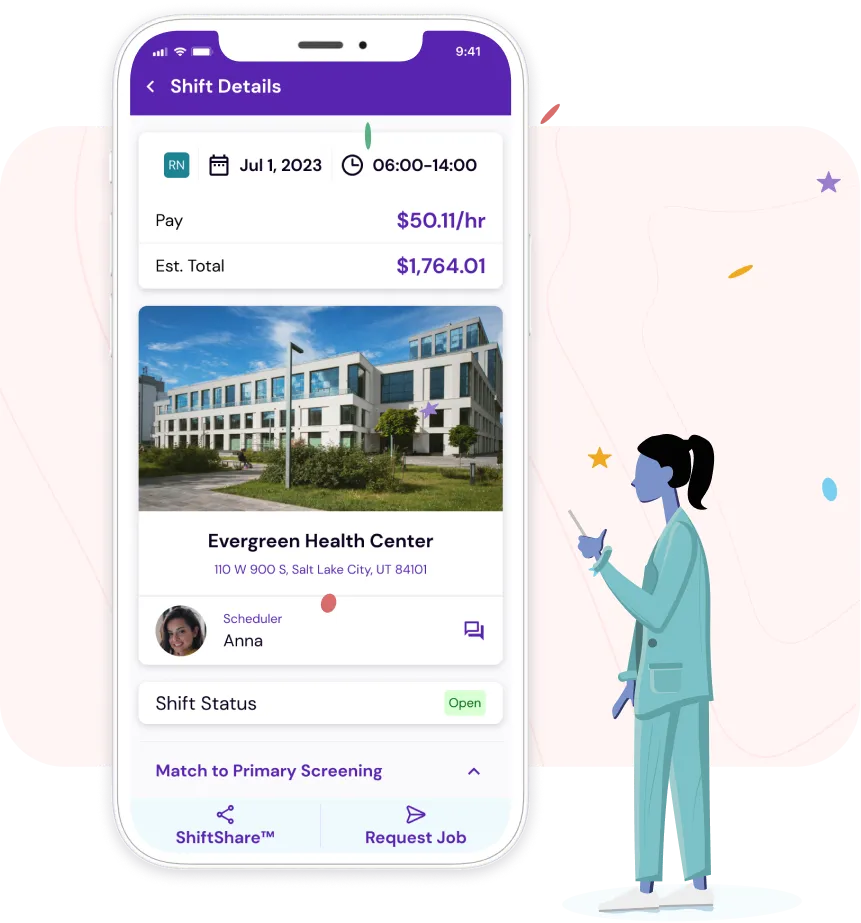
Open shifts show up in the app with the date, the unit, the setting, and the wage already attached. You scroll, you filter, you request what fits your week.
Nobody assigns you a rotation. Nobody asks you to swap a Saturday so the schedule balances out.
If your kid has a game on Thursday, you do not pick up Thursday. That sounds small until you have spent a few years begging a charge nurse for one weekend off.
The flip side is real and worth saying plainly. Hours are not promised. Some weeks have five shifts you want and some weeks have one.
Most people handle that by keeping a loose plan a month out and adjusting as postings land. You are not guessing blind after the first few weeks.
Variety across work settings
A staff position puts you on one unit in one building. PRN work does not.
You might spend Monday in long-term care, Wednesday on a medical-surgical floor, and Friday driving a home health route. Each one asks something a little different from you.
That variety keeps skills sharp. It also answers a question a lot of clinicians never get to test, which is whether they actually like the setting they landed in years ago.
Plenty of nurses find out they prefer long-term care after a decade of assuming they wanted acute. Some go the other direction. You cannot know until you work both.
Room for a life outside work
Burnout usually comes from having no say, not from the work being hard. Nursing is hard either way.
Setting your own schedule changes the math. You can front-load a month, take ten days off, and not ask permission from anyone.
Some people use PRN as their only work. Others hold a full-time position and add two shifts a month to cover something specific, like a trip or a car repair.
Both work. The app does not care which one you are doing, and there is no minimum you have to hit.
Why Bluefield fits PRN work
Small towns can be tough for per diem work when there are only two facilities within an hour. Bluefield does not have that problem.
A small town on a state line
Bluefield, Virginia and Bluefield, West Virginia function as one town split by a border. Locals cross it several times a day without thinking about it.
For a nurse, that means two states of facilities inside a normal commute. Tazewell County on the Virginia side, Mercer County on the West Virginia side.
Princeton is 10 to 15 minutes north. Tazewell runs about 20 minutes west, Richlands about 30. Beckley is roughly an hour up Interstate 77.
That radius holds skilled nursing facilities, assisted living communities, hospital campuses, and home health agencies. In a town of 5,000, that is more than you would expect.
Short drives and mountain roads
Interstate 77 and US Route 460 both run near town, and the East River Mountain Tunnel takes I-77 straight through the ridge into West Virginia. Highway access like that is unusual for a place this size.
Mileage and drive time are not the same thing here, though. Mountain grades and switchbacks stretch a 20-mile trip further than the map suggests.
Build in a cushion, especially for a 7 a.m. start. Fog settles into the valleys in spring and fall, and winter ice is a genuine factor at this elevation.
None of that is a dealbreaker. It just means you check the forecast before you claim a 6 a.m. shift 30 minutes out.
Which facilities post PRN shifts?
Southwest Virginia and southern West Virginia skew older than the national average. Rural hospitals in the region have also consolidated over the past decade.
Both trends push coverage needs toward long-term care and home-based settings. Across the app, postings around Bluefield come from settings like these:
- Long-term care facilities serving residents who live there full time.
- Skilled nursing facilities handling post-acute recovery and rehabilitation.
- Assisted living communities focused on medication passes and daily support.
- Hospitals covering medical-surgical floors, emergency departments, and observation.
- Hospice settings where the work centers on comfort and family communication.
- Home health agencies sending clinicians out on rural routes.
- Urgent care and outpatient clinics with shorter daytime shifts.
- Behavioral health settings that lean on de-escalation and close observation.
Long-term care posts the highest volume in this market by a wide margin. Census stays steady, so coverage gaps stay steady too.
A nursing assistant or medication aide will find the most consistent options in long-term care and assisted living, especially evenings and overnights. Those are the hardest slots for any building to fill.
Home health is worth a look if you document well and do not mind driving. Rural routes mean windshield time, so ask how mileage is handled before you take a first assignment.
What sets this PRN app apart?
Per diem platforms are not all the same, and the differences show up fast once you have worked a few shifts.
Fast wages and clear rates
The wage is posted before you request the shift. You know the number going in, which is not how a staff position works.
Rates for per diem coverage frequently run above what the same facility pays a full-time nurse per hour. Facilities are paying for speed, and that shows up in the posting.
Pay also moves faster than a standard two-week cycle. You can access wages from completed shifts without waiting on a calendar somebody else set.
That speed is often the reason an extra shift feels worth claiming. Picking up a Saturday overnight makes more sense when the money is not four weeks out.
A community and a support team
There is a forum where clinicians talk to each other about facilities, documentation questions, tax setup, and everything else that comes with per diem work.
That kind of thing matters more than it sounds. Independent work can get isolating, and a healthcare professional working three different buildings a week does not have a break room crew anymore.
A support team handles the account side, credential questions, and problems that come up around a shift. If something goes sideways at a facility, you are not sorting it out alone.
The platform also has a track record with facilities in the region, which is quietly useful. Buildings that trust the app post to it more often, and that means more options for you.
Rate your own shift experiences
After a shift, you can rate the facility. Ratings from other clinicians show up before you claim one.
That runs in both directions and it changes how buildings behave. A facility that consistently hands per diem staff an unsafe assignment gets seen.
Shift alerts land in real time too. Good postings get claimed quickly, especially urgent ones with higher rates.
Set your license type, your radius, and the settings you want. Then respond when something fits instead of refreshing a screen all afternoon.
How the app works
Setup happens once. After that, requesting a shift takes about as long as ordering coffee.
- Sign up with your basic personal and contact information.
- Verify your active nursing license, including multistate status if you hold it.
- Complete your clinician profile with your experience, specialties, and preferred settings.
- Upload your essential credentials so facilities can confirm you before a shift.
- Request a PRN shift that fits your schedule.
- Complete the background check, which your first shift request kicks off.
The background check is standard across healthcare staffing and exists to protect patients. It usually clears in a few days.
Once it does, confirmed shifts land on your schedule with the address, start time, unit, and check-in instructions. You show up, check in, work, and confirm your hours at the end.
One tip that saves real time. Scan every credential to a single folder on your phone before you start, because the most common reason a request stalls is a missing or expired document.
Virginia licensing and certifications
Licensing in this corner of the state has an advantage most places do not get.
Working across the state line
Virginia belongs to the Nurse Licensure Compact. West Virginia does too.
If your home state issued you a multistate license, you can practice in both without applying for a second one. For a border town, that is the difference between one pool of shifts and two.
Check your own license status first. Not every Virginia license carries multistate privilege, and a single-state license will not cover you across the line.
A nursing assistant or medication aide should confirm separately. The compact covers nursing licenses, not every certification, and state requirements differ. Ask the facility what they need on file before you request a cross-border shift.
Certifications worth keeping current
Basic life support (BLS) is the baseline. Nearly every facility requires a current card, and an expired one will stop a shift request cold.
Beyond that, what helps depends on where you want to work:
- Advanced cardiovascular life support (ACLS) opens up hospital and emergency shifts.
- Pediatric advanced life support (PALS) matters for emergency departments and any setting seeing children.
- Current tuberculosis (TB) screening and immunization records are required almost everywhere.
- Wound care or infusion certifications make home health routes easier to land.
Set calendar reminders 60 days before anything expires. Renewing early costs you nothing and missing a renewal costs you shifts.
What local shift demand looks like
Healthcare is one of the steadier fields in this part of Appalachia. Coal mining shaped the economy here for a century, and as that contracted, healthcare and education became the larger anchors.
The population skews older than the national average, which drives steady need in long-term care, skilled nursing, and home health. That is the core of what gets posted around Bluefield.
Rural facilities across the region have also had a hard time keeping units fully staffed. Fewer nurses live within commuting distance than the buildings need, and that gap is exactly what per diem coverage fills.
For you, that translates into a few practical patterns worth learning:
- Long-term care posts heavily for weekends and overnights year-round.
- Hospitals post more around holidays and through respiratory season.
- Home health needs cluster on weekdays, which suits anyone avoiding nights.
- Winter weather drives short-notice postings, often at higher rates.
Watch the app for two or three weeks and the rhythm shows itself. Most people here anchor a month with two or three regular buildings and stay opportunistic about the rest.
Things to do on your days off
The upside of working in the mountains is that recovering from a rough stretch does not require going far.
Get outside first
Bluefield sits around 2,600 feet, high enough that summers stay cooler than the rest of Virginia. Bluefield, West Virginia leans into it and has long called itself Nature's Air Conditioned City, handing out free lemonade when the temperature hits 90 degrees.
Cavitts Creek Park near Tazewell has a lake, trails, and picnic areas. It is an easy half day.
The Hatfield-McCoy Trails system runs through the coalfields with a trailhead at Pocahontas, drawing off-road riders from several states. Pipestem Resort State Park is under an hour north with hiking, a lake, and an aerial tram down into the Bluestone Gorge.
After a night shift, sleeping is genuinely easier at this elevation. Evenings cool off in a way they do not in Richmond or Norfolk.
Coal history and small-town stops
This area grew up around coal and the railroad, and it still shows. The Pocahontas Exhibition Coal Mine takes you underground into a seam that was worked for decades.
The Historic Crab Orchard Museum in Tazewell covers regional settlement and frontier life. Bramwell, just over the West Virginia line, has a row of preserved mansions built by coal operators and runs house tours through the year.
Bowen Field in Bluefield, West Virginia hosts summer baseball. A ballgame on a cool mountain evening is about as low-effort as a day off gets.
Bluefield University sits on the Virginia side and adds athletics, concerts, and public lectures. Hours and seasons shift, so check schedules before you plan around any of it.
Drives worth the gas
Two drives stand out and neither takes long.
Burke's Garden is about 45 minutes west, a bowl-shaped valley ringed by mountains that locals call God's Thumbprint. It is the highest valley in Virginia and mostly farmland, which is the appeal.
The Back of the Dragon runs 32 miles of switchbacks on Route 16 between Tazewell and Marion. Motorcyclists come from all over for it. Take it slow in daylight your first time.
For something bigger, Blacksburg is under two hours east and Roanoke about two and a half. Both give you a real city without needing to stay the night.
Making PRN work in Bluefield
Per diem suits people who would rather have control than a guarantee. You trade a fixed schedule for the ability to say no.
The tradeoffs are worth naming. Hours move week to week, and independent contractors handle their own taxes and insurance. You also walk into unfamiliar buildings often, which takes a willingness to ask questions and find the supply closet fast.
If that sounds workable, this is a reasonable place to try it. The commutes are short, a compact license opens up two states, and the mix of settings lets you sample long-term care, acute, and home health without moving anywhere.
Get your credentials scanned, finish your profile, and see what is posted this week.
Share this page:


No items found.
Featured Facilities in this City
Searching for other types of per diem nursing jobs? Find nurse and nursing assistant jobs in similar types of healthcare facilities here.
Facility Types
See All


Pick Up a Job Today
Find per diem PRN job opportunities in your area. High paying CNA, LPN and RN and many more licences are available now.
Join Nursa
Post Your Jobs Today
Facilities who use Nursa fill 3 times as many open per diem shifts, on average, compared to trying to fill the shifts themselves.
Post Jobs