Would you like your nursing license to be valid in different states? Would you like to travel and pick up PRN nursing shifts along the way?
If your state is not yet fully part of the Nursing Licensure Compact (NLC), it may have partial implementation or pending legislation.
Discover what the nurse licensure compact is, which states are compact states for nursing, which others will be shortly, and how to get a compact nursing license in this ultimate guide to the NLC.
2026 NLC status at a glance
*The NLC is enacted, but the state is awaiting full implementation.
**Guam has partial implementation (recognizes incoming multistate licenses but does not yet issue them).
What is the nursing licensure compact?
The Nursing Licensure Compact is an agreement among U.S. states and jurisdictions that allows nurses to practice in other NLC-participating states without obtaining new licenses in those states. The Nursing Licensure Compact makes it easier for nurses to find work in different states while ensuring they meet the agreed-upon safety standards set by the NLC.
Which are compact nursing states in 2026?
There are currently 41 states that are members of the nursing compact, and an additional 6 states have pending status—7 total with the nation’s capital. That leaves only 3 states with neither active nor pending NLC legislation.
Map of compact nursing states in 2026
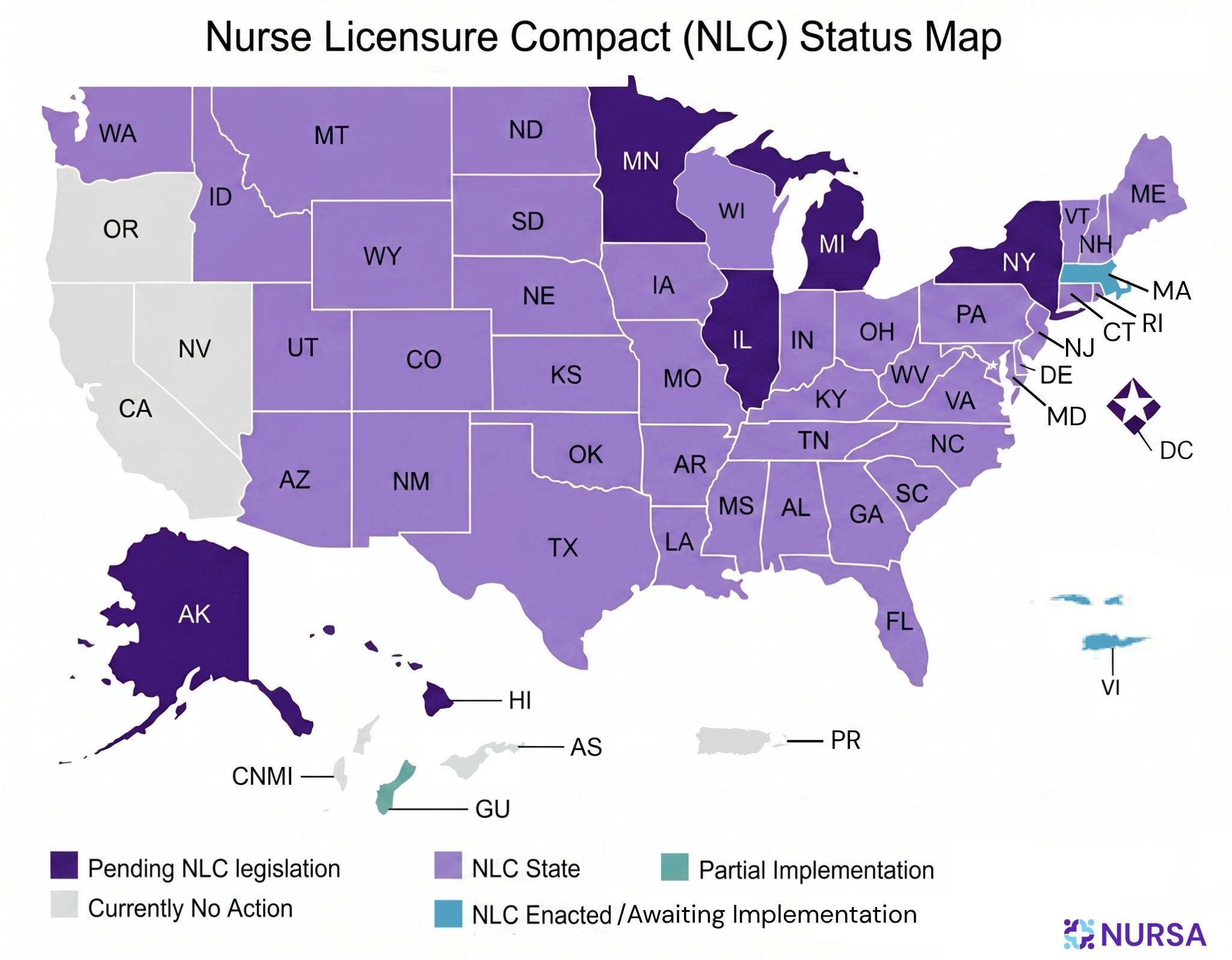
List of eNLC states
Here is the complete list of compact nursing states for RNs and LPNs/LVNs:
- Alabama
- Arizona
- Arkansas
- Colorado
- Connecticut
- Delaware
- Florida
- Georgia
- Idaho
- Indiana
- Iowa
- Kansas
- Kentucky
- Louisiana
- Maine
- Maryland
- Massachusetts*
- Mississippi
- Missouri
- Montana
- Nebraska
- New Hampshire
- New Jersey
- New Mexico
- North Carolina
- North Dakota
- Ohio
- Oklahoma
- Pennsylvania
- Rhode Island
- South Carolina
- South Dakota
- Tennessee
- Texas
- Utah
- Vermont
- Virginia
- Washington
- West Virginia
- Wisconsin
- Wyoming
*The NLC is enacted, but the state is awaiting full implementation.
The following US territories are also eNLC members:
- Guam has a partial implementation.
- The Virgin Islands is awaiting implementation.
States with a pending NLC status
Additionally, 6 states have a pending nursing compact status:
The nation’s capital, Washington, D.C., also has a pending status.
Non-compact nursing states
At this point, only 3 states have neither active nor pending NLC legislation:
The US territories of American Samoa and Northern Mariana Islands have also not entered the nursing compact nor initiated legislation.
Puerto Rico also isn’t an NLC member, as it is only an associate member of the National Council of State Boards of Nursing (NCSBN), the organization that created and facilitates the nursing compact.
History of the nursing compact: NLC vs. eNLC
In the past, nurses needed to obtain separate licenses for each state or jurisdiction where they worked.
This requirement began to change when Maryland, Texas, Utah, and Wisconsin enacted the Nurse Licensure Compact on January 1, 2000. Through the NLC, registered nurses (RNs) and licensed practical/vocational nurses (LPN/LVNs) could practice in multiple states—physically or remotely—with a single license and without meeting additional requirements or paying extra fees.
Although 25 states joined the NLC, many nurses and nursing associations expressed concerns, and new memberships plateaued. Based on these concerns, the NCSBN amended some aspects of the compact, creating the enhanced Nursing Licensure Compact (eNLC) in 2015.
This newly proposed legislation aimed to replace the original NLC and implement requirements addressing the issues that reluctant nurses and nursing associations had voiced. Members of the eNLC needed to have the same licensing requirements, were authorized to obtain and submit criminal background checks, and were required to report all disciplinary measures.
On July 20, 2017, the eNLC came into effect when North Carolina tipped the balance in favor of compact states by becoming the 26th member. The eNLC was implemented 6 months later, on January 19, 2018. On this date, nurses with multistate licenses could begin practicing in eNLC states.
Since 2017, many more states have entered or are in the process of entering the nursing compact. For example, although the Massachusetts Nurses Association raised concerns about the nursing compact, Massachusetts is now a compact state, and other states that initially resisted the change currently have pending legislation, including Illinois, New York, and Michigan.
Benefits and disadvantages of joining the nurse compact
With 47 states in the compact or awaiting legislation, the NLC is widely accepted in the United States. However, some nurses and nursing associations waited many years before entering, and a few are still resisting the change.
What are the advantages of the NLC that are responsible for drawing nearly all states into the nursing compact, and which factors have led to hesitancy?
Benefits of the nurse licensure compact
According to the National Council of State Boards of Nursing, the Nurse Licensure Compact offers the following benefits for nurses, employers, and the nation as a whole:
- Telehealth: It allows nurses to practice in person or provide telehealth nursing services to patients across state lines without requiring additional licenses.
- Education: It facilitates online nursing education.
- Budget: It reduces expenses for organizations that employ nurses.
- Emergency response: It enables nurses to cross state borders and provide vital nursing services during or after disasters.
- Travel: It facilitates practicing across state borders, including travel nursing contracts.
- PRN opportunities: Compact status makes it easier to pick up PRN shifts across state lines, offering nurses access to more options and higher-paying markets, as well as the ability to follow family or opportunities without re-licensing each time.
Disadvantages of joining the NLC
Arguably, most of the NLC's disadvantages were eliminated with the creation of the eNLC. However, some concerns individuals and organizations had before the amendments to the nursing compact remain in the eNLC, and some attempts to assuage those concerns raised new ones.
Lower standards for nursing licensure in compact states
Some nurses and nursing associations were concerned that the standards for nursing licensure in their states were higher than those of the nursing compact and did not want to weaken those standards.
Although the eNLC requires nursing programs to be approved by a board of nursing and requires candidates to qualify for licensure in their home states, which includes passing the National Council Licensure Examination for Registered Nurses (NCLEX-RN) or Practical Nurses (NCLEX-PN), it is true that state requirements vary, including those regarding continuing education units (CEUs).
Impacts of disciplinary actions
Individuals and organizations were also concerned about loosening standards regarding background checks and disciplinary actions.
In this regard, the eNLC requires applicants seeking initial licensure or licensure by endorsement to undergo a background check through fingerprints or biometric data from the Federal Bureau of Investigation (FBI) and the state. The applicant’s criminal history cannot include a conviction, a plea, or an agreed disposition of a felony offense at the federal or state level.
Note: State boards of nursing assess misdemeanor convictions on a case-by-case basis.
Furthermore, nurses must follow the laws of the states in which they practice, and compact states can revoke nurses’ privilege to practice (PTP) status when they violate state laws or the state’s nurse practice acts. Participating in databases, such as the Coordinated Licensure Information System (CLIS) or Nursys, allows compact states to share information to verify nurse licensure, disciplinary actions, and practice privileges.
So far, so good, right? Where is the disadvantage?
Disciplinary action could seriously impact a nurse’s ability to practice, not just in the state where the nurse is being disciplined but in all compact states. Being unable to practice while under investigation places a significant financial burden on nurses. In other words, the increased privilege to practice across state lines comes with increased exposure to disciplinary action.
How to get a multistate nursing license
Under the NLC, registered nurses and licensed practical/vocational nurses residing in compact states who meet the uniform licensure requirements (ULRs) may apply for multistate nursing licenses. Applicants may apply through their respective boards of nursing.
The following are the uniform licensure requirements:
- Meet the requirements for an LPN/LVN or RN license in the compact state of residency, including graduating from a board-approved nursing program or an international nursing program (approved by the authorized accrediting body in the foreign country and verified by an independent credentials review agency)
- Pass an English proficiency examination (applicable for graduates of international education programs not taught in English or for candidates whose native language is not English)
- Pass the NCLEX-RN/NCLEX-PN or a predecessor exam
- Hold or be eligible for holding an active, unencumbered license
- Pass fingerprint-based criminal background checks at the state and federal levels
- Have not been convicted/found guilty or have entered into an agreed disposition of a felony offense under applicable federal or state criminal law
- Have no misdemeanor convictions associated with nursing practice (assessed on a case-by-case basis)
- Are not currently participating in alternative programs (must self-disclose current participation in alternative programs)
- Have a valid United States Social Security number
Clarifying common misconceptions about multistate licenses
The following are additional considerations related to obtaining and maintaining a multistate license:
- A multistate license is available only to a candidate whose primary state of residence (PSOR) is an NLC state. Your PSOR is the state where you can prove you legally reside. For example, it is the state from which you have your driver’s license and voter registration card; it is also the state declared on your federal tax filing. It is not related to home or property ownership. Finally, you may only have one PSOR.
- You do not have to apply for licensure in the state of your nursing program unless you plan on living and working in that state.
- The state where you obtain your license is not dependent on where you take the NCLEX. Since the NCLEX is a national exam, candidates can take this exam at any Pearson VUE testing site throughout the US.
- You must obtain your initial license through examination; you may get additional licenses by applying for licensure by endorsement.
Already have a nursing license?
Pick up high-paying, flexible PRN jobs across the country here.
Nursing compact states frequently asked questions
Whether you still have lingering doubts after reading this article or jumped straight to this section, the following nursing compact states FAQs should clarify the most critical aspects of the NLC and of working in different states as a nurse.
What is a compact nursing license?
A compact nursing license is a multistate LPN/LVN or RN license from a state that is part of the NLC. Nurses in compact states may also apply for single-state licenses.
Can nurses work in different states?
Nurses can work in all 50 states with the appropriate licensure.
- A nurse with a multistate license from a compact state can work in all compact states with a single license.
- Nurses must obtain additional single-state licenses to work in non-compact states.
- Nurses from non-compact states can obtain single-state licenses for each state they wish to practice in, including compact states. Additionally, some states offer single-state temporary licenses that nurses can obtain shortly after submitting their applications.
How do I get a multistate license?
A candidate must live in a compact state and meet the uniform licensure requirements to obtain a multistate license.
Which states are currently not in the compact?
California, Nevada, and Oregon are the only 3 states currently not in the compact nor with pending status.
Furthermore, Washington, D.C., and the following states have pending status: Alaska, Hawaii, Illinois, Michigan, Minnesota, and New York.
How do I know if I have a compact license?
The easiest way is to check your physical license/online verification via Nursys. Your license must explicitly say “Multistate” or “Compact” to be used across state lines.
Can new grad nurses get a compact license?
Yes! If you live in a compact state and meet the requirements, you can apply for a multistate license by examination as your very first license.
- The process: When applying to take the NCLEX, you will select "Multistate License" on the board of nursing application.
- Requirements: You must meet the same standards as experienced nurses, including a fingerprint-based criminal background check and passing the NCLEX. Once your license is issued by your home state, it will be immediately active for practice in all other compact states.
What happens to my compact license if I move?
The NLC follows the 60-day rule. Your multistate license is tied to your primary state of residence.
- Moving from compact to compact: You must apply for a new license by endorsement in your new state within 60 days of establishing residency (e.g., getting a new driver’s license or registering to vote). You can continue practicing on your former multistate license while your new application is processed, provided you apply within that 60-day window.
- Moving from compact to non-compact: If you move to a state like California or Oregon, your multistate license will automatically convert to a single-state license valid only in your former home state. You will then need to apply for a separate license in your new state.
- Moving from non-compact to compact: You are eligible to apply for a multistate license as soon as you can prove legal residency in the new compact state.
Do I need to have a multistate license to pick up PRN shifts?
As with all nursing jobs, PRN shifts require nurses to hold active, unencumbered licenses valid in the state where the nursing job is. Therefore, nurses don’t need compact licenses to pick up PRN nursing jobs in their primary state of residence.
Nurses may also apply for additional single-state licenses to pick up PRN shifts in other states. However, holding multistate licenses allows RNs and LPNs/LVNs to pick up PRN shifts in any compact state without requiring additional licensure.
Road trip, anyone?
Filter your job search by city and license type to find PRN shifts as you go.
Ready to start working in other states?
Obtaining a multistate license from a compact state enables a nurse to work in most states—including some of the highest-paying states for RNs—without requiring an additional license. Additionally, RNs and LPNs/LVNs can quickly and easily pick up PRN shifts throughout the United States with Nursa.
Nursa is an open nurse marketplace that connects hospitals and other healthcare facilities with PRN clinicians to place a nurse at the bedside of every patient in need.
All nurses need to do is sign up for free, create a professional profile, upload their nursing credentials for verification, and begin requesting PRN shifts.
Find PRN nursing jobs near you or in the state you wish to work in with Nursa.
Sources:
- The Online Journal of Issues in Nursing (OJIN): The Nursing Licensure Compact and Its Disciplinary Provisions: What Nurses Should Know
- Nurse Licensure Compact: About the NLC
- Nurse Licensure Compact: Applying for Licensure
- Nurse Licensure Compact: Information for New Nurse Graduates
- Nurse Licensure Compact: How it Works
- Massachusetts Nurses Association: Why Nurses OPPOSE “Nurse Licensure Compact”